
From iPhones to AI Servers: Foxconn's Second Act
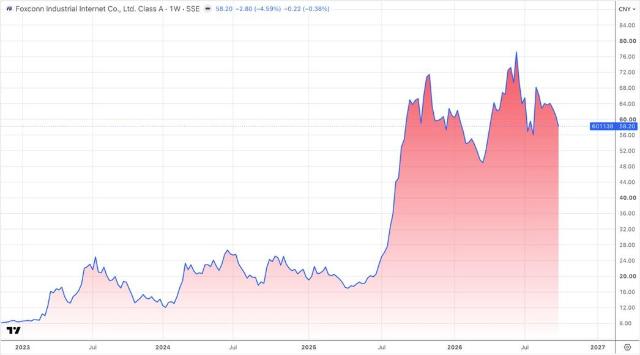
The AI boom continues to redistribute revenue within the technology industry. If previously the main investment interest was focused on chip manufacturers and model developers, now companies that serve the infrastructure supporting this growth are becoming increasingly prominent. One of the main beneficiaries has been Foxconn, which is gradually transforming from the largest assembler of Apple devices into one of the key suppliers of server hardware for artificial intelligence.
Against the backdrop of high investor interest in the technology sector — highlighted by massive potential listings, including Anthropic's market debut, Stripe IPO, and others — Foxconn’s results are particularly telling, as they reflect not just expectations but real demand. In the third quarter, the company’s revenue grew by 47% year‑on‑year and reached approximately $95.4 billion, significantly exceeding the analysts’ consensus of $89 billion. Sales increased by 38% in September alone, reaching a record $37 billion.
The server segment is becoming the main structural driver. As Foxconn has become the largest contract manufacturer of server systems for Nvidia and its customers, the company’s financial performance serves as an indicator of actual demand for AI infrastructure. While accelerator manufacturers reflect the cost of the computing chips themselves, Foxconn’s results demonstrate how quickly these chips are turned into physical servers and data centers.
The dynamics of recent months confirm that demand has not yet weakened. In August, Foxconn’s revenue grew by 52% and exceeded $29 billion, setting a seasonal record. In the second quarter, net profit increased by 35% to $1.86 billion, also beating expectations.
However, the growth cannot be fully attributed to artificial intelligence. The consumer electronics segment also showed a noticeable improvement in the third quarter, driven by the seasonal production cycle of the new iPhone generation. Foxconn continues to assemble a significant portion of Apple smartphones and therefore remains sensitive to the state of the global consumer market.
At the same time, the business structure is gradually changing. Previously, Apple provided the bulk of the demand for Foxconn’s production capacity. Now, AI servers are becoming a second major growth driver and allowing the company to diversify a business that for decades has been heavily dependent on a single customer and the smartphone market.
The geography of production is also shifting. While the majority of iPhones are still assembled in China, devices for the American market are increasingly being manufactured in India. Meanwhile, Foxconn is preparing to produce server equipment for Nvidia in the US and Mexico. This diversification allows the company to simultaneously mitigate geopolitical risks and locate production closer to key customers.
Management expects that in the fourth quarter, the AI division will continue to increase revenue, and seasonal demand for consumer electronics will further support the results. The company has previously predicted that the second half of the year will be stronger than the first, precisely due to sales of server equipment.
However, the stock market’s reaction remains rather subdued. This is partly due to the economics of contract manufacturing. Foxconn is receiving huge volumes of orders, but its margins are significantly lower than those of Nvidia and other owners of key technologies. Therefore, the sharp growth in revenue does not automatically translate into comparable growth in profits or market capitalization, while Nvidia stock chart continues to record gains.
Additional risks are associated with the macroeconomy and geopolitics. A weakening of consumer demand could hit the iPhone, while any delays in building data centers or a cooling of the AI investment cycle would affect the server segment.
Nevertheless, Foxconn’s current results show that the AI boom is still supported not only by investors’ expectations. Revenue growth, record monthly sales, and increased profits indicate large‑scale real orders for equipment. For investors, the main question now is whether Foxconn will be able to turn the rapid growth of its server business not just into an increase in turnover, but into a sustained rise in margins and profits.