
How Engineering Teams Are Scaling Mobile Development: The Case for IT Staff Augmentation

Image Source: depositphotos.com
Mobile products are evolving faster than ever. New features, platform updates, integrations, and changing user expectations continuously compete for engineering resources. At the same time, businesses are expected to deliver updates quickly while maintaining product quality and reliability.
As a result, many companies use IT staff augmentation to increase development capacity without waiting months to recruit and onboard permanent employees. For growing engineering teams, this model has become a practical way to maintain delivery speed while adapting to changing business needs.
Why Mobile Development Teams Hit Scaling Limits
Most engineering teams eventually face the same challenge. Product roadmaps continue to expand, but internal resources remain relatively fixed.
New initiatives often compete with maintenance work, bug fixes, platform updates, technical debt, and support requests. Even highly capable teams can struggle to keep pace when priorities continue to grow.
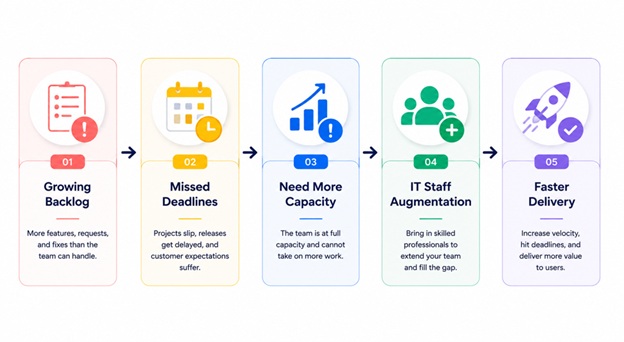
Common signs that a team is reaching capacity include:
- Growing feature backlogs
- Missed release deadlines
- Increasing technical debt
- Longer development cycles
- Delayed product launches
These challenges are often caused by limited capacity rather than a lack of expertise. When delivery pressure increases, organizations must either reduce scope or find ways to expand engineering resources.
The Difference Between Staff Augmentation and Outsourcing
Although the terms are sometimes used interchangeably, staff augmentation and outsourcing are fundamentally different approaches.
Traditional outsourcing often involves handing responsibility for a project or specific deliverables to an external team. Staff augmentation works differently.
Augmented engineers become part of the existing development process. They collaborate with internal teams, attend the same meetings, follow established workflows, and work under the company's technical leadership.
This approach allows organizations to increase capacity while maintaining control over product decisions, engineering standards, and long-term technical direction.
Why It Works Particularly Well for Mobile Products
Mobile applications often require a mix of specialized skills.
Teams may need additional Flutter developers for a product launch, QA engineers for large-scale testing, backend specialists for integrations, or DevOps expertise during infrastructure changes.
Hiring full-time employees for every short-term requirement is rarely practical. Staff augmentation gives businesses the flexibility to bring in specialists when they are needed most.
This approach can be especially valuable during periods of rapid growth, major feature releases, redesign projects, or platform migrations.
Rather than restructuring an entire team, organizations can scale resources according to current priorities.
Speed Matters More Than Ever
One of the biggest challenges with traditional hiring is time.
Recruitment can take weeks or even months. After that, onboarding and knowledge transfer require additional effort before a new team member can contribute fully.
Meanwhile, product roadmaps continue moving forward.
Staff augmentation helps reduce this delay by providing access to experienced professionals who can integrate into existing teams more quickly. Instead of pausing development while searching for talent, organizations can continue delivering features and meeting business objectives.
For engineering leaders, maintaining momentum is often just as important as expanding capacity.
Building More Flexible Engineering Organizations
The way companies build software teams is changing.
Rather than relying exclusively on permanent hiring, many organizations are adopting more flexible staffing strategies. They combine internal expertise with external specialists to create teams that can adapt as priorities evolve.
This approach allows businesses to respond more effectively to market demands while maintaining control over their products and development processes.
As mobile ecosystems become increasingly complex, flexibility is becoming a competitive advantage rather than simply a staffing decision.
Conclusion
Engineering teams are under constant pressure to deliver more while maintaining quality and reliability.
As mobile products become more sophisticated, many organizations are finding that traditional hiring alone cannot provide the flexibility required to support rapid growth.
IT staff augmentation offers a practical alternative. By extending existing teams with experienced specialists, businesses can accelerate delivery, access specialized expertise, and adapt more quickly to changing product demands.
For companies looking to scale mobile development without sacrificing speed or quality, staff augmentation has become an increasingly valuable part of the modern engineering toolkit.