
AI Is Reshaping SEO and UX-Here's How to Stay Ahead

AI isn’t just changing how we write content. It’s changing how that content gets found, read, and used.
For teams managing digital operations, it’s no longer enough to optimize for algorithms in a traditional sense. Today, your site has to serve both search engines and AI models. That means rethinking everything from content structure to user experience design.
At Composite Global, we work with growth-stage startups and enterprise brands navigating this shift in real time. Here’s what we’re seeing and how you can adapt.
1. AI Is Creating a New Kind of Search Behavior
Search used to be about keywords. Now, it’s about conversation.
Tools like ChatGPT, Perplexity, and Google’s Search Generative Experience (SGE) are changing how users gather information. Instead of browsing ten blue links, users are getting AI-generated summaries or relying on chat-style answers.
Your content needs to be:
- Structured: Clear hierarchy, short paragraphs, and modular sections help AI models extract accurate summaries.
- Credible: Citations and internal linking increase your chances of being recommended or referenced by LLMs.
- Contextual: AI looks for patterns, not just keywords—so depth matters more than density.
Explore how AI is changing SEO for a deeper look on optimizing your content.

2. UX Is No Longer Just for Users
The traditional UX focus—clarity, navigation, responsiveness—still matters. But now you also need to design for another “user”: the AI agent.
AI systems that crawl, summarize, or recommend content don’t experience your site visually. They rely on signals like semantic HTML, accessibility markup, and content relationships.
That’s why forward-thinking design teams are:
- Using ARIA roles and semantic elements to improve content clarity
- Prioritizing meaningful alt text and heading structure
- Reducing noise and duplicate content to improve crawlability
Designing for AI doesn’t mean ignoring humans. It means future-proofing your digital experiences for both.
Read more on designing for AI-first experiences.
3. Performance and Structure Are Strategic Now
Page load speed, mobile responsiveness, and clean code have always mattered for SEO. But now they also affect how quickly and accurately AI systems can process your site.
Some quick wins:
- Minimize bloated JavaScript and unused libraries
- Use structured data/schema markup to define content types
- Make sure each page has a single, clear topic or intent
- Write metadata that helps both humans and machines understand what to expect
These improvements make your site friendlier to both search engines and AI agents.
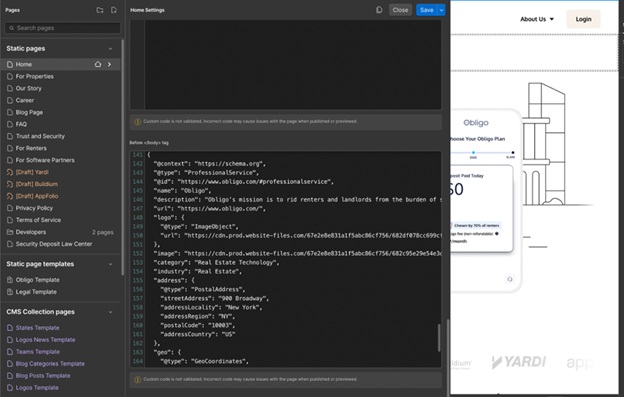
This schema we created for Obligo in Webflow defines them as a professional service in the real estate technology industry, providing structured data about its mission, location, and online presence for search engines.
4. Your Content Needs to Be Machine-Literate
In the age of LLMs, content that performs well:
- Answers questions clearly
- Uses structured layouts (bullets, subheads, summaries)
- Cites sources or offers linkable value
- Reflects topical authority, not just surface-level keywords
AI can now “read” at scale, but it still needs help understanding context and hierarchy. That’s where design, UX, and SEO converge.
Final Thoughts
The future of discoverability isn’t just Google. It’s ChatGPT, Perplexity, SGE, and every AI agent parsing your site in the background.
To stay competitive, organizations need to think beyond traditional search. That means designing with intent, structuring for scale, and optimizing for users and machines.
AI is rewriting the rules of SEO and UX. Are you ready to evolve with it?