Operations | Monitoring | ITSM | DevOps | Cloud

What is Incident Management in IT and Why does it matter?

Incident management is the process of identifying and resolving problems that occur in IT services. Incident Management is also used as a metric to measure the health of the IT Service Desk. Let’s discuss what incident management is, why it matters to your business, and how you can apply it to your organization.
Making ServiceNow better with CloudFabrix RDA

The onset of ServiceNow has relieved the IT Services workforce. With CloudFabrix RDA added to it, we made it even better. Let’s face it that many IT Service transformation implementations take longer because of a lack of automation around migration and production. The efficiency of ITSM is further compromised due to the absence of data automation and enrichment. ServiceNow with Robotic Data Automation stirs a positive impact on three critical areas of data operations ITSM teams.
Sponsored Post

Accelerate & Automate Incident Recovery with AIOps

Automating incident recovery has inculcated rhythm to systems. But ITOps need more than automation. And, that is the acceleration of automated incident recovery. 79% reported in a survey that adding more IT staff to address IT incident management is not an effective strategy. Incident recovery needs accelerated intelligent automation. The two core outputs when accelerated are better and faster Incident Diagnosis and Resolution.

AIOps Has a Data(Ops) Problem

Modern complex systems are easy to develop and deploy but extremely difficult to observe. Their IT Ops data gets very messy. If you have ever worked with modern Ops teams, you will know this. There are multiple issues with data, from collection to processing to storage to getting proper insights at the right time. I will try to group and simplify them as much as possible and suggest possible solutions to do it right.

Let 'Data bots' do the hard work of making AIOps and DataOps effortless

For a long time, IT Ops teams have been trying to keep up with the advancements in data analytics and management. In certain organizations, this problem is charged to DataOps teams. .These teams are tasked with managing data growth and complexity as well as keeping pace with new technologies like Artificial Intelligence driven Ops (AIOps).

Top 3 NLP Use Cases for ITSM

What is NLP Natural Language Processing is a specialized subdomain of Machine Learning which is generally concerned with the interactions between the human and machine using a human verbal or written language. NLP helps in processing huge volumes of text which would take a significant amount of time for a human to comprehend and process otherwise. Hence a lot of organizations take advantage of NLP to gain useful insights out of their text and free formatted data.

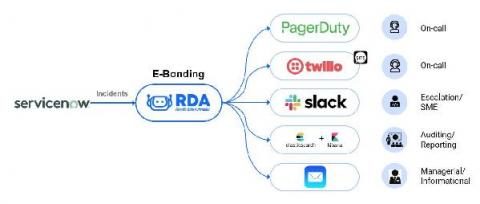
eBonding Integration: ServiceNow Incidents to 5 Destinations: PagerDuty, Twilio, Slack, ElasticSearch/Kibana and Email

In this blog, we will walk through the scenario of sending or E-bonding ServiceNow incidents to 5 destinations simultaneously, using Robotic Data Automation and AIOps Studio. E-bonding refers to a scenario where data is delivered (one-way) or synchronized (two-way) between two or different systems, which are typically under different administrative boundaries. E-Bonding term originally appeared in Service Provider and Telco space (see: ATT E-Bonding).

Go Beyond Core AIOps Use Cases with Robotic Data Automation (RDA) and AIOps Studio

Implementing any IT project requires time, planning, and effort and AIOps probably requires even more planning and stakeholder involvement, because of the breadth of coverage and potential to bring profits to multiple IT domains/functions (ex: ITOps/ITSM/NOCOps). Customers have high expectations from AIOps, but, even after taking such major projects, most AIOps vendors are only able to support a few core AIOps use cases, which severely limits the utility and potential of AIOps.

How our Field Teams' Productivity Skyrocketed with our New AIOps Studio

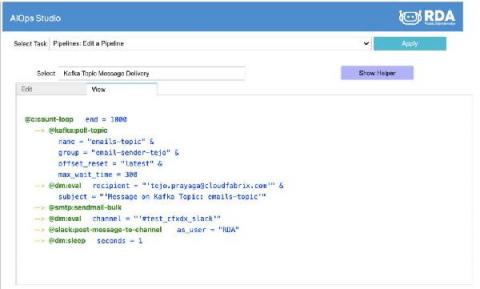
Lately, I have seen fewer call outs from our field teams to our solution engineering team, and I was wondering what could be the reason? Sometimes, our field engineers approach our solution engineering team with advanced requests for data analysis, running what-if scenarios and assessing the quality of data and what new value can be gleaned by combining related datasets.