Operations | Monitoring | ITSM | DevOps | Cloud

Accelerating Resolution with Autonomous Incident Response v1

Incident response often spans a patchwork of tools, handoffs, and manual steps. An engineer gets paged, a team investigates the issue, the incident commander coordinates the response, SREs document decisions, and somebody (anybody!) writes the postmortem. Every handoff introduces more context switching, increasing the risk of critical information loss, and ultimately slowing resolution.
Building an AI Assistant That Actually Understands Your Incidents

When production breaks, the clues are everywhere but the story is scattered. RUM sessions, APM traces, metrics, and logs allow Datadog to tell you part of the story. What’s missing is your service ownership quirks, your team's conventions, or the three-year-old workaround buried in a comment that explains why a certain endpoint behaves the way it does.

Democratizing Incident Response with AI at Riot Games - SRE Track

Senior engineers are the pillars of SRE programs—not only do they have the leadership to manage incidents well, they also have the tribal knowledge to understand the technical causes of tricky issues. But when the know-how is confined to a few individuals, it greatly limits the effectiveness of your SRE team.

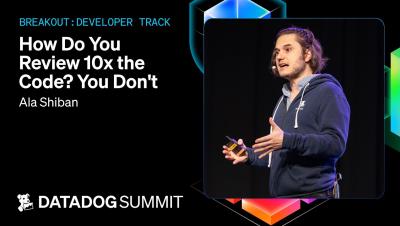
How Do You Review 10x the Code? You Don't - Developer Track

AI is generating code at 10x human speed, but we’re not shipping software 10x faster. Agents have a quality problem, and we still can’t trust their output without validation. Breaking the code review model didn’t help. So what would it take to autonomously ship code that’s actually trustworthy? Join us to explore what an agentic harness looks like when the SDLC is the harness, a validation system that spans intent, CI, staging, and production, with context flowing bidirectionally between all stages.

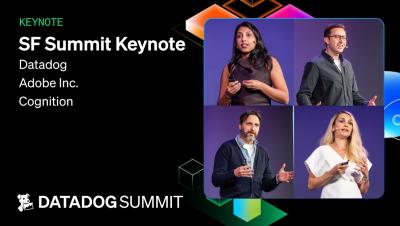
Datadog San Francisco Summit: Keynote

Datadog has always been driven by a broader vision of helping teams understand and operate complex systems. In this session, you'll hear from Michael Whetten, Senior Vice President of Product Management, and Cansu Berkem, Director of Product Management, as they share the latest updates across the Datadog product suite and discuss how that vision continues to shape the platform's evolution and support the next generation of AI-driven applications.

How to troubleshoot JMX metric collection issues | Datadog Tips & Tricks

Missing JMX metrics make it hard to know what’s happening in a Java application, especially when vague errors or configuration mismatches make the cause difficult to diagnose. In this video, you’ll see how to troubleshoot common JMX metric collection issues and isolate the cause in less time.

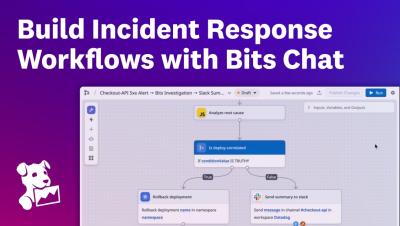
Build incident response workflows with Datadog Bits Chat

See how Bits Chat turns a natural-language request into an automated incident response workflow. In this demo, Bits Chat builds a workflow that investigates a monitor alert, identifies whether a recent deployment caused the issue, rolls it back when appropriate, and sends a summary to Slack.

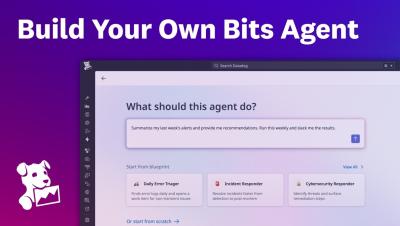
Build your own Bits Agent with Datadog Bits Agent Builder

Datadog Bits Agent Builder lets you build AI agents that use your observability data to automate operational tasks. In this walkthrough, see how to build an agent that analyzes monitor and alert activity, identifies patterns, and provides actionable recommendations to improve your monitoring strategy. With Bits Agent Builder, you can give agents access to Datadog data and tools, customize their instructions and models, and run them automatically to continuously analyze and act on your environment.

How to add Software Catalog metadata at scale with Terraform | Datadog Tips & Tricks

Adding metadata to Software Catalog entities manually is a tedious process that doesn’t scale as your service count grows. This video shows you how to automate that work with Terraform so you can add shared metadata across existing Software Catalog entities at scale.

Product leaders talk safer, faster releases and deeper analysis with Bits | This Month in Datadog

In July’s This Month in Datadog, Jeremy is joined by Datadog product leaders for in-depth conversations about how Bits enables you to confidently evaluate and release features containing AI-generated code, and use natural language to ask, understand, and act across Datadog.