Operations | Monitoring | ITSM | DevOps | Cloud

Retroactive sampling reduce trace traffic and costs

In this short, our software engineer Zhu Jiekun, explains how retroactive sampling can reduce trace traffic and ingestion costs by sending minimal data for sampling decisions and retrieving full spans only when needed—at the cost of added system complexity. Resources for Further Learning.

Multi-tiered Observability: A Practical Way to Handle Diverse Workloads

Observability in large companies is rarely one-size-fits-all. The VictoriaMetrics topologies guide shows why different deployment patterns are needed as scale, isolation, and reliability requirements grow. Different workloads require different trade-offs: some need long retention for audits and trend analysis, while others need higher resolution for debugging. Business-critical systems also demand dependable alerting and high availability, often with several 9s of reliability.


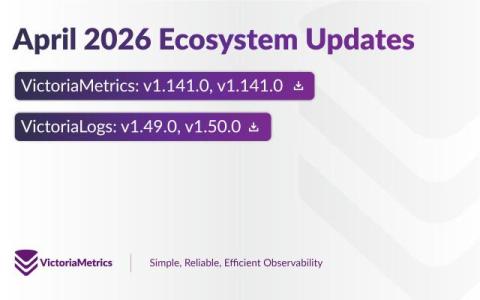
VictoriaMetrics April 2026 Ecosystem Updates

We’re excited to learn that our vmagent helped Airbnb migrate its high-volume metrics pipeline from StatsD and Veneur to OpenTelemetry. Airbnb is now handling 100 million samples per second. You can read more about the migration in these articles: In other news, April saw releases across the VictoriaMetrics Observability Stack. We have released several important bugfixes for VictoriaMetrics and many new features in VictoriaLogs. This release round-up covers updates for.

Telemetry Talks ep 4: Retroactive sampling and OpenTelemetry

This episode of Telemetry Talks explores the evolution of an OTLP/gRPC tracing pipeline for VictoriaTraces within OpenTelemetry and VictoriaMetrics, including a shift from standard gRPC-Go to a simplified HTTP/2-based implementation to reduce complexity and improve flexibility. Together with the our guest, Jiekun, we revisited the VictoriaMetrics KubeCon talk ideas on tail-based and retroactive sampling — and their impact on the broader OpenTelemetry community.