
Why Injection Molding Samples Pass but Mass Production Fails
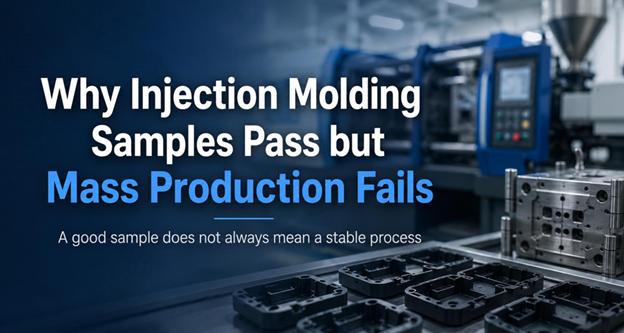
A first molded sample can look good on the bench. The size is close, the surface is clean, and the assembly works. But in plastic manufacturing, a good sample does not always mean the process is ready for mass production.
This problem is common in real projects. A few trial parts pass inspection, but after longer production, the same mold may start showing warpage, sink marks, flash, color variation, short shots, or unstable assembly fit. In most cases, the sample only proves that the part can be made under one set of conditions. Mass production needs to prove that the part can be made repeatedly.
A Good Sample Does Not Always Mean a Stable Process
Samples are usually made under close attention. The technician watches the machine, adjusts pressure and temperature, checks the parts often, and may run only a small batch. Under these conditions, a part can look acceptable even when the process window is narrow.
Mass production is different. The mold runs for hours or days. Material batches may change. Operators may change shifts. Mold temperature can drift. A small change in holding pressure, cooling time, or material drying can affect the final part.
This matters even more in precision plastic injection molding. For example, a connector housing may pass the first sample check, but later the clip position shifts slightly due to shrinkage variation. The part still looks fine, but it no longer locks smoothly during assembly.
A sample is a useful milestone. It is not the final proof of production stability.
Process Parameters Can Change the Part
Injection molding depends on connected process settings. Melt temperature, mold temperature, injection speed, holding pressure, holding time, cooling time, and cycle time all affect the part.
If holding pressure is too low, the part may show sink marks or lower weight. If it is too high, flash or internal stress may appear. If cooling time is too short, the part may eject while still too soft and warp later. If mold temperature is not stable, shrinkage can change during production.
One practical example is a plastic cover with a thick screw boss near the center. During the first trial, the surface may look acceptable after careful tuning. But in longer production, the boss area may begin to show a sink mark as the mold temperature and cycle rhythm change. The part did not suddenly become badly designed. The trial simply did not reveal how sensitive the part was.
A good plastic molder should record the process window during the mold trial, not only provide a few good samples. The process record helps show whether the part is easy to run or only works under a narrow setting.
Material and Drying Conditions Matter
Plastic molding materials need proper handling. Some materials are sensitive to moisture. Some require controlled drying before molding. Others have a wider processing window but can still be affected by batch changes, color masterbatch, or regrind ratio.
For materials such as nylon, PC, PBT, or some engineering plastics, poor drying can cause surface marks, bubbles, silver streaks, weak mechanical performance, or dimensional instability. Even with common materials, a different resin batch can change flow behavior or shrinkage slightly.
This is why material approval should include more than a material name. The grade, supplier, drying condition, color system, and regrind policy should be clear before production starts.
Cooling and Venting Issues May Appear in Production
Some mold problems are not obvious in the first few shots. Cooling balance and venting are two common examples.
If cooling is uneven, one side of the part may shrink more than the other. During short sampling, the part may still look acceptable. After longer production, the same issue can lead to warpage, dimensional drift, or longer cycle time.
Poor venting can also create unstable results. Air trapped in the cavity may cause burn marks, short shots, weak weld lines, or filling problems. These defects may appear only when production speed increases or material conditions change slightly.
For flat panels, uneven cooling may cause one corner to lift after the part sits for several hours. For thin housings, poor venting near the end of fill may cause occasional short shots. A proper mold trial should check parts after cooling, storage, and assembly, not only when they first come off the machine.
Inspection Standards Are Often Set Too Late
Another reason samples pass but production fails is that the inspection standard was not clear enough at the beginning.
A sample may be accepted because it “looks good.” But during production, the team may start asking more detailed questions:
- How much color difference is acceptable?
- Which surface is cosmetic?
- What flash limit is allowed?
- Which dimensions are critical?
- Is a small sink mark acceptable on a hidden surface?
- Should the part be tested after assembly?
If these rules are not defined early, production becomes difficult to control. A visible consumer product cover may reject a small weld line. An internal bracket may accept the same weld line if strength is not affected. Without a clear standard, both sides may judge the same part differently.
Approved samples, 2D drawings, critical dimension lists, and inspection plans help reduce this problem.
Late Tooling Changes Increase Cost
When a production issue appears after sampling, the fix is not always simple. Some problems can be adjusted by process settings. Others require mold modification.
Sink marks near a boss may need better packing, cooling changes, or boss redesign. Warpage may come from uneven wall thickness, cooling imbalance, or material shrinkage. Short shots may need better venting, gate changes, or process adjustment. Flash may come from high pressure, poor shut-off, or mold wear.
The important point is that not every problem can be solved by the machine operator. If the root cause is part design or mold structure, late changes take time and cost money.
This is why mass production failure after sampling is not only a production complaint. It is usually a design, tooling, process, and quality control issue working together.
How OEMs Can Reduce the Risk Before Mass Production
The best way to reduce mass production risk is to treat sampling as process validation, not just part approval.
Before moving to production, OEMs and suppliers should confirm:
- DFM risks were reviewed before mold making
- Material grade and drying conditions are clear
- Critical dimensions are marked on the drawing
- Mold trial records include key process parameters
- Part weight, size, and appearance are checked across multiple shots
- Samples are tested after cooling and assembly
- Cosmetic standards are confirmed with approved samples
- A basic control plan is ready for production
A practical injection molding quality control checklist can help structure this review. It gives both sides a clearer way to check parts, process settings, and inspection points before full production starts.
For high-volume or tight-tolerance parts, a longer trial is also useful. A short trial may show whether the mold works. A longer trial shows more about process drift, cooling balance, material behavior, and operator handling.
Supplier Communication Makes a Difference
A supplier should not only send good samples. They should also explain what happened during the trial.
Useful feedback includes which areas were difficult to fill, whether the part has a narrow process window, whether the material needs special drying control, and whether any dimensions are close to the limit.
This type of feedback helps OEM teams make better decisions before volume production. If a part is difficult to run, it is better to know before the order starts.
For projects that need tooling, molding, inspection, and follow-up support, choosing a reliable plastic injection molding service can make the process easier to control from sampling to production.
Final Thoughts
A passed sample is important, but it is not the same as stable production. Injection molding depends on part design, plastic molding materials, mold cooling, venting, process settings, inspection standards, and supplier communication.
The real question is not only “Can this part be molded?” The better question is “Can this part be molded repeatedly, within tolerance, at the required volume?”
Checking DFM, material control, mold trial records, process parameters, approved samples, and inspection standards before production can reduce many common risks. It takes more work at the start, but it is much cheaper than fixing problems after mass production begins. At my company, HingTung Injection Molding Manufacturer , we usually prefer to review these risks early with customers, because small design or tooling questions are much easier to solve before production starts.