
7 Private Video Hosting Platforms Compared for Audit Trails

Every week brings a new headline about video data leaks. IT Governance logged 4,645 publicly disclosed security incidents in January 2024. When a single training clip or board-meeting stream can trigger legal or financial fallout, “private” must mean more than an unlisted URL.
Teams are flocking to dedicated hosts that tout encryption, password locks, and domain whitelists. Yet most comparison guides gloss over the audit trail: who pressed play, on which device, and for how long. Auditors, regulators, and CISOs need that evidence.
We put seven leading platforms under a microscope, scoring each on six weighted criteria—audit logging carries the most weight—so you can match a host to your risk profile.
Let’s roll.
How we scored every platform
Choosing a private-video host can feel like speed-dating in the dark. Feature pages toss around the same buzzwords (encryption, DRM, one-click embeds) yet leave you guessing about the audit trail under the hood.
We built a six-point rubric to spotlight that trail. Audit trails & logging carries the heaviest weight at 25 percent because regulators and security teams judge platforms on provable evidence, not glossy dashboards. The next two slots, security & content protection (20 percent) and formal compliance certifications (15 percent), cover the hard controls that keep outsiders out and lawyers satisfied. We then scored integrations & access control at 15 percent, analytics & engagement at 10 percent, pricing & scalability at 10 percent, and ease of use & support at 5 percent.
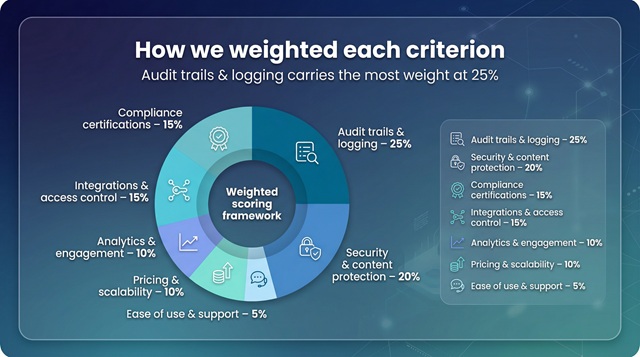
Why this spread? Market research from The AI Journal shows that companies now rank “exportable audit logs and chain-of-custody reports” above player branding or marketing widgets when short-listing secure video tools. If you can’t prove who watched what, and when, no amount of pixel-perfect playback will satisfy an auditor.
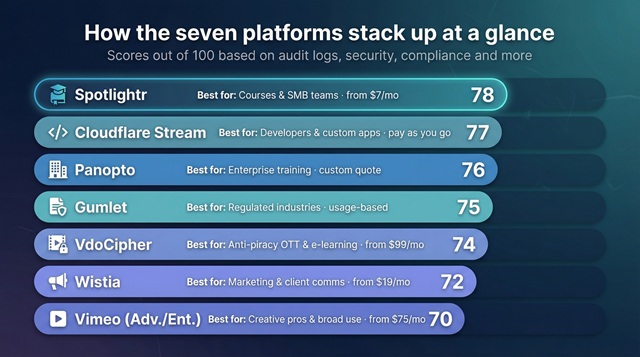
Each vendor earned a raw score out of 100. We combined hands-on testing with documentation reviews and customer interviews, then normalized results against the weightings above. The outcome is the numeric ranking you’ll see in the next table, followed by concise, use-case-driven reviews.
Numbers alone don’t tell the whole story, but they do surface clear leaders. With the framework in view, you can map your risk profile to the criteria that matter most, then focus on the two or three platforms that truly fit.
At a glance: how the seven platforms stack up
Before we dive into individual reviews, here’s a quick view.
The table shows each platform’s score, ideal use case, standout strength, and the lowest plan that unlocks private hosting.
|
Platform |
Score (100) |
Best for |
Standout strength |
Entry price* |
|
Spotlightr |
78 |
Course creators, SMB teams |
Per-viewer heat-map logs |
$7 / mo |
|
Cloudflare Stream |
77 |
Developers, custom apps |
API-level audit logs |
Pay-as-you-go |
|
Panopto |
76 |
Enterprise training |
SSO plus exportable view logs |
Custom quote |
|
Gumlet |
75 |
Regulated industries |
DRM and AI optimisation |
Usage-based |
|
VdoCipher |
74 |
Anti-piracy OTT, e-learning |
Hollywood-grade DRM |
$99 / mo |
|
Wistia |
72 |
Marketing & client comms |
Lead-level viewer tracking |
$19 / mo |
|
Vimeo (Adv./Ent.) |
70 |
Creative pros, broad use |
Granular privacy controls |
$75 / mo |
*Published pricing at time of research; larger plans or enterprise tiers may cost more.
Only eight points separate first from seventh, so every contender brings genuine value. Spotlightr and Wistia lean into marketing analytics, Cloudflare Stream hands developers raw control, while Panopto and Gumlet appeal to auditors with formal logs and certifications.
Keep this cheat sheet handy as we move into the mini-reviews. It will help you connect each nuance back to the bigger picture without flipping pages.
1. Spotlightr: big-brother-style tracking for small-team budgets
Spotlightr tops our table for a clear reason: it gives course creators affordable, viewer-level evidence. According to www.spotlightr.com, more than 8,000 creators rely on its HLS encrypted streams, confirming that the granular heat-map analytics travel with enterprise-grade protection.
Upload a lesson and the dashboard lights up with color-coded heat maps for each student. Dana replayed the tax-deduction segment twice; Leo left after five minutes. That detail doubles as an audit record. When a certifying body asks for proof of completion, you can export the data in seconds.
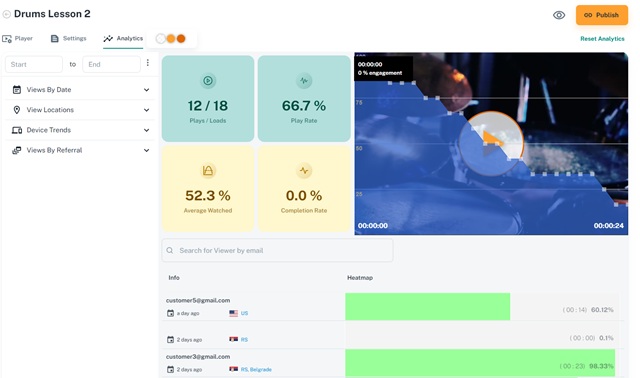
Spotlightr per-viewer heatmap analytics dashboard
Security outperforms the price. Streams are encrypted, embeds lock to your domain, and one-time passwords end when the tab closes. Anyone hunting for a plain MP4 meets only scrambled pieces.
Integrations target tools small teams already use such as WordPress, HubSpot, and most mainstream LMS plug-ins. No SSO option, but course sellers usually find access tokens sufficient.
The core plan costs seven dollars a month, making Spotlightr a budget choice that still satisfies most compliance checklists for small and midsize businesses.
2. Cloudflare Stream: raw control, API-ready audit logs
Cloudflare built its name speeding up the public internet. Stream directs that global network at your private videos.
Instead of a glossy CMS, you get an API that records every upload, token request, and playback event to Logpush. Pipe those logs into your SIEM and you keep a forensic timeline accurate to the second. Security teams value that this detail comes with the base plan.
Access control relies on short-lived JSON Web Tokens. Your app issues a token, the player validates it, and segments download. Cut the token lifespan to minutes and link sharing fails immediately.
Because Stream runs on Cloudflare’s 285 plus points of presence, capacity adjusts on demand, and the invoice reflects storage minutes and streamed minutes.
Non-developers may find the interface sparse. If you have engineering muscle and prize transparent, exportable logs over in-app widgets, Stream delivers enterprise discipline at usage-based prices.
3. Panopto: compliance officer’s best friend
If Spotlightr charms bootstrappers and Stream excites coders, Panopto speaks to the governance crowd.
Each view, pause, and scrub is stamped with a user ID through built-in SSO links to Azure AD, Okta, or your preferred directory. Need proof that 2,317 employees watched the new safety video before quarter-end? Click Export and a timestamped, filterable spreadsheet lands in your inbox.
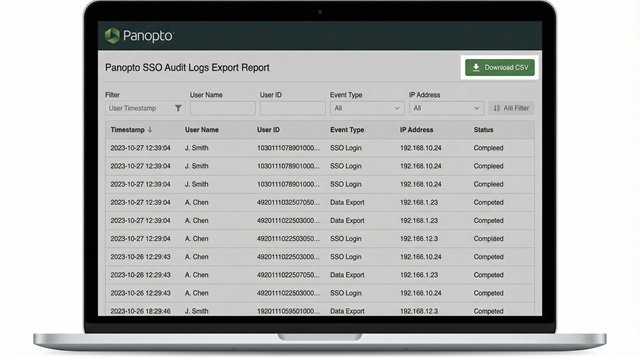
Panopto SSO-enabled compliance audit export interface
Security defaults to locked-door mode. Libraries inherit your org chart, so finance never sees engineering’s videos unless you allow it. Admins can watermark streams with each viewer’s name, a gentle reminder that leaks are traceable.
Panopto also excels at knowledge management. Automatic transcripts turn every spoken word into a searchable index, so staff can jump straight to “ISO 27001 clause nine” in a town-hall recording.
You exchange simplicity and cost for this rigor. Deployment usually involves IT, and pricing starts with a custom quote. For universities, hospitals, and Fortune 500s that depend on audit readiness, Panopto’s detailed logs and SSO fences justify the spend.
4. Gumlet: speed meets stringent DRM
Gumlet blends enterprise requirements into one pipeline.
Streams travel across a multi-CDN mesh tuned by AI, so video starts quickly even on a 4G train ride. Widevine and FairPlay DRM lock each segment to the viewer’s device. If someone records the screen, optional watermarks stamp the footage with that user’s email, giving legal teams clear evidence.
Audit data sits next to performance stats. From one dashboard you can pull a play-by-play report or spot unusual spikes that hint at credential sharing. Need raw logs? The API delivers them so your SIEM can raise alerts automatically.
Gumlet also meets paperwork demands. SOC 2 and ISO 27001 certifications reassure risk teams, and data-residency controls keep EU streams inside EU borders.
Pricing is usage-based, letting startups test the service without a “call sales” hurdle and scale later when traffic grows.
5. VdoCipher: Fort Knox for video assets
VdoCipher targets publishers who lose revenue to piracy. If Netflix trusts studio-grade DRM, your course or indie film can too.
Each stream is encrypted with Widevine or FairPlay. Even if someone saves the HLS segments, the license key never leaves the device enclave, so unauthorized playback shows static. Dynamic watermarks brand any screen recording with the user’s email, giving legal teams clear evidence.

VdoCipher DRM and dynamic watermark anti-piracy screenshot
Audit data is modest out of the box, but the API fires a webhook when a token is issued or a video finishes. Connect that feed to your membership system for a tamper-proof log by user and device.
The dashboard is pragmatic: paste the embed script, call the getPlaybackInfo endpoint, and let the DRM handshake secure delivery. Plans start at 99 dollars a month, reflecting license fees. For teams selling premium content, that cost is lower than monitoring pirate links.
If “no downloads” tops your checklist, VdoCipher delivers.
6. Wistia: marketing analytics first, security close behind
Wistia wears a marketer’s blazer over a solid security vest. You still get password-protected or domain-locked embeds, but the star is lead intelligence.
Gate a webinar with an email form and Wistia tags every play, pause, and re-watch to that contact. Sales sees a timeline: “Alex watched 93 percent, replayed the pricing slide twice,” a gold mine for follow-up calls. The same heat maps double as lightweight proof of viewership for teams that must confirm a client or contractor finished the video.
Because the platform is SOC 2 audited, most B2B buyers clear it without involving the CISO for weeks. There is no DRM, so a determined techie can still rip the stream with effort. If that risk is acceptable, Wistia rewards you with a refined player, easy WordPress embedding, and tight CRM hooks that make lead nurturing feel automatic.
Plans start at nineteen dollars per month, though large libraries pay more for extra uploads. Think of Wistia as the friendly neighborhood host that keeps marketing running while offering “good enough” privacy for external content.
7. Vimeo (Advanced and Enterprise): familiar face, enterprise locks
Vimeo is the brand most people already know, which lowers training friction. The Advanced and Enterprise tiers add the privacy controls professionals need while keeping the polished player creatives enjoy.
Toggle a switch to restrict embeds to your domains, block downloads, or hide videos from Vimeo’s public search. Upgrade to Enterprise and you add SSO, so every play maps to an employee identity inside a clean internal portal. Export engagement reports, and you gain a basic audit trail that covers most internal-communications checks.
Vimeo trails competitors on piracy defense. DRM is a paid add-on through the OTT product, not part of the standard business plans. If hardened encryption sits atop your list, consider another host. If you need distraction-free playback, password controls, and a name stakeholders trust, Vimeo handles the job with minimal lift.
Pricing starts around seventy-five dollars a month for the Advanced plan, with Enterprise quotes rising based on seats and features. Vimeo feels like the reliable sedan of private hosting: it may not match sports-car speeds, yet nearly everyone can drive it and meet routine compliance needs.
Which host fits your risk profile?
Now that we have walked the roster, let’s map each platform to common scenarios.
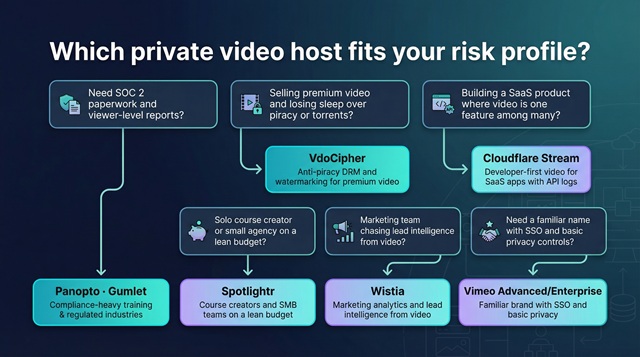
If your board wants SOC 2 paperwork and viewer-level reports before signing the PO, start with Panopto or Gumlet. Both export detailed logs and carry the certifications auditors expect.
Selling premium video and losing sleep over torrents? VdoCipher’s DRM and watermark pairing stops casual piracy. Spot-check a leaked clip and you will know whose account leaked it.
Running a SaaS product where video is one feature among many? Cloudflare Stream drops into your stack. Its API feeds audit events to Splunk while the network scales without a capacity meeting.
Solo course creator or small agency on a lean budget? Spotlightr delivers heat-map evidence, domain locks, and quiz tracking for about seven dollars a month.
Marketing team chasing lead intelligence? Wistia combines email gates with viewer heat maps, sending data to HubSpot in real time.
Need a name everyone recognises, with SSO and basic privacy? Vimeo’s Advanced or Enterprise plan meets that need with minimal onboarding.
Use this lens to shortlist two finalists, spin up trials, and run an “access-log fire drill.” The winner will show itself the first time you prove, within minutes, exactly who watched what.
Conclusion
Selecting a private video host ultimately hinges on how much audit-trail depth, security control, and budget flexibility your organization requires. Align the platform’s logging and protection features with your risk profile, test them in a real-world scenario, and you will quickly see which contender delivers the evidence your auditors—and your stakeholders—demand.