
Cheapest High-Speed Internet in Alabama 2026: Affordable Broadband Alabama 2026 Guide
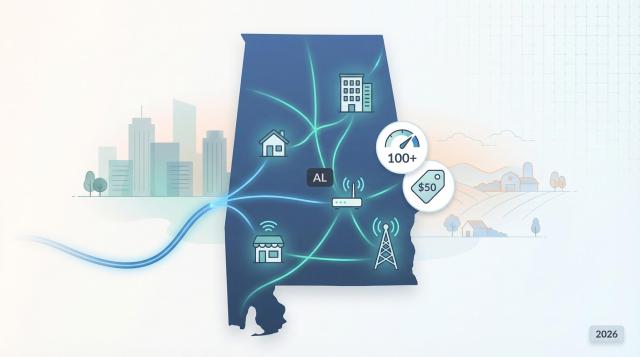
Alabama ranks 44th for broadband coverage and speed, according to the latest BroadbandNow report, and cost keeps two in five households offline while current subscribers pay about $74 a month.
Fast, reliable internet is no longer a luxury—it powers remote work, virtual classes, telehealth, and family streaming nights that all need at least 100 Mbps.
This guide identifies every Alabama plan that hits 100 Mbps for $50 or less, compares promo and regular rates, and flags fees to avoid when you set up service—especially if you’re moving. Ready to save? Let’s dive in.
Our value criteria: what counts as “cheap, high-speed internet?”
We don’t toss the word “cheap” around lightly. A plan qualifies only if it delivers at least 100 Mbps download speed. That speed lets a family stream, Zoom, and game at the same time without stutters.
Price matters just as much. We draw a hard line at $50 a month before taxes and fees. Intro deals are great, but we always check the regular rate that shows up in month 13. If that number balloons, the plan drops in our rankings.
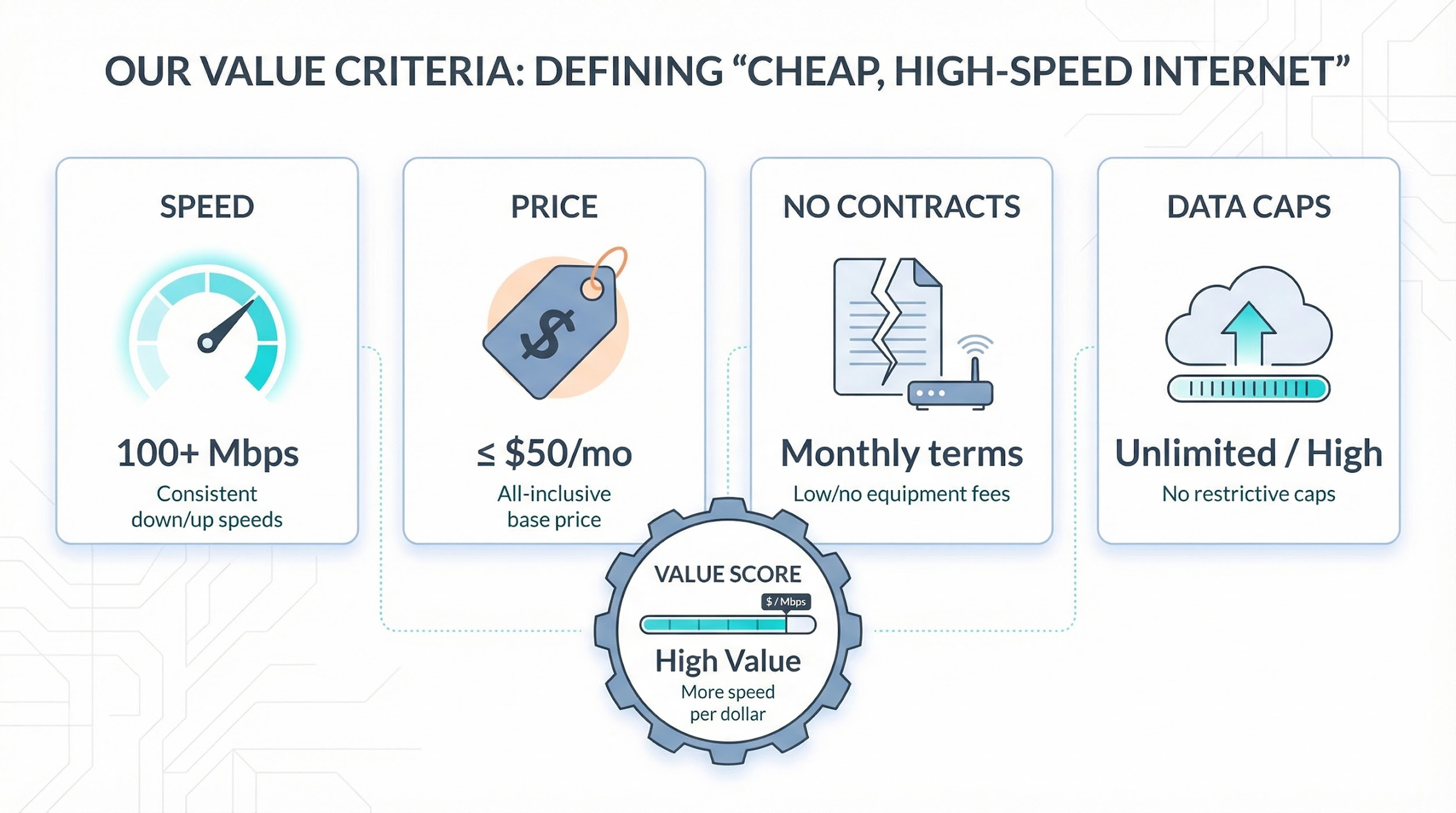
Beyond speed and price, we favor providers that skip contracts, waive data caps, and keep equipment costs low. We then crunch a simple value score—dollars divided by megabits—with bonus points for unlimited data and statewide reach.
The result is a shortlist of offers that respect both your bandwidth needs and your budget.
Quick comparison: Alabama’s cheapest high-speed plans
Before we dive into individual providers, here’s the big picture. The table below shows the eight plans that passed our value test. Scan it to spot your best match, and keep reading as we unpack the pros and cons of each option.
|
Provider & plan |
Download / Upload |
Promo price |
Ongoing price |
Data cap |
Estimated availability |
|
WOW! Internet 300 |
300 / 10 Mbps |
$30 (12 mo) |
~ $50 |
3 TB |
Dothan + SE counties |
|
Spectrum Internet 500 |
500 / 20 Mbps |
$30 with bundle |
~ $75 (price locked 3 yr) |
Unlimited |
about 60% of homes |
|
T-Mobile 5G Home |
~ 100 / 10–25 Mbps |
$50 (or $30 with Magenta plan) |
Same |
Unlimited |
≈ 89% of homes |
|
Xfinity Connect More 200 |
200 / 10 Mbps |
$25–$30 (12 mo) |
~ $55 |
1.2 TB |
Huntsville + select areas |
|
AT&T Fiber 300 |
300 / 300 Mbps |
N/A (everyday price) |
$55 |
Unlimited |
major metros (≈ 45%) |
|
Mediacom Access 100 |
100 / 10 Mbps |
$20 (12 mo) |
~ $50 |
200 GB |
Gulf Coast pockets |
|
Verizon 5G Home |
100–300 / 10–20 Mbps |
$50 (or $25 with Unlimited plan) |
Same |
Unlimited |
30–50% of metros |
|
Freedom FIBER 500 (co-op) |
500 / 500 Mbps |
N/A |
$60 |
Unlimited |
NW rural counties |
Treat these numbers as starting points, not gospel. Prices change, promos expire, and coverage lines creep every quarter. Always punch your exact address into the provider’s site before you sign.
Up next, we’ll break down each pick, starting with the plan that offers triple-digit speeds for the price of a take-out pizza.
1. WOW! Internet 300: fiber-powered speeds for $30 in southeast Alabama
If you live near Dothan, WOW! is the deal to beat. Thirty dollars buys a 300 Mbps download pipe, plenty for a family’s HD streams, Zoom calls, and Fortnite matches, all on a month-to-month plan.
WOW!’s hybrid network handles the heavy lifting. Neighborhoods keep coax for the last mile, yet a fresh fiber backbone keeps performance snappy and congestion low. You also get a three-terabyte data allowance, equal to roughly 3,000 hours of Netflix before overage fees appear.
Many customers sign up for WOW! while still unpacking, yet the excitement of $30 fiber speeds can fade if installation steps are missed. A quick read of WOW!’s guide to setting up internet when moving reminds you to confirm address eligibility and position the router centrally, so that 300 Mbps pipe performs at its best from day one.
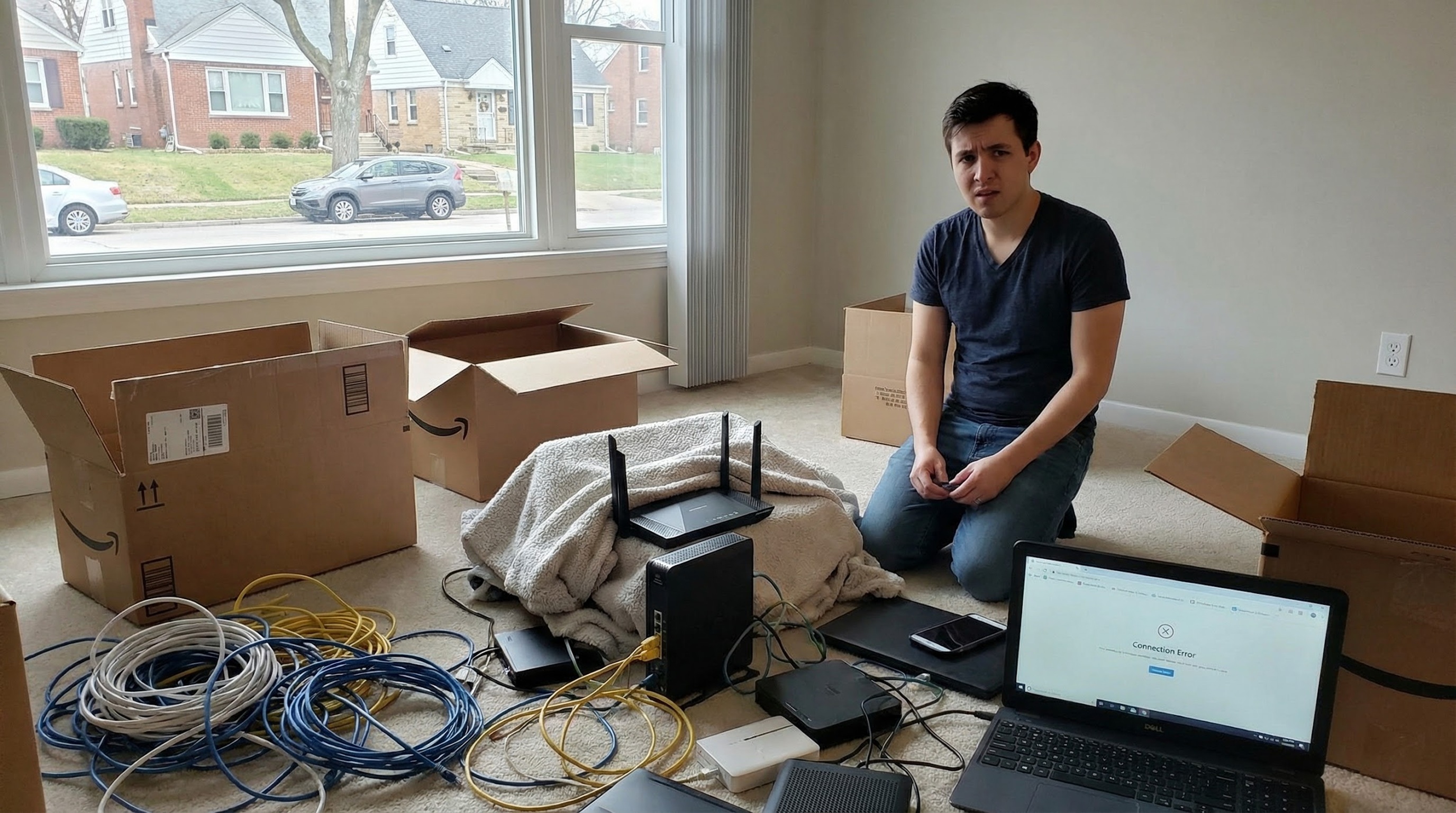
WOW! Internet 300 moving and setup guide screenshot
Value steals the spotlight. At about ten cents per megabit, WOW! undercuts Alabama’s average broadband cost by nearly ninety percent. Even when the promo rises to fifty dollars in year two, the math still favors you.
Coverage is the one catch. WOW! clusters around Dothan, Headland, and nearby towns. If your address qualifies, grab it; rival cable plans cost more and deliver half the upload speed.
2. Spectrum Internet 500: half-gig speeds statewide for $30
Spectrum shook up Alabama’s cable market when it bumped its base tier to 500 Mbps and set entry pricing at $30 a month for customers who bundle a single mobile line. Even without the bundle, standalone service starts near fifty dollars, still a solid price for half-gig downloads.
Spectrum Internet 500 Alabama cable plan webpage screenshot
There is no contract, no modem fee if you self-install, and, best of all, no data cap. Stream 4K movies nightly, back up your photo library, and let the kids marathon Roblox without watching a meter.
Coverage is broad. Spectrum reaches about sixty percent of Alabama homes, from Birmingham’s suburbs to college towns like Auburn. When you bundle, the cost per megabit drops to six cents; without the bundle, it stays close to ten cents.
Watch the fine print. The thirty-dollar tag lives only while the mobile line stays active, yet a three-year price guarantee shields you from the bill creep common in cable service.
3. T-Mobile 5G Home Internet: wireless broadband that reaches 89% of Alabama
No cable line? T-Mobile’s 5G Home gateway fills the gap. For a flat $50 a month, or $30 if you have a Magenta mobile plan, you get unlimited data and average speeds around 100 Mbps. Setup is as easy as placing the gray cylinder by a window and scanning a QR code.
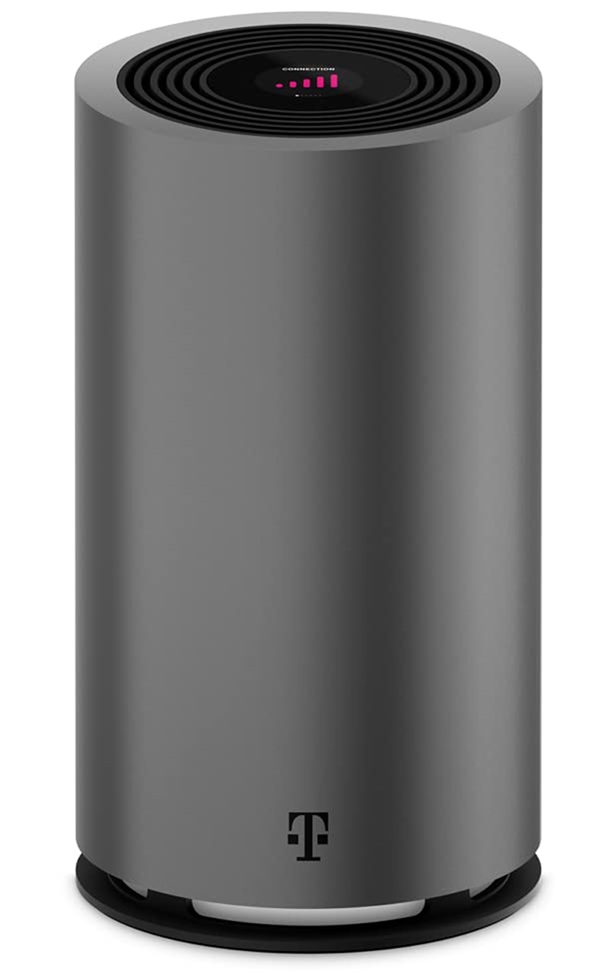
T-Mobile 5G Home Internet gateway official product photo
Coverage is the big win. Independent testing shows the service now qualifies about 89% of Alabama households, making it the state’s most widely available high-speed option beyond legacy DSL.
Performance depends on tower capacity, so speeds can swing between 50 and 200 Mbps. T-Mobile offers a 15-day test drive; if the gateway cannot keep up, return it at no cost.
For rural pockets without cable, or anyone who wants a contract-free setup, this wireless plan turns your living room into the fast lane without running a single foot of coax.
4. AT&T Fiber 300: symmetrical speeds with no surprise hikes
When stability tops your wish list, AT&T Fiber checks every box. The entry tier delivers 300 Mbps up and down for $55 a month, with no promo games, no contract, and no price jump in year two.
Those symmetrical uploads matter. If you work from home, back up photos to the cloud, or run Twitch streams, cable’s 20 Mbps uploads feel cramped. AT&T’s fiber lines hand you 300 Mbps both ways, so files fly and video calls stay clear.
Equipment and installation are painless. The Wi-Fi gateway is free, and most addresses qualify for a self-install kit that gets you online in minutes.
Coverage spans large parts of Birmingham, Huntsville, Mobile, and Montgomery, plus an expanding patchwork of suburbs. Enter your address in AT&T’s checker and confirm it reads AT&T Fiber; legacy DSL is a different product.
Yes, fifty-five dollars is higher than the flashiest cable promos, but the flat rate, uncapped data, and reliable performance make AT&T Fiber a smart long-term pick.
5. Xfinity Connect: promo pricing in Huntsville and a few lucky ZIP codes
Comcast doesn’t blanket Alabama, yet where its lines reach, it offers some of the strongest introductory deals. New customers in Huntsville, Florence, and pockets along the Georgia border often see the Connect More 200 plan for $25 to $30 a month during the first year.
Two hundred Mbps may not wow speed fans, but it is plenty for most households, especially when the bill costs less than dinner for two. Xfinity adds free access to millions of public Wi-Fi hotspots, a plus for students and commuters.
Read the fine print. After twelve months, the bargain plan usually doubles in price, and the 1.2-terabyte data cap can catch 4K binge-watchers off guard. You can pay for unlimited data or track usage in the Xfinity app.
If you grab the promo, set a reminder for month eleven. Call retention, ask for a fresh discount, or be ready to switch to Spectrum, AT&T, or T-Mobile. With the right timing, Xfinity remains one of the cheapest tickets to 200-plus Mbps in its limited Alabama footprint.
6. Mediacom Xtream 100: a $20 lifeline for small-town budgets
Head south toward Baldwin or Mobile County and another provider appears: Mediacom. Its Xtream 100 tier launches at $19.99 a month for a full 100 Mbps connection.
For cash-strapped households, that saves real money. A single parent can keep the kids’ homework online, and still meet the grocery budget. The trade-off is data: the plan carries a 200 GB cap, roughly 60 hours of HD streaming before overage fees.
After the 12-month intro period, the bill climbs to about fifty dollars. Use the promo, then either negotiate an extension or switch providers. If you stay, consider a higher Mediacom tier with a one-terabyte allowance.
Why include it? In towns where Spectrum or Xfinity never built, Mediacom is often the only wired option. If that is your ZIP code and every dollar counts, the Xtream 100 promo keeps you online today while you advocate for future fiber.
7. Verizon 5G Home Internet: price-locked wireless for city dwellers
Verizon’s 5G Home Internet mirrors T-Mobile’s playbook but performs best in Alabama’s larger cities where Ultra Wideband spectrum is active. Eligible addresses in Birmingham, Huntsville, Montgomery, and Mobile can get 100 to 300 Mbps service for $50 a month, or $25 if you already have an unlimited phone plan.
The monthly charge covers taxes, equipment, and installation, and Verizon guarantees no increases for at least two years. Data is unlimited, so you can stream, game, and back up files without watching a meter.
Setup takes minutes. Plug in the white cube router, use the app to find the strongest signal, and you’re online. Downloads feel similar to cable, while uploads hover around 10 to 20 Mbps, enough for smooth video calls but not fiber-level symmetry.
Coverage still trails T-Mobile, reaching roughly one-third of Alabama households. Check Verizon’s map; if your block shows Ultra Wideband 5G, you are likely eligible. For homes stuck on slow DSL or facing high cable bills, this wireless option can lower monthly costs without trading away speed.
8. Rural fiber co-ops and city networks: hometown gigabit without gimmicks
Big brands make the headlines, yet Alabama’s electric cooperatives and municipal utilities are quietly stringing fiber across farmland and pine forest. If you see names like Freedom FIBER, Sprout, Central Access, or Buzz Broadband in your mailbox, take note: they often deliver 500 Mbps to 1 Gbps for $60 to $80 with no data caps and no contract.
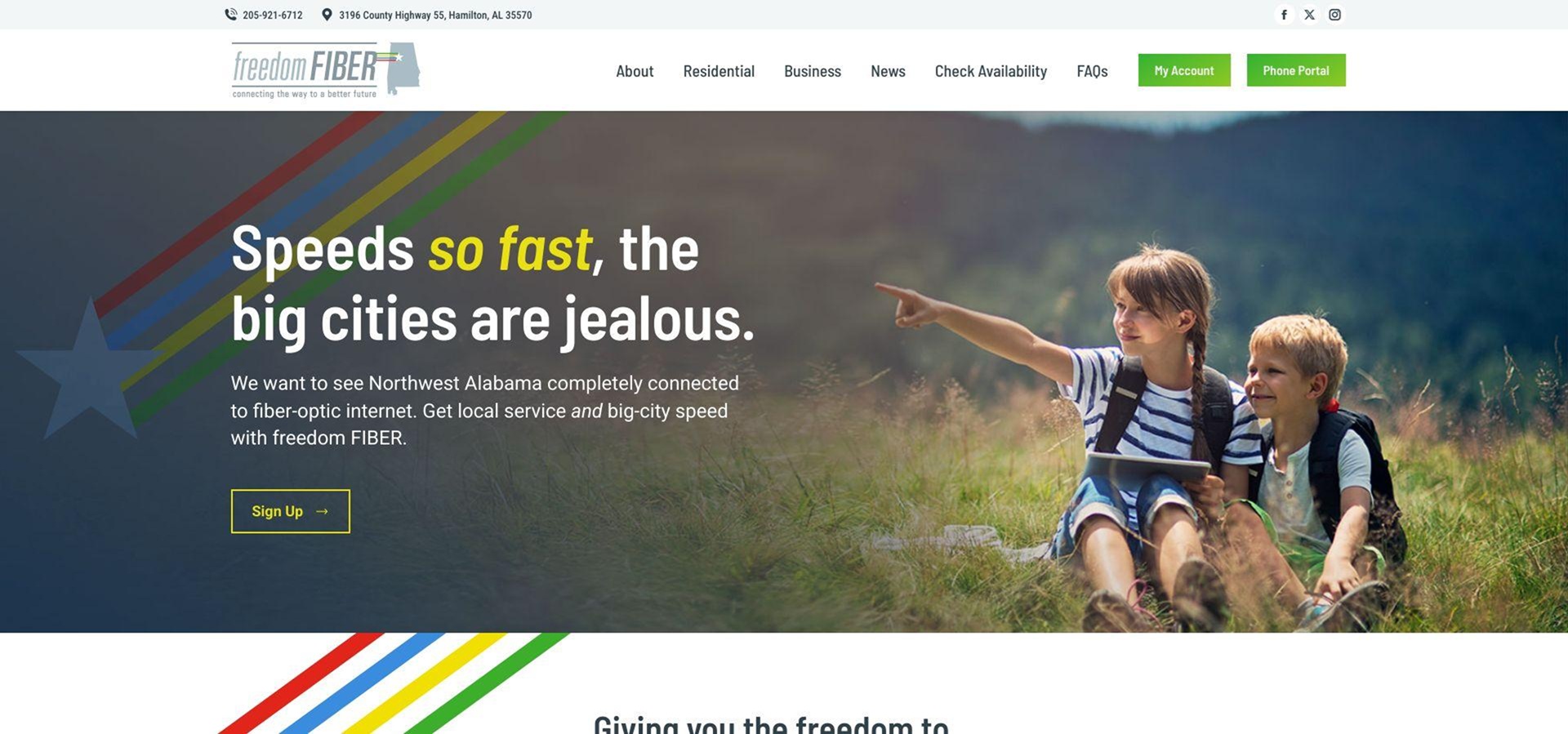
Freedom FIBER rural Alabama fiber internet homepage screenshot
The model is straightforward. Local residents fund the build, excess revenue stays in the community, and pricing remains flat for years. Freedom FIBER in northwest counties charges $60 for symmetrical 500 Mbps. Cullman Electric’s Sprout offers a gig for about $70. Huntsville Utilities even hosts Google Fiber’s $70 gig plan.
Coverage follows power lines rather than profit maps. Sparsely populated roads outside Hamilton or Opp can enjoy gigabit service while nearby suburbs wait on cable upgrades. Check your electric bill or the ADECA broadband map. If your co-op is laying fiber, you could leapfrog to gigabit speeds and eliminate data limits entirely.
Money-saving tips for Alabama internet shoppers
Before you click order, pause for a quick strategy check. A little homework can shave hundreds from your yearly bill.
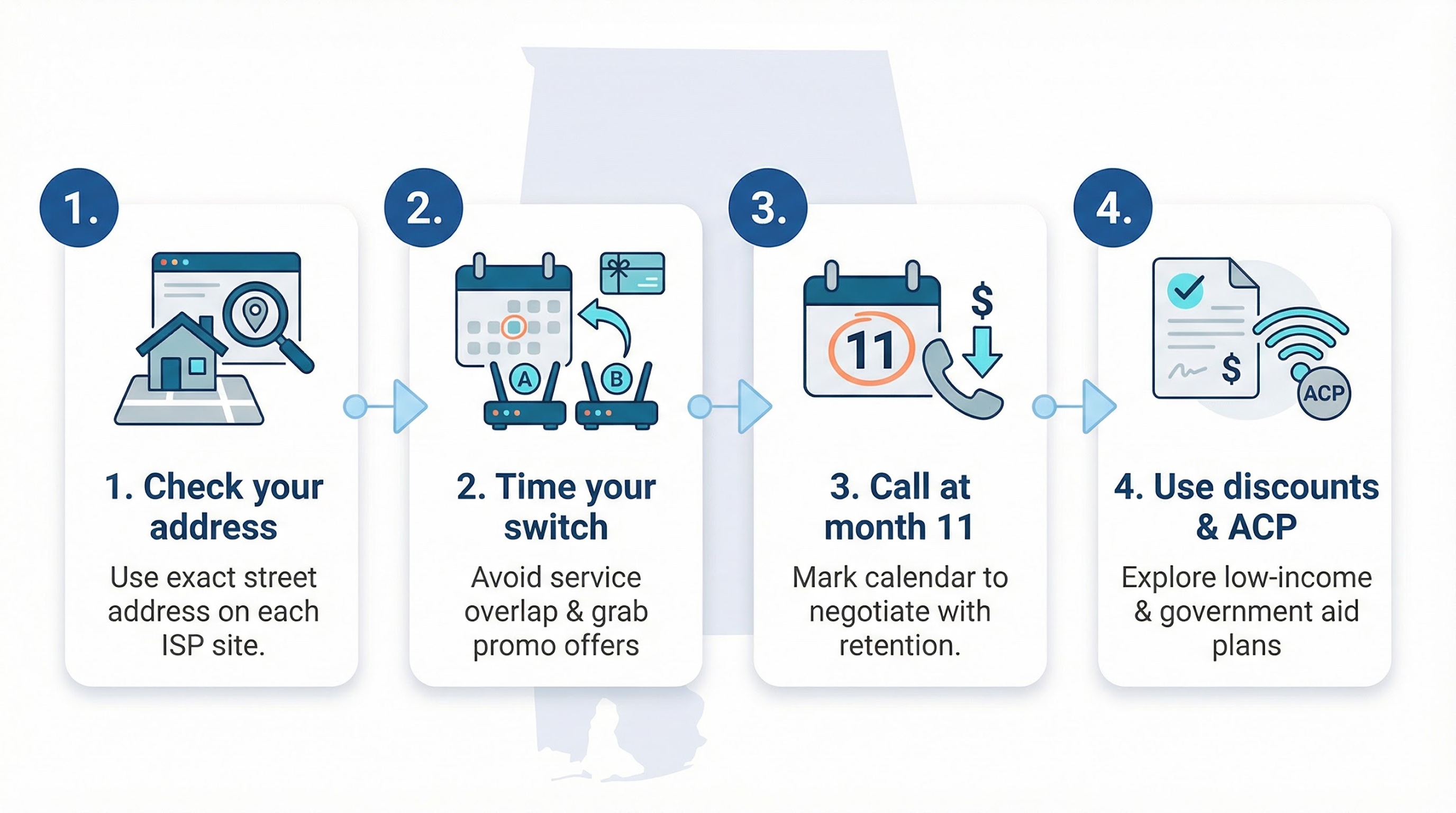
First, enter your exact address on each provider’s site. Rural routes often have a new fixed-wireless or co-op fiber option that a basic ZIP search misses.
Second, time your switch like a pro. Ask for gift cards, free months, or installation waivers, then schedule activation the day after your old plan ends to avoid paying two bills.
Third, mark month eleven on your calendar. When the promo clock starts ticking, call retention and politely request a fresh discount. Most providers would rather trim ten dollars than lose you.
Finally, if cash is tight, check whether you qualify for the Affordable Connectivity Program or a provider’s low-income tier. A five-minute form can turn a thirty-dollar invoice into zero.
Conclusion
Scoring fast, reliable internet in Alabama no longer requires an outsized budget. By focusing on plans that deliver at least 100 Mbps for $50 or less, comparing promo and long-term pricing, and negotiating when discounts expire, you can keep working, streaming, and gaming without overspending.