
6 Best SOC 2 Continuous Monitoring Tools for SaaS: Closing the 20% Manual Evidence Gap
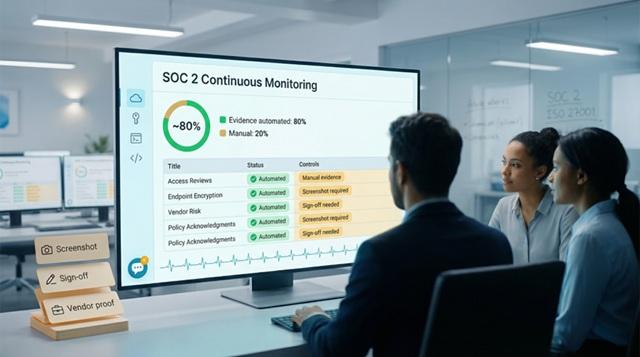
Landing a big-logo customer feels great—until their security questionnaire hits your inbox. For most B2B SaaS teams, SOC 2 compliance is the roadblock. You connect a tool, dashboards turn green, and then stall: about 20% of evidence still needs screenshots, sign-offs, or frantic Slack chases. That last-mile grind drags engineers back into spreadsheets just when the audit seems done.
Why does the gap persist? Even top platforms automate roughly 90% of control checks in real time, but human-heavy tasks—quarterly access reviews, vendor proofs, policy acknowledgments, and legacy systems with no API—still slip through. Those loose ends delay audits, stall deals, and drain morale.
This guide compares five continuous-monitoring vendors on evidence automation, pricing clarity, integration depth, and auditor acceptance. Each tackles the nagging 10% differently—AI copilots, built-in policy workflows, or vendor-risk modules.
Read on to find the tool that fits your stack, budget, and growth stage—and turn the yearly scramble into quiet confidence.
How we ranked the platforms
We kept the scoring strict yet practical. Each platform earned points across six practitioner-focused factors: evidence automation, pricing transparency, integration breadth, auditor acceptance, vendor security posture, and startup friendliness. Automation alone counts for one-quarter of the total because removing manual toil is what saves teams the most time.
Price clarity carried the next-largest slice, since unknown costs stall deals. We benchmarked public or analyst-verified price ranges, then marked down vendors that hide numbers behind repeated sales calls. For context, lean SaaS-focused tools start around $6K–$10K per year, while premium continuous-monitoring platforms like Vanta often land above $15K—and can exceed $50K when add-ons appear.
Integration depth also matters; every missing API means another screenshot chase. We tallied native connectors—cloud, identity, CI/CD, HRIS, and endpoint tools—and noted whether a public API exists for edge cases.
Finally, we awarded bonus credit when a vendor’s evidence exports are already familiar to auditors or when the vendor maintains its own SOC 2 report. The result is a ranked list that mirrors day-to-day pain, not marketing fluff. Let’s dive into the tools, starting with the one that closes the evidence gap fastest.
1. Vanta: closing the gap with hourly checks and an AI co-pilot
Vanta is a continuous-compliance platform that handles the tedious evidence work for you. The software connects to more than 400 services and runs about 1 400 automated control tests every hour, far more than most rivals complete in a day. When a developer changes an S3 policy or a laptop drifts out of compliance, Vanta flags it before an auditor—or a prospect—can notice, so your evidence never goes stale.
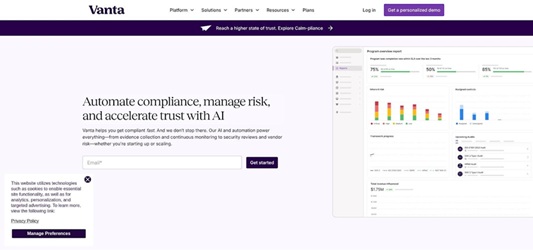
Its newest feature is an AI agent that guides tasks, verifies screenshots, and drafts answers to the security questionnaires that slow sales. The same intelligence now drives Vanta's vendor risk management platform, automatically discovering every supplier, running AI-powered security assessments, and cutting vendor review time by up to 80 percent—shrinking what used to be 50 hours of work to just a few hours each week. Early adopters report saving a dozen hours each week and cutting questionnaire response time by 81 percent.
Pricing begins near $10K for a small SaaS team and rises into the high-five figures as you add frameworks or private-cloud scope. The cost sits above lean, audit-bundled options but close to other premium continuous-monitoring platforms, and teams justify the spend by pointing to deals won and headcount avoided.
When to choose Vanta
- You want maximum automation and accept a premium price.
- You sell to enterprise buyers who probe vendor risk and need a polished Trust Center.
- You prefer engineers focused on product work, not screenshot duty.
Bottom line: If the last-mile evidence grind is slowing revenue, Vanta removes the roadblock fastest.
2. Thoropass: audit-integrated automation for teams scaling past one framework
Thoropass acts like a growth-ready compliance engine with the auditor already inside it.
The platform links to more than 200 native services—from AWS and Okta to Jira—then runs continuous control tests and stores evidence in one dashboard, creating a single source of truth that auditors can sample directly without exports or email chains.
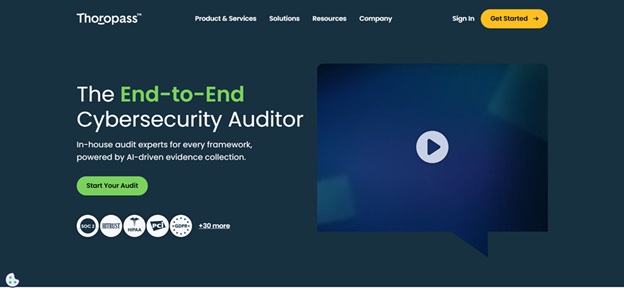
Breadth is the standout feature. Out of the box you get mapped controls for SOC 2, ISO 27001, HIPAA, GDPR, and PCI. Add a new framework, and Thoropass reuses existing evidence, so another certification feels like flipping a switch, not a six-month project.
The capability comes with a distinctive commercial model. Many customers buy software and audit as a bundle, with a fixed-fee Type I or Type II that includes weekly office hours and rehearsal walkthroughs. Contracts often start near $8K for a single-framework plan and reach about $15K–$20K for the multi-framework tier most growth-stage startups need. Larger enterprises with multiple entities pay more, but at that scale Thoropass offsets headcount rather than just spreadsheets.
Choose Thoropass when
- You juggle several frameworks and want one vendor to own software, evidence, and the audit relationship.
- You want an interface executives—and auditors—will open without prompting.
- You prefer the audit to feel like a formality, not a scramble.
Thoropass is the step up from “good enough” tooling to a proactive trust program that evolves with your roadmap.
3. Hyperproof: policies, programs, and proof in one dashboard
Hyperproof closes the evidence gap by removing the paperwork most tools ignore.
Beyond cloud and identity connectors, you get one of the largest framework template libraries on the market—140+ standards built on a Common Control Framework so a single piece of evidence can satisfy controls across SOC 2, ISO 27001, HIPAA, and PCI without duplicate work.
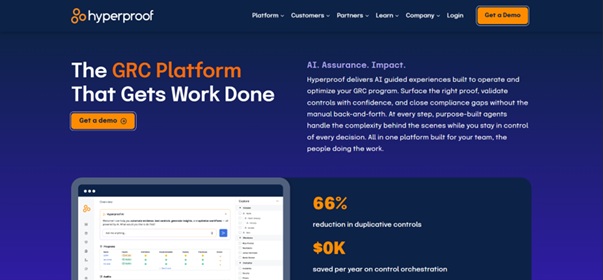
The platform rolls SOC 2 controls into a guided program that non-technical teammates can follow. HR verifies off-boarding, IT confirms endpoint agents, and leadership signs risk assessments—all without another spreadsheet. Continuous monitoring still runs in the background, flagging drift in AWS or GitHub, but Hyperproof’s main strength is turning alerts into tasks business owners actually finish, then keeping vendor reviews, access reviews, and annual drills on a templated calendar.
Pricing lands mid-range. Teams report quotes between $15K and $30K per year for the core compliance module, with risk and vendor management available as add-ons. Modular tiers appeal to teams that want to start small and grow into a full compliance program.
Choose Hyperproof when
- Year-round compliance operations matter as much as code checks.
- You need one platform to manage policies, recurring reviews, and a tidy evidence package for auditors.
- You want broad framework coverage and the flexibility to add risk or vendor management later.
4. Strike Graph: lean, fast, and priced for startup reality
Strike Graph is a continuous-compliance platform built for the company that just had a deal blocked by a SOC 2 task. Connect your cloud, identity, and ticketing tools once, and Strike Graph maps applicable controls, then guides you through a Trust Operations workflow so you never chase irrelevant tasks. Users call it “lightweight but complete”—the controls you need, none you don’t.
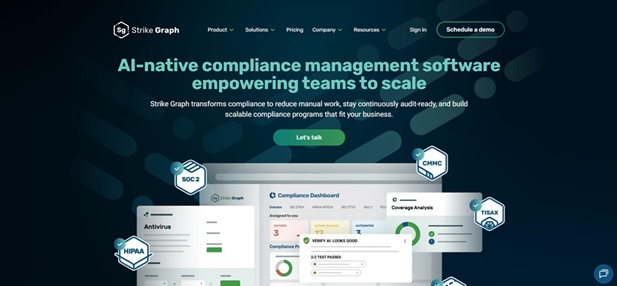
Speed is the headline stat. Many early teams earn a clean Type I report in roughly four to six weeks because the platform pulls evidence on a schedule, maps it to the trust services criteria, and time-stamps everything for the auditor. Security questionnaires improve as well; the auditor view lets reviewers browse evidence directly, reducing back-and-forth email.
Cost is where Strike Graph stands out. Public starting tiers begin in the low five figures, with bundles that fold the assessment itself into a fixed-fee invoice—because Strike Graph maintains its own AICPA-licensed audit firm. That’s far less spend than premium platforms for similar scope, and it removes the “quote and haggle” step many founders dread.
Choose Strike Graph when
- You are a lean SaaS team that needs compliance quickly.
- You have limited headcount to manage tooling.
- You want a predictable annual invoice—including the audit—without extra charges.
5. Scytale: an AI co-pilot that talks back to your auditor
Scytale is a compliance platform that turns evidence gathering into a guided conversation.
Its built-in agent, Scy, reviews logs, flags gaps, and tells you what to fix before an auditor signs in. The same agent drafts answers to security questionnaires and fills a public Trust Center, so sales and security stay aligned without copy-pasting from spreadsheets.
Coverage is wide: more than forty frameworks—from SOC 2 and ISO 27001 to GDPR and CSA STAR—live in one workspace. Flip a control once and Scytale maps it everywhere else, trimming duplicate work for teams managing multiple certifications.
Pricing is custom. Early customers place quotes somewhere between budget and premium averages, scaling with user count and framework scope. In return you get proactive AI coaching and a live Trust Center that can shorten every vendor review.
Choose Scytale when
- You want an AI sidekick that not only collects evidence but explains it.
- Real-time sharing of compliance status helps close deals faster.
- You need broad framework coverage without juggling separate tools.
Side-by-side snapshot: which platform fits your stack?
We have covered each tool’s story. Now see how they compare on the facts that drive purchase decisions: automation depth, integrations, and starting price.
|
Platform |
Monitoring frequency |
Native integrations |
Frameworks supported |
Notable differentiator |
Typical first-year cost |
|
Vanta |
Hourly |
400+ |
35+ |
AI agent plus vendor risk suite |
$10K–$50K+ |
|
Thoropass |
Continuous |
200+ |
30+ |
In-house audit team on the platform |
$8K–$20K+ |
|
Hyperproof |
Daily |
60+ |
140+ |
140+ framework templates and ops workflows |
$15K–$30K |
|
Strike Graph |
Continuous |
75+ |
30+ |
Bundled audit with AICPA-licensed firm |
low five figures |
|
Scytale |
Continuous |
100+ |
40+ |
AI co-pilot and public Trust Center |
Custom quote |
Use the columns as a quick check. If you need the most integrations and have budget flexibility, Vanta or Thoropass lead. If cost control is the priority, Strike Graph provides core automation without sticker shock. When AI guidance and multi-framework coverage matter most, Hyperproof or Scytale belong on your shortlist.
Buyer FAQs: straight answers to what we hear every week
Do these tools replace an external auditor?
No. The software gathers and organizes evidence, but you still need a licensed CPA firm to issue the SOC 2 report.
Type I versus Type II—why does continuous monitoring matter?
Type I proves controls exist on a single day. Type II shows they operated over six to twelve months. Continuous platforms collect evidence every hour, so when you upgrade to Type II the historical data is already in place.
Can a five-person startup handle SOC 2 with spreadsheets?
It is possible, but it consumes more engineering hours than launching your first major feature. As headcount, cloud accounts, or customer demands grow, manual tracking quickly fails. Even budget-focused founders say the least-expensive automation tool pays for itself in recovered dev time and faster closed deals.
Will a platform lock us in if we add ISO 27001 or HIPAA later?
All five vendors support multiple frameworks, but pricing varies. Hyperproof and Scytale excel at cross-mapping evidence across dozens of standards. Vanta charges by framework, while Thoropass typically bundles software and audits for a fixed annual fee. Strike Graph remains affordable while covering the big three (SOC 2, ISO, HIPAA). Ask for a multi-year, multi-framework quote upfront.
How do we prevent alert fatigue?
Assign one owner and tune alerts during onboarding. Disable checks that do not apply, send Slack or email digests, and review exceptions weekly. The software learns from false positives, and auditors prefer a clean exception log over a silent dashboard.
Key takeaways and your next move
Continuous compliance is no longer optional; it is essential for landing enterprise deals and sleeping well during audit season. The five platforms we covered each remove at least 80% of manual work. Your decision comes down to how much help you want with the remaining 20% and how much budget you can allocate.
If deep automation and a polished Trust Center speed revenue, Vanta or Thoropass repay the spend.
If compliance operations and policy hygiene matter most, Hyperproof brings programs and people into one workspace.
If you are racing toward a first audit on a seed-stage budget, Strike Graph keeps you lean without cutting corners.
If you want an AI teammate that explains evidence as well as it collects it, Scytale is the emerging choice.
Next steps:
- List your must-have integrations and frameworks. Anything missing will create manual work later.
- Invite your auditor to the demos; their approval of evidence exports prevents surprises.
- Run a one-week proof of concept. Measure how many controls turn green without human input; that is the clearest ROI signal.
- Negotiate multi-framework, multi-year pricing before signing. Locked-in rates beat renewal sticker shock.
Close the gap now, and the next time a prospect asks for your SOC 2 you will share a live dashboard instead of a promise.