
5 Best AI Business Accelerators for Infrastructure, Training & Vendor Access
Training a large-language amodel drains cash fast. GPU time, cloud storage, and the talent to wrangle both can wipe out a young company’s runway before the first enterprise contract lands.
Top programs combine capital with hard-to-get essentials—high-end compute, hands-on mentors, and warm enterprise introductions. Amazon’s Generative AI Accelerator even offers up to $300 000 in AWS credits, often more than an entire pre-seed raise. Yet credits alone won’t land your first Fortune 500 pilot. We benchmarked dozens of accelerators on the levers founders value most: infrastructure, deep technical coaching, and real customer access.
Five outranked the rest.
Our research & ranking methodology
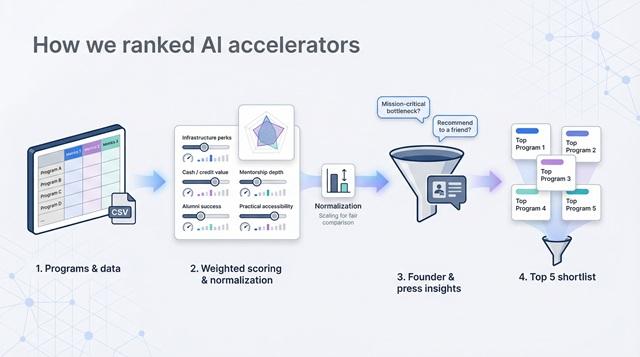
We didn’t start with opinions; we started with a spreadsheet. We scored every accelerator on your radar, plus a dozen you may not have heard of, across six weighted criteria: infrastructure perks, cash or credit value, mentorship depth, partner network, alumni success, and practical accessibility.
To keep things fair, we normalized raw numbers, then folded in qualitative signals from founder forums and recent press. An AWS credit that wipes out a GPU bill counted more than a vague promise of “support.” A mentor list packed with PhDs beat glossy marketing copy. Finally, we pressure-tested each ranking with two questions: Does this program remove a mission-critical bottleneck? Would we recommend it to a friend building an AI company?
Only five cleared the bar. You’ll meet them next.
Destination AI, TD SYNNEX’s ecosystem acceleration program
Picture an express lane into the enterprise market. That is Destination AI.
TD SYNNEX, one of the world’s largest IT distributors, launched the program in 2023 to help software vendors and services firms bundle, demo, and sell AI solutions faster. Instead of a three-month cohort, Destination AI runs year-round. You enroll, plug into the catalog, and tap a team whose only job is to shorten your sales cycle.
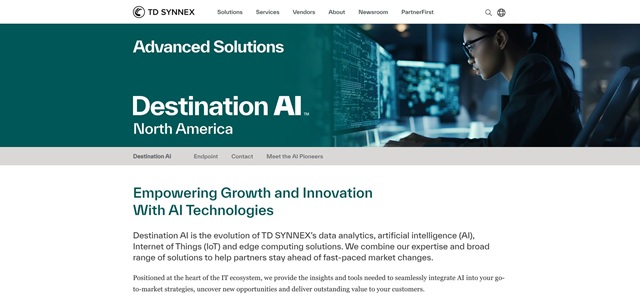
TD SYNNEX Destination AI accelerator program homepage screenshot
The magnet here is reach. Partners gain exposure to more than sixty pre-validated AI vendors the moment they sign up, according to https://www.tdsynnex.com/na/us/destination-ai/. Need a reference architecture for computer vision at the edge? It is already drafted. Want a sandbox to prove ROI for a skeptical prospect? The team spins one up and even joins the call.
Training is equally hands-on. TD SYNNEX’s AI Practice Builder walks your engineers and sales crew through go-to-market playbooks, pricing tactics, and vertical use cases such as “retail shrink detection” or “predictive maintenance in oil and gas.” Those blueprints compress months of trial and error into a few guided workshops.
There is no equity ask, no cash investment, and no hand-holding on product-market fit. Destination AI assumes you have a working solution and revenue ambition. In return you gain:
- Immediate channel access to thousands of resellers trusted by Fortune 500 buyers.
- Demo labs and proof-of-value support that make enterprise pilots painless.
- A bench of AI architects who troubleshoot real deployments, not hypothetical slide decks.
Founders who crave venture money or daily stand-ups with mentors should keep reading; other accelerators cover that ground. But if your biggest hurdle is scaling distribution, and your cloud burn is under control, Destination AI can feel like flipping a switch labeled “pipeline.”
Enrollment happens through TD SYNNEX’s partner portal, with acceptance based on technical readiness rather than a fixed deadline. Join when you are ready to sell, then let the ecosystem do its work.
NVIDIA Inception: GPU power on tap
If you train models for a living, you speak two languages: Python and “where can we find more GPUs.” NVIDIA Inception answers the second question with remarkable generosity.
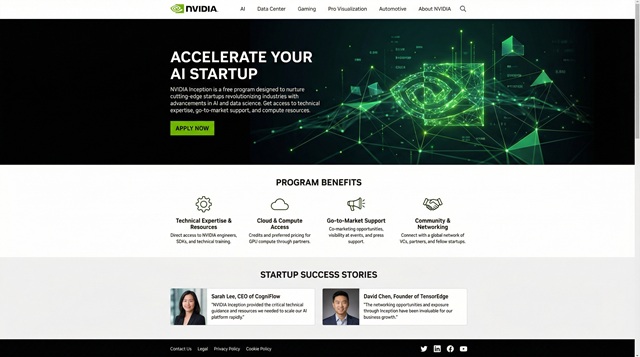
NVIDIA Inception AI startup program homepage screenshot
The program is not a cohort or a three-month sprint. It is an always-open membership that now counts more than fourteen thousand AI startups, according to NVIDIA. Join once, level up as you hit milestones, and watch the perks grow alongside your compute needs.
The headline benefit is discounted or free access to NVIDIA’s latest GPU instances in the cloud. Early-stage members receive credits large enough to run serious experiments, and Premier members negotiate steep hardware discounts when it is time to own the metal. Pair that with complimentary passes to the Deep Learning Institute, and you gain both the horsepower and the playbook.
Mentorship here is pragmatic. NVIDIA engineers host office hours on kernel optimizations, mixed-precision tricks, and memory profiling. They do not lecture from slide decks; they walk through your code until the kernel sparks.
Commercial doors open too. Inception Capital Connect showcases startups to a hand-picked pool of VCs, while NVIDIA’s enterprise sales teams often invite members into joint pitches. Landing a slot on a GTC keynote reel can boost credibility faster than a seed round announcement.
There are trade-offs. You will not see a direct equity check, and the program’s scale means you drive your own roadmap. Founders who need weekly accountability may miss the cadence of a classic accelerator.
But if your single biggest cost center is GPU time, Inception feels like a cheat code. Sign the NDA, upload your deck, and get back to training. The silicon is waiting.
Y Combinator: credibility at Silicon Valley speed
Three months, unrelenting focus, and a Demo Day that feels like a tech IPO compressed into an afternoon. That is the Y Combinator rhythm.
YC invests five hundred thousand dollars for roughly seven percent equity, a founder-friendly SAFE that buys immediate runway. Cash is only the opener. The real asset is a phone book stacked with alumni willing to answer a late-night Slack about scaling, hiring, or structuring an enterprise pilot.
The program treats every startup, AI or otherwise, as a growth experiment. Partners push you to ship weekly, talk to users daily, and pitch investors with ruthless clarity. AI founders benefit from a sub-community of machine-learning alumni who freely trade GPU hacks, prompt-engineering tricks, and secondhand compute credits.
That network snowballs. Investors scout YC batches months in advance, cloud providers extend extra perks because they know Demo Day converts to spend, and enterprise buyers perk up; a YC logo signals diligence they do not have to redo.
The cost is intensity. Acceptance hovers near one percent, and the three-month sprint will flatten any side projects. If you need day-to-day technical tutoring on model architecture, look elsewhere. If you crave momentum, accountability, and a roundtable of founders who scale from zero to Series A in record time, the Bay Area flight is worth it.
Applications open twice a year. Polish your story, clear your calendar, and press send.
AWS Generative AI Accelerator: all-you-can-train cloud credits
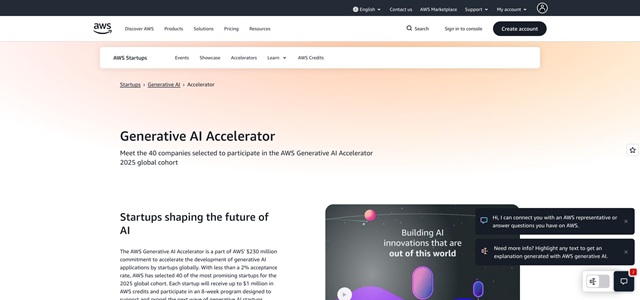
AWS Generative AI Accelerator official program page screenshot
AWS did the math: the fastest way to win founders’ hearts is to erase their largest bill. The Generative AI Accelerator follows through, handing each company up to three hundred thousand dollars in AWS credits that can be spent on Trn1 instances, Bedrock APIs, or a fleet of H100s in EC2, according to AWS. The amount dwarfs many pre-seed rounds and lets you experiment without staring at the meter.
The program runs for eight weeks. Each week blends two threads: deep architecture sessions with senior ML engineers and go-to-market coaching from Amazon’s field team. One call tackles sharding large language models across accelerators; the next walks through enterprise procurement cycles. The mix keeps technical founders from over-indexing on code or slides.
Cohorts stay small—roughly twenty to forty startups—so office hours feel like genuine whiteboard time, not webinar theater. Graduates say solution architects jump into their repos, tweak a Dockerfile, and push a better inference pipeline before lunch.
Amazon’s channel amplifies the finish. Demo Day draws VCs, but the hidden gem is introductions to AWS’s top customers looking for generative AI pilots. A single proof of concept inside a Fortune 100 account can snowball into a reference logo and a procurement shortcut across the vertical.
The trade-offs are clear. You give up zero equity, yet you commit to the AWS stack. If your roadmap depends on on-prem or another cloud, integration friction may outweigh free credits. For teams already betting on AWS, this accelerator feels like AWS Activate dialed up to eleven, plus a personal trainer who counts the reps and spots the weight.
AI2 Incubator: from research paper to revenue
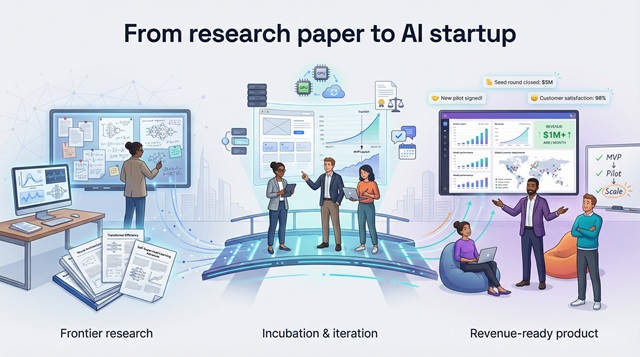
Some breakthroughs sit locked in PDF limbo. The Allen Institute for AI built a bridge that turns those citations into companies.
The AI2 Incubator starts earlier than any accelerator on this list. Founders often arrive with a domain obsession and a blank slate. Over the next nine to twelve months they co-create a product beside PhD researchers who wrote the state-of-the-art papers the rest of us quote. The Institute seeds each spin-out with roughly half a million dollars and provides office space, compute clusters, and legal help.
Daily life feels like a research lab grafted onto a startup war room. Morning stand-ups might dissect a new transformer architecture; afternoons shift to customer discovery calls. That tight loop keeps science pointed at a paying problem.
Success stories prove the model. Xnor.ai pioneered ultra-efficient edge ML and later sold to Apple. MosaicML refined large-model training costs before Databricks acquired it. Investors track these alumni and often commit capital the moment a new AI2 concept graduates.
There are strings. AI2 sits on the cap table as a true co-founder and expects relocation to Seattle for the incubation period. If you need a fast fundraising badge or enterprise pipeline next quarter, choose another path. If your goal is to wield frontier research with commercial intent, and have seasoned scientists review every commit, AI2 offers a lab-to-launch shortcut no traditional accelerator can match.
Five accelerators at a glance
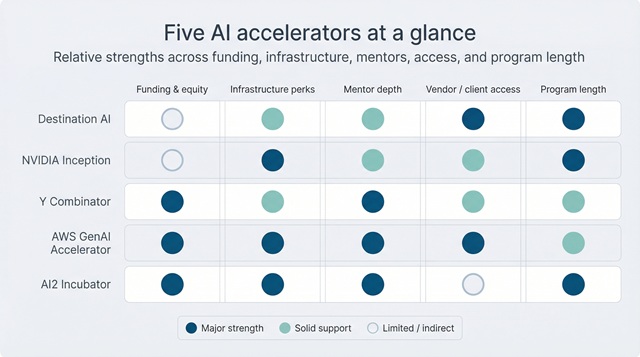
We have covered a lot of ground, so let’s zoom out. The table below recaps the essentials you will weigh when picking a program: money, compute, mentors, and market reach.
|
Accelerator |
Funding & equity |
Infrastructure perks |
Mentor depth |
Vendor / client access |
Program length |
|
Destination AI |
None, zero equity |
Demo labs, 40+ vendor integrations |
AI architects, go-to-market playbooks |
Very high—TD SYNNEX reseller channel |
Ongoing |
|
NVIDIA Inception |
None, zero equity |
GPU credits, hardware discounts |
NVIDIA engineers, DLI courses |
Medium—VC showcase & enterprise intros |
Rolling |
|
Y Combinator |
$500 000 for ≈ 7 percent SAFE |
~$100 000 partner cloud credits |
Generalist partners + AI alumni |
Medium—alumni & investor network |
3 months |
|
AWS GenAI Accelerator |
Up to $300 000 AWS credits, zero equity |
Full AWS stack, Trn1 / Bedrock |
Senior ML solution architects |
High—AWS enterprise customers |
8 weeks |
|
AI2 Incubator |
~$500 000 pre-seed, equity split |
Allen Institute clusters & datasets |
PhD researchers + serial founders |
Low early, rises post-spinout |
9–12 months |
Use the grid as a filter. Circle the column that solves your biggest constraint, then reread the deeper dive on that program. Momentum follows focus.
Honorable mentions & rising programs to watch
Five spots forced tough decisions, so a few strong contenders sit just below the cut line.
Techstars runs AI-focused cohorts in Montreal and Los Angeles, pairing hands-on coaching with a six-figure check. Plug and Play offers a different path: three whirlwind months of corporate matchmaking that can land a paid pilot before you finish the paperwork.
Government and university efforts are expanding. Canada’s Creative Destruction Lab matches founders with Turing-level scientists in a zero-equity setting. Intel Liftoff, IBM Hyper Protect, and a growing list of AI-safety incubators suggest a future where specialty beats general purpose.
Check the ecosystem every quarter; new vertical tracks emerge as fast as new model architectures.
How to choose the right AI accelerator
Start with the constraint that keeps you up at night. If compute spend drains your runway, focus on programs rich in cloud credits. If customer access stalls progress, target accelerators plugged into enterprise channels. Fit beats fame every time.
Stage matters. Pre-idea technologists thrive in lab-style incubators such as AI2, where research depth outweighs sales polish. Seed-stage teams hungry for investor attention gravitate to YC’s pressure cooker. Revenue-ready vendors craving scale lean toward Destination AI or AWS for distribution and infrastructure in one move.
Interview alumni. A ten-minute call tells you more than a hundred LinkedIn posts. Ask three blunt questions:
- Which promise proved true?
- What resource did you use weekly?
- Would you join again knowing what you know now?
Finally, tally the cost of equity. Cash plus clout is powerful, but seven percent of a unicorn is steep rent for three months of guidance. If credits and partnerships solve the same problem without dilution, keep your cap table clean.
Choose deliberately, commit fully, and remember: the best accelerator is a catalyst, not a crutch.