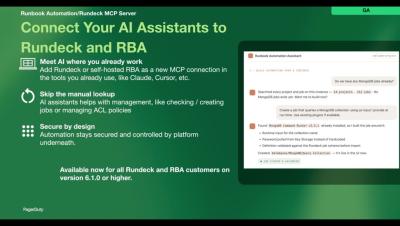
Connect your instance to Claude, Cursor, or any MCP-compatible tool to easily manage automation jobs, workflows, and ACL policies. API token and permissions still apply, keeping your automation secured and controlled.#Automation.
PagerDuty’s October Product Drop is here! Includes PagerDuty Docs (GA), AI-Powered Incident Communications (in rolling GA) and RBA/Rundeck MCP Server (GA).
PagerDuty’s September Product Drop is here! Includes PD Automation Runner (Early Access), Slack Experience Enhancements (in rolling GA now and Early Access), Post-Incident Reviews in PagerDuty web UI (Generally Available), and Scoped OAuth for Public Apps (Early Access).
Turn incidents into learning without leaving your workflow. Start drafts with one-click, from Slack or the incident details page, and complete them in the web UI with context and timelines built in. Post-Incident Reviews in web UI and AI-generated Post-Incident Reviews now generally available.
See, approve, and revoke third-party OAuth apps from one place. Apps request only the specific resources they need, and developers can publish them for customers to install.
Extend PagerDuty Workflow Actions and the SRE Agent to your on-prem and self-hosted tools, like Kubernetes, Splunk, and Grafana, without opening a single inbound port. Pull diagnostics or trigger remediation the moment an incident hits.
Ensure your team is ready to respond to incidents with On-Call Readiness Reports. Configure the notification requirements for your team, see who has their notifications configured, and send reminders to folks not yet finished with their configurations.