Operations | Monitoring | ITSM | DevOps | Cloud

The cloud optionality blueprint: standardizing the stack to end vendor lock-in

Key takeaway: Real cloud strategy isn't about running the same workload everywhere at once; it’s about the freedom to move when you need to. By standardizing the unified configuration file, Upsun enables true cloud optionality, moving provider migration from a re-architect project to a data move project.


Five questions your platform evaluation is missing

Years back I sat in on a platform evaluation with a customer who spent forty-five minutes of the meeting focusing on one thing: their custom PHP content management system. They had opinions about the CMS. Strong opinions. They had benchmarks, a migration plan, a proof of concept. They had a diagram. They had questions about the deployment pipeline for this CMS that were, for a single application, more thoroughly considered than most organizations' entire infrastructure strategies.

Stop watching the looms: why the AI era belongs to infrastructure

I live in Manchester, England now. I moved here from Texas last summer (which is its own story), but the thing I wasn't prepared for is how the Industrial Revolution isn't history here. It's the city itself. And if you're American like me, you might need to hear this: the Industrial Revolution didn't start in the US. It started here. Manchester is where the modern world was born. You see it everywhere. The old cotton mills converted into apartments.

Anything but that cloud

"Anything but that cloud." I asked why. "Our biggest customer is a giant retailer," he said. "That hyperscaler's parent company is the retailer's biggest competitor. So our customer refuses to do business with anyone who uses that cloud. We use that cloud, we lose our biggest customer. Full stop." That was the entire conversation about cloud choice. It wasn't a technical preference. It wasn't a pricing optimization. It wasn't a sovereignty concern.

Beyond the frontend: choosing between Vercel and Upsun for full-stack applications in 2026

If you're building a modern web application in 2026, Vercel is almost certainly on your shortlist, and probably near the top of it. The developer experience Vercel pioneered for Next.js and the frontend ecosystem around it is a real achievement. Push a branch, get a preview URL, ship. It works, it's fast, and an entire generation of frontend teams have built their workflow around it. This article is not here to argue with any of that.

Why your ecommerce dev team ships slower than your competitors (and how to fix it)

Key takeaway: Development velocity in e-commerce is often throttled not by headcount, but by invisible infrastructure friction that forces developers to spend time on environment management and deployment pipelines instead of shipping revenue-generating features. Ecommerce teams rarely think they have an infrastructure problem.

Ecommerce replatforming without a revenue freeze: how preview environments reduce migration risk

Key takeaway: Upsun eliminates the need for code freezes during ecommerce migrations by using instant, data-complete preview environments to validate replatforming efforts against production-grade data without interrupting the live store. Ecommerce replatforming is one of the highest-stakes decisions an online retailer makes, and for most, the biggest risk is what happens to revenue during the migration.

Beyond the pull request: why code review is not infrastructure validation

Code review and infrastructure validation are distinct problems. While AI can review syntax, only an active, data-complete environment can validate system-wide state. Upsun provides the unified configuration file needed to turn "looks good to me" into verified production-readiness.

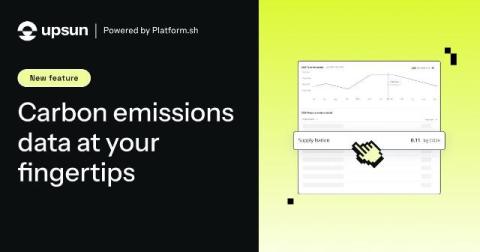
Carbon emissions data at your fingertips

This post is also available in German and in French. Tracking environmental impact can be fragmented, time-consuming, and disconnected from operational data. Beyond simply checking ESG reporting boxes or making sure your company is CSRD compliant, actively monitoring environmental impact is the foundation for building an effective sustainability strategy. At Upsun, we know that measuring progress is the first step toward improvement.

The hidden cost of scaling ecommerce on hyperscalers

Key takeaway: Hyperscaler pricing models often penalize e-commerce growth due to unpredictable egress fees and unbounded auto-scaling, but moving to a resource-based allocation model allows teams to treat infrastructure costs as a deliberate business decision rather than a post-campaign surprise. Ecommerce traffic doesn't grow linearly. It spikes, and every spike rewrites your cloud bill.

Peak traffic without the panic: auto-scaling infrastructure for ecommerce flash sales

Key takeaway: Upsun replaces manual, high-stress peak traffic prep with automatic scaling, keeping your e-commerce site fast and available during flash sales while you only pay for the resources you consume. For every e-commerce team, an outage means lost revenue, failed checkouts, and a flood of support tickets. For most stores, this gets worse during peak events like Black Friday and flash sales.

How instant environment cloning reduces the "Triage Tax"

The most expensive hour in software engineering is the hour spent trying to figure out why a bug exists in production that doesn’t exist anywhere else. For many teams, the first 70% of a debugging cycle isn't spent fixing code; it is spent on "plumbing." This is the time lost to reproducing the issue, wrestling with environment drift, and sanitizing datasets just to get to a starting line.

The reproduction problem: why you can't recreate the investigative gap

In the modern dev stack, we have mastered the art of the deploy. We have CI/CD pipelines that ship code in minutes and observability dashboards that track every millisecond of latency. Yet, when a P0 incident strikes, the most common phrase in Slack isn’t a solution; it’s "I can’t reproduce this locally." This is the Reproduction Gap. Most engineering teams are world-class at building and monitoring, but they are remarkably fragile at recreating runtime behaviour.

That production incident cost more than downtime

Every developer knows the sudden, cold spike of adrenaline that comes with a P0 alert. The site is down, the Slack channel is overwhelmed with notifications, and the "war room" is officially open. In the immediate aftermath, leadership looks at one metric: downtime. They calculate the lost revenue per minute and the hit to brand reputation. But for the engineering team, the official resolution of the incident is only the beginning.

Debugging the black box: why LLM hallucinations require production-state branching

The most frustrating sentence in modern engineering is no longer "it works on my machine." It is: "It worked in the playground." When an LLM-powered feature, such as a RAG-based search, an autonomous agent, or a dynamic prompt engine, fails in production, it doesn’t throw a standard stack trace. It returns "slop," hallucinations, or silent retrieval failures. Standard debugging workflows fail during triage because LLM hallucinations cannot be reproduced using static mocks or clean seed data.

Architecture deep dive: What makes a bug reproducible?

The most difficult bugs to solve aren't those with the most complex code, but those with the most complex state. For a bug to be "reproducible," it must be deterministic, meaning the same set of inputs always yields the same failure. In a modern cloud environment, those "inputs" include more than just your code; they include the specific version of your database, the latency of your service mesh, and the exact configuration of your underlying infrastructure.

What fast debugging actually looks like on Upsun

Debugging a broken deployment can take hours, especially when the cause is unclear. Recently, a customer ran into this exact situation: their AI agent produced a Drupal site with broken composer scripts and mismatched database credentials, and nothing they tried got it running. This video shows how debugging works in practice on Upsun.

The reality check: why manual debugging setups are a hidden factory

The first 70% of a debugging cycle is usually spent on "plumbing", the undocumented toil of syncing databases, matching service versions, and aligning networking to mimic a production failure. This manual setup is a hidden factory that consumes senior engineering capacity and delays recovery. True velocity is found by eliminating the infrastructure variables that make bugs hard to reproduce.