
Virtual Dedicated Servers vs. Public Cloud: Cost Breakdown

Image Source: depositphotos.com
Infrastructure costs can spiral fast when you pick the wrong hosting model. Many teams lock into public cloud contracts only to face unpredictable bills month after month.
The choice between a virtual dedicated server and public cloud comes down to one thing: predictability. VDS gives you fixed costs. Public cloud gives you flexibility, but at a price that fluctuates with usage.
Cloud infrastructure spending crossed $675 billion globally in 2025, with 27% of it wasted. Most of it traced back to idle resources and poor tier selection.
This article breaks down the real cost differences between VDS and public cloud, when each model makes financial sense, and how to decide which one fits your infrastructure needs.
What Is a Virtual Dedicated Server and How Does It Work?
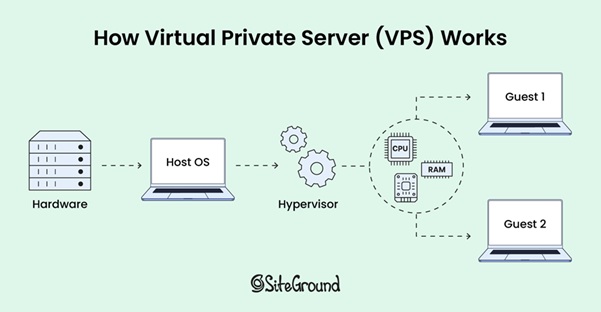
Image Source: SiteGround
A virtual dedicated server gives you a partitioned slice of a physical machine with dedicated resources. Unlike shared hosting, your CPU, RAM, and storage are yours alone. Unlike a bare metal server, you still benefit from virtualization, which keeps provisioning fast and management simple.
For example, Gcore’s virtual dedicated servers have fixed monthly rates with predictable resource allocation. That means no surprise charges when traffic spikes or when a background process runs longer than expected.
Gcore operates across 180+ locations globally, which means low-latency access to your server is available regardless of where your users are based. That matters for teams running latency-sensitive applications who also want cost predictability.
No surprise charges when traffic spikes, and no background process quietly inflating your bill at the end of the month.
VDS sits between shared hosting and full bare metal in terms of cost and control. You pay for what you reserve, not what you consume in real time.
How Public Cloud Pricing Actually Works?
Public cloud providers like Gcore, AWS, Azure, and Google Cloud use a consumption-based model. You pay per hour, per request, per gigabyte of storage, and per gigabyte of data transferred out.
That model sounds efficient, but it creates complexity fast.
- Compute costs vary by instance type, region, and reservation level
- Storage costs are layered: block storage, object storage, and backup storage are billed separately
- Egress fees are often the biggest surprise, charged every time data leaves the cloud network
- Support tiers, monitoring tools, and managed services stack additional charges on top
A basic web application on a mid-tier cloud instance can easily run $150 to $400 per month once storage, bandwidth, and add-ons are factored in.
VDS vs. Public Cloud: Side-by-Side Cost Comparison
Here is a direct comparison for a mid-sized application with moderate traffic:
|
Cost Factor |
VDS |
Public Cloud |
|
Monthly compute |
Fixed, e.g. $20-$80 |
Variable, $80-$200+ |
|
Storage |
Included or flat rate |
Per GB, billed separately |
|
Bandwidth/Egress |
Often unmetered or generous |
Per GB, can escalate fast |
|
Backup |
Usually included |
Add-on cost |
|
Support |
Included in plan |
Tiered, often paid |
|
Total estimate |
$50-$100/month |
$150-$500/month |
The gap widens as traffic scales. Public cloud costs scale linearly with usage. VDS costs stay flat.
When Does Public Cloud Make Financial Sense?
Public cloud has a legitimate place in infrastructure planning. The consumption model works when your workloads are irregular, short-lived, or hard to predict.
It makes sense when:
- You need to spin up resources for a few hours or days and shut them down
- Your traffic is highly seasonal, with long quiet periods between spikes
- You are running experiments or staging environments that should not run 24/7
- You need access to managed services like machine learning pipelines or serverless functions that would be costly to self-manage
According to Flexera's State of the Cloud report, 62% of enterprises describe optimizing cloud costs as their top challenge. That stat alone signals that public cloud efficiency is harder to achieve than vendors suggest.
The flexibility premium is real. You pay for it whether you use it or not.
Do Hidden Fees Make Public Cloud More Expensive Than It Looks?
Yes. The advertised instance price is rarely the final bill. Public cloud providers have built pricing structures that are difficult to estimate in advance. Egress fees are the most cited culprit.
Moving data out of a cloud region, whether to users, to another region, or to an on-premise system, triggers per-gigabyte charges that compound quickly on high-traffic applications.
Here is how to identify hidden costs before they hit:
- Audit egress patterns before migrating. If your app sends large volumes of data to end users regularly, egress fees will be significant.
- Check storage tiers carefully. Retrieval fees on cold storage can exceed the storage cost itself for frequently accessed data.
- Review default logging and monitoring. Many cloud dashboards enable verbose logging by default, which writes to billable storage.
- Test with cost calculators, then add 30%. Real-world bills consistently run higher than calculator estimates due to overlooked services.
- Look at inter-region transfer costs. Multi-region architectures multiply bandwidth charges in ways that are easy to miss in initial planning.
A CNCF survey found that 68% of engineers reported unexpected cloud bills as a recurring operational problem. The issue is structural, not accidental.
Which Workloads Fit VDS Better Than Public Cloud?
VDS performs best when your resource needs are stable and your traffic patterns are consistent. If you can predict what you need each month, you should not pay a variable rate for it.
Workloads well suited to VDS:
- Websites and web applications with steady traffic that do not spike dramatically
- Databases that run continuously and require consistent IOPS and low latency
- Game servers that need dedicated CPU and memory without noisy neighbors
- Development and staging environments that run around the clock
- Email servers and internal tools with predictable resource consumption
The dedicated resource model also removes noisy neighbor risk. On public cloud shared infrastructure, another tenant's activity can degrade your performance. On a VDS, your allocation is protected.
How to Make the Right Infrastructure Decision for Your Budget
The decision framework is straightforward. Start with your workload profile.
If your application runs continuously, has predictable traffic, and does not require burst-scale compute, VDS will almost always cost less. Run a 12-month projection comparing your current or expected cloud spend against a flat VDS rate. Include egress, storage add-ons, and support in your cloud figure.
If your workload is bursty, temporary, or requires managed services that would take significant engineering effort to replicate, public cloud flexibility justifies the cost.
Many teams land on a hybrid approach: VDS for core, always-on workloads, and public cloud for overflow or specialized managed services. That split keeps baseline costs predictable while retaining access to cloud capabilities when genuinely needed.
Conclusion
VDS and public cloud solve different problems. Public cloud offers flexibility that comes with pricing complexity and recurring hidden costs. VDS offers resource predictability at a fixed rate, which makes budgeting straightforward.
For most steady-state workloads, VDS delivers better cost efficiency. For irregular, short-lived, or highly specialized workloads, public cloud earns its premium.
Audit your usage patterns before committing to either model. The right choice is the one that matches your actual workload, not the one with the best marketing.