
Operations | Monitoring | ITSM | DevOps | Cloud

Self-Improving Agents: A Practical Guide to Continuous Learning

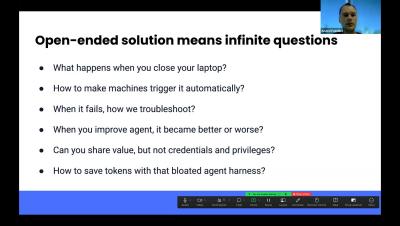
We build agents to take work off engineers’ plates. Then we give those engineers a new manual job: reading failed runs and babysitting prompts. Agents will improve themselves automatically. We’re not there yet, but this is the future I’m betting on. We’ve been working on this ourselves at Komodor over the past year. We know how hard it is to turn a failure into an improvement that holds up beyond a few examples.
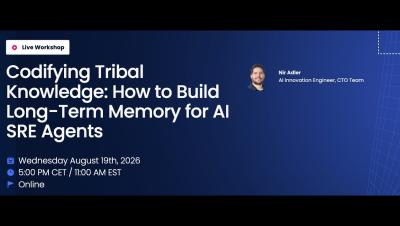

[WEBINAR] Codifying Tribal Knowledge - How to Build Long Term Memory for AI SRE Agents

In this technical webinar, Komodor’s engineering team unveils Agent Memory – the long-term operational memory behind our AI SRE agents. We’ll go deep into how it works: why we modeled it on human memory research (episodic vs. semantic, consolidation, reinforcement, decay), why off-the-shelf memory frameworks like Mem0 and Graphiti fell short for SRE workloads, and how we built a fast, purpose-built alternative on PostgreSQL and pgvector – one table, three search indexes, and a hybrid retrieval engine that fuses exact, lexical, and semantic search into a single ranked answer.

Building AI SRE Agents, Part 2: Leave the Laptop, Earn Trust

Moving the agent off your machine and pointing it at real clusters — read-only, in shadow mode — then climbing a trust ladder toward carefully scoped action. This is the second article in a three-part series on taking an AI SRE agent from a weekend experiment to enterprise production. Part 1 built a local agent on a throwaway cluster: read-only, propose-only, refined against a small eval set, with portable skills and no production write access.

4 Cloud-Native Challenges AI SRE Is Solving in 2026 and the 3 New Ones to Look Out For

AI SRE is making real strides in resolving some of the greatest pains related to incident response, troubleshooting, and complex root cause analysis. The on-call rotation, the war room, the week-long RCA, and the ticket queue that ate a third of every platform engineer’s week all look different now than they did two years ago.

5 Optimization Blockers You Didn't Know Were Inflating Your Cloud Bill

Most cloud-native cost tools are built to find and address waste reactively. Underutilized nodes, oversized requests, and idle workloads are revealed in the utilization data, the fixes are well documented, and the initial savings these tools drive are very real. But what we’ve seen consistently across clusters is a different category of blocker, one that quietly prevents consolidation and strands capacity your autoscaler can never reach. They don’t surface in dashboards as obvious waste.

The Investigator That Remembers: Inside Klaudia Memory

There is a particular kind of incident every SRE team is familiar with. A common component of your stack, say your Redis database, starts misbehaving. Someone spends two hours tracing it back to a connection pool exhausted by a misconfigured client, the fix goes in, and everyone moves on, for today. The following Tuesday it happens again, and whoever is on call investigates it from scratch, because the person who solved it last week is asleep, on vacation, or working somewhere else now.

Building AI SRE Agents, Part 1: Start Local, Break Things, Learn Fast

The first stage of AI SRE maturity is a laptop, a throwaway cluster, and zero production access. Here’s how to set it up, and what to watch for. AI SRE (Site Reliability Engineering) agents are AI-powered systems that automate the most time-consuming parts of incident response: triaging alerts, correlating logs and metrics, generating root-cause hypotheses, and proposing remediation steps.

Klaudia Under the Hood: How We Built an AI SRE That Actually Earns Trust

In reliability engineering, being ‘mostly right’ is a liability. An AI SRE that sometimes misses the root cause or gives a confident, wrong answer at 2:17 AM has no place in an enterprise cloud environment. In this context, silence is better than noise. That’s the bar Klaudia is built to clear: genuine reliability that you can trust in production. The kind of reliability that earns a place alongside your best engineers. Getting there requires more than just a capable model.