
Building a Smarter Incident Response Framework for Field Operations

A field incident rarely arrives as a clean message explaining exactly what happened and what should happen next. It may begin with a vehicle stopping unexpectedly, a worker missing a check-in, a machine reporting unusual pressure, or a camera detecting movement inside a restricted area.
The challenge is turning those scattered signals into a reliable operational picture before teams lose time deciding what is real, who owns the response, and which action has priority. The U.S. Bureau of Labor Statistics recorded 5,070 fatal occupational injuries in 2024, including 1,937 involving transportation incidents, which shows why field response needs to be treated as operational infrastructure rather than an administrative layer.
A smarter incident-response framework therefore has to do more than issue alerts. It needs to convert incomplete and sometimes conflicting information into coordinated action while conditions are still changing.
Incidents Begin as Signals
The first technical mistake is treating every incoming alert as an incident. Field systems constantly produce signals through telematics, wearables, IoT devices, cameras, equipment sensors, radios, and mobile applications.
Any one of those signals can be misleading. A vehicle may stop because it reached a worksite, a vibration spike may reflect a normal operating cycle, and a computer-vision system may mistake steam or glare for smoke.
A wearable can also register a fall when the device has simply been dropped. This is why a response framework needs a correlation layer between raw detection and operational escalation.
Instead of asking whether one sensor crossed a threshold, the platform can examine whether several independent signals support the same interpretation.
|
Initial signal |
Weak interpretation |
Stronger combined context |
|
Vehicle stops unexpectedly |
Normal delay or possible incident |
Driver also misses check-in and vehicle remains stationary |
|
Worker fall alert |
Device movement or possible fall |
No movement follows and worker does not respond |
|
Camera detects smoke |
Possible classification error |
Temperature and air-quality sensors also rise |
|
Equipment vibration rises |
Routine variation or wear |
Temperature rises while output falls |
|
Restricted-zone detection |
Possible false alarm |
Badge data confirms nobody authorized should be present |
This changes AI's role inside the framework. The model contributes evidence to a larger incident picture instead of being treated as the final decision-maker.
Build an Incident Graph
Most operational dashboards are built around lists. They can show that an alarm appeared at 10:14, a vehicle stopped at 10:15, and a worker failed to check in several minutes later.
The problem is that lists do not automatically expose relationships between people, assets, locations, hazards, and responders. That becomes a serious limitation when several apparently separate signals actually belong to one developing incident.
A stronger framework can build an incident graph connecting those elements in real time. If an abnormal gas reading appears at a remote facility, the system can associate it with workers assigned to that location, recent GPS positions, nearby equipment, current environmental conditions, and technicians qualified to isolate the affected system.
The resulting record could connect a gas sensor with Site 14, two workers, an active ventilation unit, a maintenance zone, and a qualified responder six minutes away. That structure gives an AI assistant or workflow engine far more useful context than the original alarm by itself.
Creating it requires scheduling data, telematics, asset systems, cameras, environmental sensors, and GIS information to work together. The objective is not to gather every possible record but to assemble the minimum useful context quickly enough to improve the next decision.
Freshness Beats Data Volume
A response system can contain correct information and still create a poor decision if that information is old. Location data makes this particularly obvious because a precise map marker can create a false sense of certainty.
A dashboard may show a technician beside a pumping station, but if the GPS point is twelve minutes old, that worker may now be miles away. The location remains historically accurate while becoming operationally misleading.
Important incident fields should therefore carry metadata describing age and reliability. The framework should know when a value was generated, how often its source normally updates, whether the device is still connected, and whether another source contradicts the same information.
A useful interface should expose those differences instead of flattening every feed into one apparently live view. Showing “last location: 14:08, device offline” is much more useful than leaving an old map pin on the screen without explaining its age.
More data does not automatically improve situational awareness. Current and attributable information is generally more useful than a larger volume of records whose freshness cannot be established.
Separate Detection From Response
AI can recognize patterns, but operational policy should not be buried inside a machine-learning model. Detection and response solve different problems, and keeping them separate makes the overall system easier to update, inspect, and control.
A model might estimate that a worker has fallen with high confidence. The organization's response policy then decides whether the appropriate next step is a confirmation attempt, supervisor escalation, dispatch of a nearby colleague, or contact with external emergency services.
A machine-readable policy can combine several conditions before committing to an escalation:
- A lone-worker alarm can require failed confirmation attempts before escalating, while location data verifies that the person is actually inside an active work area.
- An equipment anomaly can require a supporting condition before triggering a shutdown workflow, such as rising temperature combined with declining output or abnormal pressure.
- A severe vehicle event can automatically gather context without making the final operational decision, including recent location, nearby resources, vehicle status, and supervisor availability.
This separation also prevents routine procedural changes from becoming machine-learning projects. An operations team can modify an escalation path or response threshold without retraining the model responsible for detecting the original event.
The result is a cleaner architecture in which AI supplies evidence and policy determines what that evidence should trigger. That distinction becomes particularly valuable when procedures differ by site, shift, asset type, or incident severity.
Route Work, Not Alerts
A notification tells someone that something happened, while a task tells someone what they are responsible for doing next. That difference is easy to miss when incident software is designed around messaging rather than operational ownership.
Many platforms distribute the same alert to supervisors, dispatchers, safety teams, and technicians and assume that broad visibility will produce action. In practice, several people may see the notification while each assumes another person has already handled it.
A better workflow turns the response into explicit assignments. If equipment overheats, the system might ask a technician to isolate the asset, assign a supervisor to confirm nearby personnel, instruct dispatch to redirect incoming work, and give the safety lead responsibility for deciding whether the area can remain operational.
Each task should contain a priority, target completion time, acknowledgement state, current status, and escalation path. The platform becomes valuable because responsibility is visible rather than because more people receive the same notification.
This also gives managers a clearer view of response progress. Instead of seeing twenty people who opened an alert, they can see which actions are complete, which are delayed, and where an escalation is required.
Design for Broken Connectivity
Field software is often designed in environments where reliable connectivity is assumed. Actual operations may take place on remote construction sites, utility corridors, industrial facilities, highways, or rural locations where cellular service is intermittent.
Major incidents can also damage communications infrastructure at exactly the moment teams need it most. A framework that depends entirely on constant cloud access can therefore lose critical capabilities under the conditions where they matter most.
A resilient architecture needs an offline-first layer with enough local information and processing capability to continue basic response functions:
- Field devices should retain essential operational information locally, including active assignments, emergency contacts, site maps, hazard instructions, and the most recent synchronized incident state.
- Edge hardware should handle selected processing without waiting for the cloud, such as evaluating sensor thresholds or running lightweight computer-vision models close to the source.
- Synchronization should reconcile offline changes instead of blindly overwriting them, using timestamps, version information, and conflict rules when connectivity returns.
The design goal is graceful degradation, not the unrealistic promise that every service will always remain available. If live video disappears, location or sensor data may still work, while a mobile device can retain the current response plan even when cloud access is temporarily unavailable.
That approach gives field teams several layers of operational continuity. Losing one communication channel reduces capability without making the entire response system unusable.
Operational Activity Becomes Evidence
Once the immediate hazard is controlled, the purpose of the incident platform begins to change. During the event, the system helps people decide what to do, while afterward the same records may help establish what happened and how the response unfolded.
A serious incident can generate vehicle telemetry, GPS positions, camera footage, equipment alarms, environmental readings, dispatch messages, worker check-ins, acknowledgement logs, and automated severity changes. No single record necessarily explains the event, but together they can form a detailed chronology. Those records may later be examined outside the original operational team. After a commercial-vehicle incident, for example, someone may consult a San Luis Obispo truck accident attorney while insurers, investigators, and other parties review available vehicle and operational information.
From a systems perspective, the important issue is whether the platform can preserve a trustworthy sequence. If a vehicle records braking at 14:21:06, a camera clock runs several seconds behind, and the dispatch platform uses another time source, combining those records without correction can create a misleading timeline.
A strong framework therefore needs data provenance. Teams should be able to determine where a record originated, when it was created, whether it later changed, and how its timestamps align with other systems. This requirement should be designed into the platform before an incident happens. Reconstructing metadata after the fact is far harder than preserving it correctly as records are created.
Automation Needs a Brake
The fastest automated action is not always the safest one. A system that reacts immediately to an incorrect assumption can distribute that mistake through several workflows before anyone verifies the original event.
A computer-vision model might incorrectly identify smoke and trigger an unnecessary equipment response. A location engine could direct responders to the geographically closest entrance even though that gate is inaccessible to emergency vehicles.
Automation therefore needs clear boundaries. Low-risk actions such as saving relevant footage, opening an incident workspace, locating nearby personnel, or sending acknowledgement requests are easier to automate because they can usually be reversed.
Actions with operational consequences deserve a higher threshold. Equipment shutdowns, evacuations, traffic-control changes, or decisions that could introduce secondary hazards may require accountable human approval before execution.
Overrides also need to remain visible. If a supervisor changes the severity of an incident or cancels an automated escalation, the platform should preserve the change and the reason behind it rather than silently replacing the earlier state.
The useful question is not whether humans or AI should control the response. It is which actions are safe to automate and which require accountable judgment before they are carried out.
Recent OSHA citation data also shows where common safety weaknesses continue to appear in field-heavy work. In federal construction inspections during FY2025, fall protection generated 6,774 citations, followed by ladders with 2,760 and training requirements with 2,171. These patterns matter for incident-response systems because recurring hazards can help determine which alerts, procedures, and response information need to be surfaced fastest when something goes wrong.
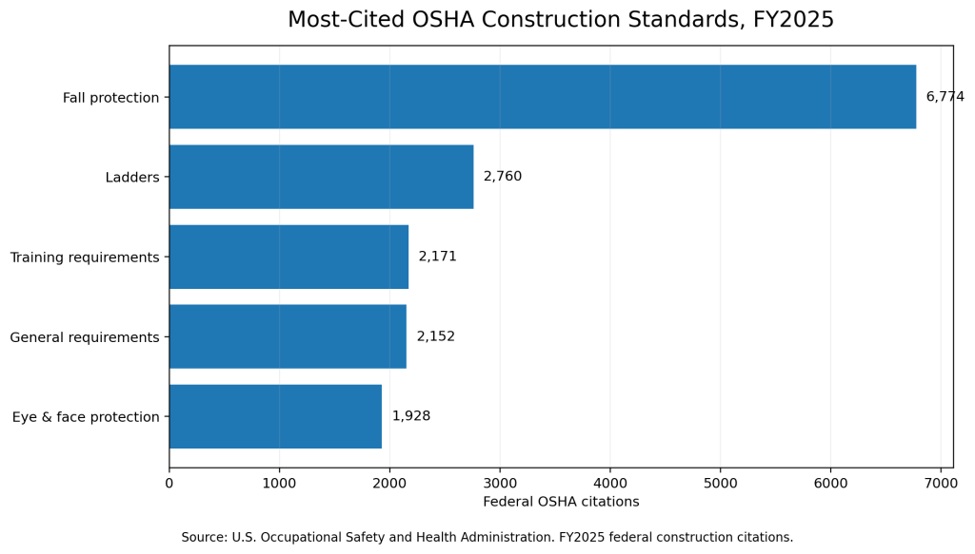
Top Federal OSHA construction citations in FY2025 (generated by chartgpt.co)
Measure the Response Debt
Operational weaknesses often accumulate quietly because they do not interrupt normal work. A manager may change roles while the escalation tree still points to the old contact, or a site entrance may close while an emergency map continues showing it as available.
A sensor might also generate so many nuisance warnings that employees begin ignoring it. Two departments can maintain different versions of the same response procedure without discovering the conflict until an incident forces both teams to use it.
These problems create response debt, which resembles technical debt in software. Small inconsistencies remain manageable during ordinary operations but become expensive when conditions turn abnormal.
|
Response metric |
What it exposes |
|
Detection-to-acknowledgement time |
How long signals remain unowned |
|
Acknowledgement-to-action time |
Delay after someone becomes aware |
|
Manual rerouting rate |
Whether workflows frequently assign the wrong person |
|
Duplicate incident rate |
Whether disconnected systems create parallel responses |
|
Stale-contact rate |
Whether escalation information is being maintained |
|
Offline synchronization failures |
Whether updates survive connectivity gaps |
|
Repeated nuisance alerts |
Whether noisy detection is reducing trust |
The objective should not be chasing the lowest response-time number in isolation. A ten-second acknowledgement followed by six minutes of confusion is not better than a twenty-second acknowledgement that immediately produces the correct assignments.
A more useful question is where time, context, or ownership is being lost. Once those points become measurable, teams can improve the process instead of simply telling people to react faster.
Replay the Information State
Post-incident reviews often suffer from hindsight because reviewers can see every sensor reading, statement, photograph, and outcome at once. The person making the original decision rarely had access to that complete picture.
A stronger review reconstructs what was known at each moment. Dispatch may know only about an equipment alarm at 14:03, receive a worker location update at 14:05, obtain visual confirmation at 14:07, and receive enough information to order an evacuation at 14:10.
That chronology changes how a decision should be evaluated. A response that appears slow when viewed with complete hindsight may have been reasonable if the information required for action arrived only moments earlier.
AI can make this review more useful by searching historical incidents for similar sequences, recurring handoff delays, repeated equipment conditions, or locations where escalation frequently slows. A review may discover that location verification repeatedly loses three minutes because two platforms use different names for the same field site.
That finding is much more actionable than concluding that “communication needs improvement.” It identifies a specific systems problem with a measurable technical fix.
Turn Playbooks Into Logic
Many organizations already have detailed emergency procedures, but those procedures often live in PDFs, binders, intranet pages, or training documents. The information exists, yet responders may still have to search for it while conditions are changing.
Digitizing a playbook should therefore mean more than converting a document into searchable text. Parts of the procedure can become executable logic that surfaces information according to incident type, location, workforce, and current operating state.
For a chemical release at Site B during the night shift, a digital playbook could automatically:
- Load the correct site map and isolation procedure, removing the need to search several repositories for the latest version during an active event.
- Identify employees and qualified responders associated with the location, allowing the framework to connect response procedures with the people actually available.
- Surface reporting, evacuation, medical, and contact requirements as trackable work, so required actions can be assigned and their completion verified.
Human responders still control consequential decisions, while software removes time spent finding information the organization already possesses. OSHA emergency-action-plan requirements include emergency reporting, evacuation procedures, employee accounting, rescue or medical duties, and designated contacts, which illustrates how much operational information may need to be surfaced quickly during an event.
This is a more practical use of automation than generating another notification. Technology adds value when established procedures can become timely information, clear assignments, and visible progress.
Bottom Line
A smarter incident-response framework is not defined by how many sensors, dashboards, or AI models an organization deploys. Its quality becomes visible in the gaps between systems, especially when information is incomplete, connectivity is weak, and several teams need to act at the same time.
The framework should correlate weak signals before escalation, show whether operational data is current, assign work rather than simply broadcast alerts, and continue functioning when connectivity deteriorates. It should also preserve enough context to reconstruct what people knew, which actions followed, and where unnecessary delay entered the process. AI can accelerate classification, search, correlation, and workflow routing, but those capabilities only become useful inside a disciplined operational architecture. The strongest system reduces the distance between detecting that something changed and giving the right person enough reliable context to make the next decision correctly.