
What to Say When Things Break: Outage Notification Templates for Ops Teams
When systems fail, technical remediation is only half the job. The other half is communication. And it’s often overlooked.
Poor outage communication creates confusion, erodes trust, and floods support teams with “any updates?” messages. Clear, timely messaging does the opposite. It reassures users, sets expectations, and gives operations teams breathing room to focus on resolution.
This guide provides ready-to-use outage notification templates and best practices to help ops teams communicate effectively at every stage of an incident, from first detection to post-mortem.
Why Outage Communication Matters in 2026
Downtime is unavoidable. Silence during downtime is not.
When users aren’t informed:
- They assume the worst
- They lose confidence in reliability
- They overwhelm support and internal teams
In many high-profile outages, frustration stems less from the outage itself and more from the lack of updates. Users don’t expect perfection. They expect acknowledgment, clarity, and honesty.
That’s why experienced ops teams treat outage communication as a core part of incident response, not an afterthought.
How to Nail Every Outage Message
Effective outage notification answers three questions:
- What do we know about the issue right now?
- Who or what is affected?
- When will the next update arrive?
If your message covers those points, you’re already ahead of most incident responses.
Outage Notification Templates by Incident Stage
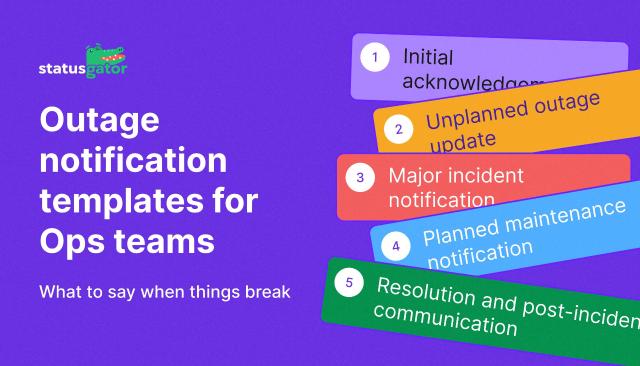
Rather than treating templates as generic messages, it’s more effective to align them with the incident lifecycle. Below are practical templates ops teams can use at each stage.
1. Initial Acknowledgement (First 5-10 Minutes)
When to use:
Immediately after abnormal behavior is detected, whether from internal monitoring or early outage indicators from third-party services your systems depend on.
Why it matters:
Early acknowledgment reduces speculation and demonstrates that your team is actively tracking system health, including the services you rely on.
Outage Notification Template – Initial Acknowledgement
“We are currently investigating an issue affecting [service/system] that was detected at [date/time]. Our team is actively assessing impact and working to restore normal service. We will provide an update by [next update time].”
Best practice:
Focus on confirmed signals and observed impact. Avoid speculation while showing that detection and investigation are already underway.
2. Unplanned Outage Update
When to use:
Once impact is clearer but the issue is still unresolved.
Why it matters:
Transparency builds trust, even when the news isn’t good.
Outage Notification Template – Unplanned Outage
“We are experiencing an unplanned outage affecting [service/system]. The issue began at [date/time] and is impacting [users/regions]. Our engineers are actively working on a fix, and we will share further updates as they become available.”
Include:
- A clear apology/understanding of the impact on users
- Known scope of impact
- Commitment to updates
3. Critical or Major Incident Notification
When to use:
For high-severity outages affecting many users, security, or core functionality.
Why it matters:
Tone and clarity are critical. This message sets expectations for the duration and seriousness of the incident.
Outage Notification Template – Critical Incident
“We are currently experiencing a critical outage affecting [service/system] starting at [date/time]. This issue impacts [stakeholders/regions]. Resolution efforts are our top priority, and we will continue to provide regular updates as progress is made. We sincerely apologize for the disruption.”
Best practice:
Increase update frequency during critical incidents, even if progress is limited.
4. Planned Maintenance Notification
When to use:
Before scheduled maintenance or known downtime.
Why it matters:
Planned outages should never surprise users.
Outage Notification Template – Planned Maintenance
“Please note that [service/system] will be unavailable due to scheduled maintenance from [start date/time] to [end date/time]. This maintenance is required to [reason]. We apologize for any inconvenience and appreciate your understanding.”
Best practice:
Send reminders ahead of time and clearly state the expected impact.
5. Resolution and Post-Incident Communication
When to use:
After the service has been fully restored.
Why it matters:
Closing the loop reinforces accountability and transparency.
Outage Notification Template – Incident Resolved
“The issue affecting [service/system] from [start time] to [end time] has been resolved. The incident impacted [users/regions] due to [high-level cause]. We apologize for the disruption and are taking steps to prevent similar incidents in the future.”
Optional additions:
- Link to a detailed post-mortem
- Preventative actions taken
Best Practices for Effective Outage Communication
1. Communicate Early, Even Without Full Details
Acknowledgment is more important than completeness during the early stages of an incident.
2. Match Message Tone to Severity
A minor degradation and a major outage should not sound the same.
3. Avoid Over-Promising
Be realistic with timelines. Missed expectations damage trust more than delays.
4. Centralize Updates
A single source of truth, such as a status page, reduces confusion and duplicate messaging.
5. Prepare Templates in Advance
Templates remove guesswork when teams are under pressure and ensure consistency across incidents.
Why Ops Teams Rely on Outage Notification Templates
During incidents, cognitive load is high. Templates:
- Reduce decision fatigue
- Improve consistency
- Speed up communication
- Reduce inbound support volume
Many teams also use monitoring and aggregation tools like StatusGator to automatically surface outages, detect issues early, and keep internal and external stakeholders informed through unified status pages.
Final Thoughts
Outages will happen. How you communicate during them defines how users remember the incident.
By preparing clear outage notification templates and aligning them with your incident response process, ops teams can reduce chaos, manage expectations, and maintain trust, even when systems break.
Effective SaaS outage communication isn’t about saying more.
It’s about saying the right things, at the right time, in a clear and consistent way.