
How to Qualify B2B Leads Before Writing a Cold Email

A cold email is often judged by its opening line. The more important decision happened earlier: whether that person and company belonged on the list at all. A clever sentence sent to someone who cannot use the product is still an interruption. A plain message to a well-chosen account can at least begin a relevant conversation.
Qualification is not a claim that an individual is “ready to buy.” Public signals rarely tell you that. It is a disciplined way to separate observable fit from speculation, decide what you still need to learn, and avoid asking an AI agent to invent personal details. Before drafting, build an account-level reason to contact, identify an appropriate role, and check that the outreach method is permitted for the jurisdiction and channel. A reusable lead-research workflow from NanoSkill's sales and marketing Agent Skills directory can help enforce those steps, provided the human team reviews the evidence and the data source.
Define the Problem Your Offer Solves
Start with one use case, not a broad industry. “Manufacturing companies” is not a useful qualification rule if your service only helps operations teams that coordinate shipments across several warehouses. Write the problem in the buyer's language, note the conditions that make it painful, and specify when your product is a poor fit. This negative definition saves time and protects sender reputation.
Make a short account profile with observable criteria: company type, operating model, market, relevant technology or process, and likely scale. Distinguish mandatory criteria from nice-to-have signals. A small company might still be ideal if its workflow is unusually complex. A famous brand might be a poor prospect if it has a mature internal system for the same task.
Then define the role you need to reach. An economic buyer, day-to-day owner, technical evaluator, and eventual user may be different people. If you cannot say why a given role would care, do not let an enrichment tool select a job title by keyword alone. A “VP of Operations” at one company may own the problem; at another, it may sit with procurement or finance.
Build a Two-Column Evidence Record
For every candidate account, keep two columns: verified observation and working inference. “The company lists three distribution centers on its site” is an observation. “It must have a shipment reconciliation problem” is an inference. The distinction matters because many bad emails turn a tenuous inference into a confident claim about the recipient's internal work.
Use sources you are entitled to access: the company's public site, its published roles, relevant product pages, permitted professional data, and your own CRM history. Record the source URL and check date. Do not rely on a stale scraped profile or a model's memory of a company. If the account has been contacted recently, has opted out, or is an active customer, that information should override a new prospecting idea.
A simple evidence record might read: “Observation: the company advertises same-day delivery in two cities. Inference: route planning may be important. Unknown: whether the current process is a priority to change.” That is enough to guide a respectful opening question. It is not a license to write, “I saw your team struggling with late deliveries.”
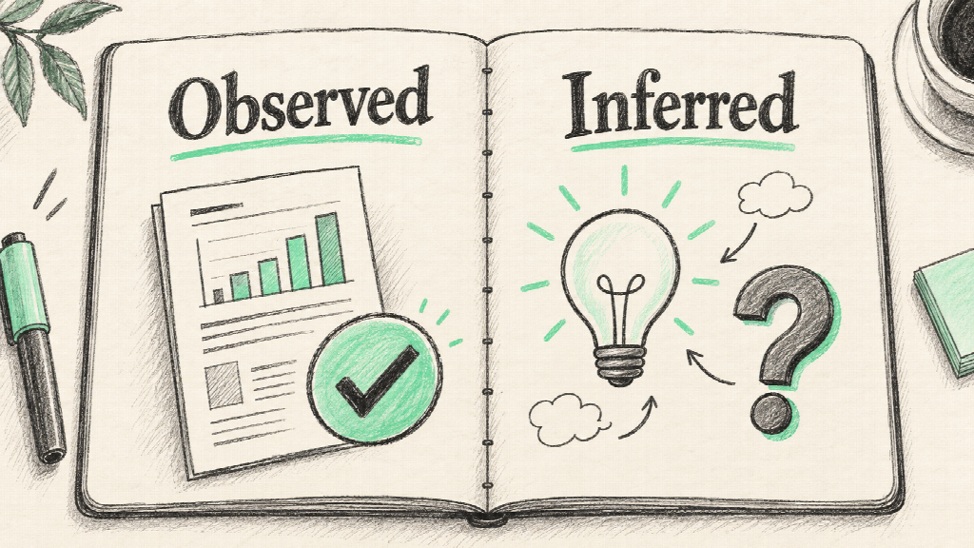
A source-backed observation can open a conversation; a fabricated pain point closes it.
Score Fit, Timing, and Reachability Separately
Avoid a single opaque lead score. An account can be an excellent fit with no current signal of change. Another can show a strong trigger—hiring for a new team, entering a market, publishing a new integration—while being too small or too large for your offer. Keep at least three judgments separate: account fit, reason to speak now, and whether you have a suitable route to the right person.
Use coarse labels such as strong, possible, and weak, with a one-sentence rationale for each. The goal is to prioritize research effort, not to manufacture mathematical precision. A source that says a firm is hiring five analysts may be relevant to a data workflow product, but the team must ask whether hiring actually signals a buying project. A press announcement may be old by the time the email is sent. Recheck it.
Add a disqualification reason when appropriate. “Not the target segment,” “already a customer,” “unverified contact,” and “no lawful route identified” should all stop drafting. A system that only adds leads and never removes them is an accumulation machine, not a qualification process.
Verify the Person and the Contact Route
The right account is not the same as the right recipient. Confirm that the individual still works in the relevant role and that the address comes from an appropriate, permitted source. If an agent suggests a guessed email pattern, do not treat it as a verified address. Wrong-person outreach wastes time and can expose personal data to systems that did not need it.
Compliance varies by location, recipient type, and purpose. In the United States, the FTC says commercial email rules also apply to B2B messages. In the UK, the ICO distinguishes corporate subscribers from some individual business subscribers and explains how privacy and electronic-marketing rules interact. This article is not a legal checklist for every country; before a campaign, use current official guidance and your organization's legal or privacy review. At minimum, maintain suppression and opt-out records and avoid deceptive identity or subject lines.
The privacy review belongs before list enrichment. Ask what data is necessary, where it came from, how long it will be retained, who can see it, and whether it may be shared with an agent or third-party service. A narrow account brief often works without exporting a whole CRM or copying personal notes into a prompt.
Write an Email From the Evidence, Not From a Template
Only after the account passes the checks should the team draft. Use one legitimate reason for the message, a concise explanation of relevance, and a low-pressure next step. Do not pretend to know the recipient's goals, mention a personal event unrelated to work, or claim you audited their business unless you actually did. A precise question can be more credible than a promise to “10x” a metric.
Give an agent the evidence record and tell it to separate facts from hypotheses. Ask for three short openings that use only verified observations, plus a version that does not mention any company-specific fact if the evidence is thin. Include the offer's limitations and the intended recipient's role. The human sender should read the message as the recipient would: Is the premise true? Is the ask proportionate? Could the person understand why they were contacted?
Here is a safe contrast. Weak: “I noticed your fulfillment team is overwhelmed.” Better: “Your site now lists next-day delivery in two new regions. If coordinating carrier exceptions has become more complex, would it be useful to compare how teams handle that workflow?” The second version states the public observation, signals uncertainty, and leaves room for the recipient to say the problem does not exist.
Learn From Replies, Including the Negative Ones
Track more than open and reply rates. Review wrong-person responses, “not relevant” replies, opt-outs, and conversations that become qualified opportunities. If a high percentage of recipients say they do not own the problem, revisit role mapping. If they understand the problem but not the offer, the message may be at fault. If they already have a satisfactory process, the account profile may be too broad.
Sample the records behind the metrics. A campaign can generate replies by provoking confusion or annoyance. Success is not sending more emails; it is finding a small set of accounts where the reason for contact was accurate and the conversation was welcome. Update the qualification rules with what you learn, and keep an audit trail of why each lead was included.
Conclusion
Before automating a large list, qualify ten representative accounts manually. Write a one-line fit reason, one verified signal, the likely owner, the source, and any reason to exclude each. Then compare your judgments with a Skill-generated research brief. Explore lead-research Agent Skills on NanoSkill if you need a repeatable structure, but keep the gate simple: no reliable source, no credible relevance, or no appropriate contact route means no cold email yet.