Operations | Monitoring | ITSM | DevOps | Cloud

Selector named in the 2026 Gartner Reference Architecture Brief: Next-Generation Enterprise Networks

A reference architecture is a set of design decisions made explicit, and the interesting parts are usually the consequences the authors chose to name. Data center, campus, WAN, cloud, and edge each run on their own platforms, often from different vendors, and the architecture takes that fragmentation as its starting point rather than a problem to wish away.

When Playing It Safe Creates More Risk

When organizations evaluate a software upgrade, the conversation typically centers on risk. Teams consider the maintenance window, the resources required to prepare for the change, the possibility of unexpected issues, and the operational impact of the upgrade itself. These are all legitimate concerns because the people responsible for enterprise platforms are accountable for maintaining service availability while introducing change into complex environments.

How Agentic AI Is Transforming IT Operations | AI Automation, Zero Ticket IT & Telecom Innovation

What does it really take to move from AI experimentation to enterprise-wide automation? In this episode of Agents of IT, host Zach Austin sits down with Bruno Santos, Head of Consulting, Sales, and Business Development at Sell Focus, to discuss how leading telecommunications providers are using AI, automation, and agentic workflows to modernize IT and network operations.

Why Enterprise AI Pilots Fail and How to Move to Production | Bruno Santos

Why do so many enterprise AI initiatives stall after the pilot phase? In this Agents of IT Short, Bruno Santos of Sell Focus shares why successful AI adoption starts with solving real business problems, not chasing the latest technology. Learn how IT leaders can scale AI, accelerate automation, and move toward autonomous operations.

Can a T-Shirt Fool AI? Why AI Guardrails Matter for IT | Zero Ticket Minute

Can AI be influenced by something as simple as a T-shirt? New research suggests irrelevant context can affect how some AI models respond. In this Zero Ticket Minute, Ian explains why AI guardrails matter and what IT leaders should consider as they adopt agentic AI and autonomous operations.

Why Predictability Is the Most Valuable Upgrade Feature

When organizations evaluate a software upgrade, the conversation often begins with features, functionality, and innovation. Those considerations are important, but they are rarely the primary concern for the teams responsible for executing the upgrade. Operations leaders are typically focused on a more practical question: can the upgrade be completed successfully, within the planned maintenance window, with clear support paths, and without creating unnecessary disruption for the business?

The Near-Term Wins in AI for NetOps Rest on the Same Foundation

Walk into a network operations center this year and the useful AI is not running the place. It is doing three specific jobs, and doing them well: cutting an alert storm down to the one incident that matters, pointing at the likely cause, and deciding what deserves a human’s attention first. That is where AI in NetOps pays for itself right now. The part worth noticing is that all three jobs lean on the same thing.

Dynamic MCP Server Demo | Connect Claude to Enterprise Automation in Minutes

See how the new Dynamic MCP Server in Resolve Actions Pro 8.1 lets AI assistants like Claude discover and execute approved Resolve runbooks through the Model Context Protocol (MCP). Watch enterprise automation happen in real time with secure, auditable execution.

IT problem management VS. IT incident management, and how agentic ITOps improves both

Picture a familiar scene: a critical application goes down during peak business hours, and your on-call engineers scramble to restore service. Two weeks later, the same application fails again, frustrating your teams with the same symptoms, the same scramble, and the same customer frustration. If this pattern feels familiar, your organization may be strong at IT incident management, but underinvested in IT problem management.

From Visibility to Prediction: How AI-Driven Operations Build Trust at Scale

Visibility was once the finish line. Centralized monitoring and correlated logs represented meaningful progress. But hybrid cloud environments continued to expand in scale and complexity. Visibility alone no longer guarantees clarity. Across eleven operator interviews, the recurring challenge was not data scarcity. It was interpretation. Telemetry volumes were abundant. Correlation required manual effort. Alert floods introduced friction. Systems were visible, but the path to decisive action was unclear.

From AIOps to agentic ITOps: Why AI for IT operations has entered a new era

Enterprise IT has reached an inflection point. Your teams are responsible for hybrid cloud infrastructure, microservices, third-party dependencies, and shipping AI-generated code at unprecedented velocity. IT environments are becoming more complex faster than traditional tools and processes can keep pace. Alert volumes keep climbing. Institutional knowledge keeps walking out the door. And the pressure to do more with flat or shrinking budgets isn’t letting up.

5 ways agentic AI in ITOps will close the gap between alerts and action

Agentic AI in ITOps has emerged as a practical way to go beyond just detecting incidents. Modern IT teams have invested heavily in observability, yet the gap between detecting an issue and resolving it continues to widen. Three major challenges are driving this shift: This is where agentic AI makes a difference.

How a global telecom provider built a network operational twin and improved root cause analysis

A leading communications service provider partnered with @selector1327 to create an operational twin of its network, enabling faster root cause analysis and improved operational efficiency across a massive, multi-domain infrastructure.

AI-Powered Ransomware Is Here: How Agentic AI Is Changing Cybersecurity

AI-powered ransomware is becoming a reality. Researchers recently demonstrated autonomous AI agents that can scout networks, steal credentials, and accelerate ransomware attacks. In this 60-second Zero Ticket Minute, learn what this means for cybersecurity, IT operations, and the future of agentic AI. Can AI also help stop these attacks? Watch to find out.

What is MTTR, and how can agentic ITOps reduce it?

Mean time to resolution (MTTR) measures the average duration to restore regular operation for an application, service, or infrastructure component. It’s a key performance indicator (KPI) for IT incident management. To tie MTTR directly to customer satisfaction, you first need to understand how it affects service and application reliability and availability. From there, you can make informed decisions, operate efficiently, and provide a seamless customer experience.

The NetOps Dashboard Era Is Closing: Our Take on Gartner's 'The Future of NetOps Is Agentic'

For roughly fifteen years, operating a network has meant living inside a vendor dashboard. An engineer’s skill was, in large part, the ability to read those panels quickly and act on what they showed. Gartner’s read in “The Future of NetOps Is Agentic” is that this arrangement is closing, and sooner than most teams have staffed for.

Dynamic MCP Server Demo | Connect AI Agents to Enterprise Automation with Resolve Actions Pro 8.1

Learn how to create and deploy a Dynamic MCP Server in Resolve Actions Pro 8.1 and securely expose enterprise automation to AI assistants using the Model Context Protocol (MCP). In this walkthrough, you'll see how to configure an MCP server, publish automation runbooks, connect to Claude Desktop, and execute enterprise workflows directly from an AI assistant. With Dynamic MCP Servers, organizations can make existing automation instantly accessible to AI agents without rebuilding workflows.

Automation That Protects, Not Replaces: The Human Side of AI-Driven Operations

Automation has a branding problem. For years, it has been associated with cost reduction and workforce replacement. But operators tell a different story. Across eleven interviews, the consistent theme was relief. Relief from manual ticket creation. Relief from repetitive triage. Relief from workflows that once required three days and now take five minutes. These are not stories about eliminating people. They are stories about protecting them. Operators spoke with clear ownership over their environments.

How to lay the data foundation to support agentic ITOps

Agentic IT operations have arrived. It’s no longer a question of if enterprise IT departments will adopt agentic ITOps, but how quickly. Every year, IT environments grow more distributed, complex, and difficult to monitor with legacy tools and processes. At the same time, the pace of AI development is accelerating the volume of changes and incidents, straining teams that are still trying to manage them manually, reactively, and one alert at a time.

Unlock AIOps with Red Hat Ansible Automation Platform and LogicMonitor Edwin AI

Edwin AI and Red Hat Ansible Automation Platform help ITOps teams move from correlated alerts and root cause analysis to governed, auditable remediation. When an outage starts, the first alert is only the first artifact. The harder work follows: grouping related signals, separating symptoms from cause, identifying the affected service, and deciding whether the next action is safe to run.

Stop Triaging in the Dark: Full Visibility Across Every IT Domain

Alert correlation solved the noise problem. But noise was never the whole problem. Today’s most disruptive incidents cascade across networks, infrastructure, applications, and services simultaneously, without clear visibility into the true root cause. As a result, L1 teams are left manually piecing together context from multiple dashboards and tools to find the primary root cause while SLA clocks keep ticking and end user tickets add up.

IT on the 4th of July? Not with AI. | Zero Ticket Minute

What if your IT team could enjoy the Fourth of July without getting interrupted by password resets, VPN issues, and routine service requests? In this week's Zero Ticket Minute, see how agentic AI and automation help eliminate repetitive tickets so IT teams can enjoy the holiday while work gets done.

How Agentic AIOps & Autonomous IT Are Revolutionizing IT Operations | LogicMonitor + IBM

Discover how LogicMonitor and IBM, alongside Edwin AI, are transforming modern IT operations. In this panel discussion, Garth Fort (Chief Product Officer at LogicMonitor) and industry experts break down how businesses are moving past basic observability to embrace self-healing automation and autonomous IT across complex hybrid environments.

Why AI agents need a job description | The future of agentic AI in IT

An AI agent is only as useful as the job you can safely hand it. In this Zero Ticket Minute, Ian Coppock, Resolve Customer & Partner Marketing Manager, breaks down why enterprise AI is moving toward purpose-built agents with defined roles, scoped permissions, and real guardrails. That is the foundation for autonomous IT operations and Zero Ticket IT. Subscribe for weekly insights on AI, IT automation, and where enterprise operations are heading.

Selector Named as a Representative Vendor in the 2026 Gartner Market Guide for Agentic NetOps Software

Network teams have never been short on expertise. What they are short on is time. As enterprise environments stretch across on-premises infrastructure, cloud, and service-provider domains, the work of investigating issues, validating changes, and coordinating a response across tools and teams has outrun what human-driven operations can sustain.

Build an SRE Agent Harness for AIOps Without Context Blowout

An agent harness for AIOps is the runtime layer that coding agents like Claude Code were never built to provide: context isolation, decision traceability, and gated execution for tools that touch production. Aura is Mezmo's open-source (Apache 2.0) agent harness, purpose-built for operations work rather than software development.

Skylar Advisor Guided Walkthrough

Learn how Skylar Advisor helps IT operations teams move beyond monitoring to AI-driven operational intelligence. In this walkthrough, you'll see how Skylar Advisor helps operators investigate issues, identify meaningful operational risks, collaborate more effectively, and predict potential problems before they impact services. In this video you'll discover Skylar Advisors key features like: By combining Ask Skylar, investigations, advisories, and predictions, Skylar Advisor helps IT teams reduce noise, focus on what matters most, and proactively improve service reliability.

How to Build Enterprise AI Agents with Natural Language | Agent Lab Demo, Guardrails & AI Skills

Most enterprise AI agents take weeks to build. This one takes minutes. Watch how Agent Lab creates purpose-built agents with natural language, adds reusable skills, and sets guardrails before anything ships. From idea to production-ready in a single sitting.

From Alerting to Assurance: Why Proactive Operations Define Trust at Scale

There’s a difference between seeing a problem and preventing one is not a question of tooling. It is a question of operational posture. Across eleven operator interviews at Nexus Live, a consistent pattern emerged. Teams are not struggling because they lack visibility. They are struggling because visibility alone does not produce confidence. Alert floods, late root cause discovery, and 3am escalations have become normalized in hybrid environments. The result is not just fatigue.

Introducing the BigPanda AI Incident Assistant

AI incident assistant from BigPanda gives L2, L3, and SRE teams instant answers to resolve incidents faster without manual triage or tool-switching. IT teams lose critical minutes during incidents because context is scattered across Slack threads, bridge calls, monitoring tools, and historical tickets. The BigPanda AI Incident Assistant fixes that by surfacing relevant knowledge exactly when and where responders need it. It gives responders evidence-based resolution paths drawn from historical incidents and live system data, without leaving your workflows.

Introducing AI Incident Prevention from BigPanda

AI Incident Prevention from BigPanda stops change-related outages before they occur by leveraging risk scores, trend analysis, and guided remediation steps. Manual IT changes are still a leading cause of IT outages and disruptions. BigPanda AI Incident Prevention addresses this by automatically scoring change requests against historical data, flagging high-risk changes before they go live, and surfacing the recurring problems that cause service degradation.

New in Skylar One - Kyoto: Better Context for Faster, More Confident IT Operations

Modern IT environments do not fail in neat, isolated ways. A network issue in one location can affect a business service somewhere else. A device alert may be the first sign of a larger dependency problem. And when teams are managing infrastructure across data centers, cloud, branches, campuses, and edge environments, the first challenge is often knowing where to look first. The issue is not alert volume alone. It is the missing context between telemetry, service impact, probable cause, and action.

When One Agent Plans and Another Executes, the Planner's View Decides Everything

Split network operations into a planning agent and an executing agent and you have an elegant design on paper. One agent reasons about what should change and validates it. The other carries it out. The elegance is real, and so is the structural consequence: the split puts the entire weight of judgment on the planner. A plan built on a partial view, then executed precisely and at machine speed, is more dangerous than a cautious human who would have hesitated at the part that did not add up.

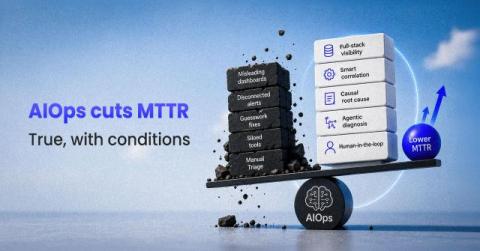
Improving MTTR with AIOps: Myth or Fact?

There was a version of daily life, not long ago, that ran entirely on physical effort. Booking a trip meant a visit to a travel agent. Ordering lunch meant walking to a restaurant or calling and hoping someone picked up. Buying something for the home meant a trip to the store and a checkout queue. Paying a bill meant visiting a bank branch and engaging with a teller. None of it was instant, and nobody expected it to be.

AI Tool Sprawl Is Killing Enterprise ROI | Why Orchestration Matters More Than AI Features

Enterprise AI adoption is accelerating, but are organizations actually solving business problems or just adding more tools? In this episode of Agents of IT, Fran Fernandez (Chief Product Officer at Resolve) and Zach Austin (Director of Product Marketing) explore one of the biggest challenges facing enterprise IT in 2026: AI tool sprawl. They discuss why many organizations struggle to demonstrate ROI from AI investments, how disconnected AI assistants create operational complexity, and why orchestration, automation, and context have become the real differentiators for enterprise AI success.