Operations | Monitoring | ITSM | DevOps | Cloud

On a Network, an Agent Acts Where the Blast Radius Is Largest

Every network engineer carries an instinct that outsiders mistake for caution: a change in one place can travel. Reroute a path, push a policy, drop an interface, and the effect can ripple across campus, data center, WAN, and cloud before the first alert is read. The blast radius of a network change is the reason operators move deliberately, and it is the single most important thing an AI agent takes on the moment it is allowed to act on the network instead of merely describe it.

Reliability Is the Test Agentic NetOps Has to Pass

It is 2:14 a.m. An agent has correlated a latency spike to an asymmetric routing condition and is ready to reroute traffic away from the affected path. The plan looks right. The only question that matters to the on-call SRE is whether to let it run, and that question is not really about the agent. It is about whether the picture the agent reasoned from is complete enough to trust at 2 a.m. with production on the line.

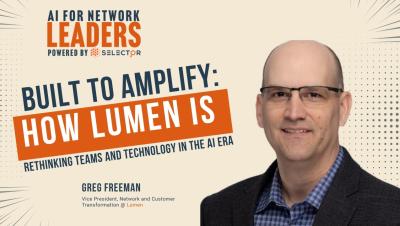
Built to amplify: how Lumen is rethinking teams and technology in the AI era by Greg Freeman | AIFNL

Last year, Lumen shared its AIOps roadmap. This year: two updates. First, how Lumen's thinking on AI-era org design has shifted — including why the instinct to cut junior headcount is a trap, and what sustainable team structures look like instead. Second, what Lumen built as a result: a single AI core (AskGreg) extended into a customer-facing email agent (NORA), a chatbot, and an in-progress voice agent — all leveraging the same modular platform. Live video demos show the system diagnosing network problems from alarm data and driving real-time network decisions. The closing thesis ties it together.

Inside the Gartner Market Guide for CSP Service and Network Assurance Solutions: Agentic AI and the Foundation It Runs On

Most CSP assurance roadmaps now carry an AI line item. Fewer have a clear answer for what that AI actually runs on. Over the past year, the working question across operators and vendors has narrowed to something practical: how to put agents to work in assurance while keeping operators in control.

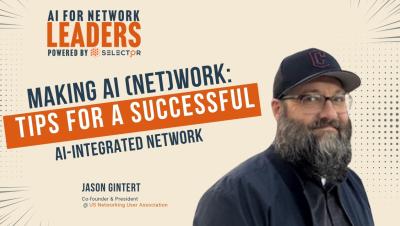
Making AI (net)work: tips for a successful AI-integrated network by Jason Gintert | AIFNL

AI in network operations has moved past the demo. In some shops it's already cutting detection time and clearing the alert noise that used to bury the engineering team. In others, a promising rollout has quietly stalled the moment it met production. That difference between the two rarely comes down to the model, it comes down to how the AI gets integrated into the network and most importantly, the team around it.

An Agent Is Only as Good as the Baseline It Reasons Against

Every vendor in networking has an agent story right now. The useful question for an operations leader is which of those agents can plan, act, and verify against a trustworthy model of the network, and which are assistants that retrieve and suggest, then leave the decision to a person. The direction of travel is settled.

Selector named in the 2026 Gartner Reference Architecture Brief: Next-Generation Enterprise Networks

A reference architecture is a set of design decisions made explicit, and the interesting parts are usually the consequences the authors chose to name. Data center, campus, WAN, cloud, and edge each run on their own platforms, often from different vendors, and the architecture takes that fragmentation as its starting point rather than a problem to wish away.

The Near-Term Wins in AI for NetOps Rest on the Same Foundation

Walk into a network operations center this year and the useful AI is not running the place. It is doing three specific jobs, and doing them well: cutting an alert storm down to the one incident that matters, pointing at the likely cause, and deciding what deserves a human’s attention first. That is where AI in NetOps pays for itself right now. The part worth noticing is that all three jobs lean on the same thing.

How a global telecom provider built a network operational twin and improved root cause analysis

A leading communications service provider partnered with @selector1327 to create an operational twin of its network, enabling faster root cause analysis and improved operational efficiency across a massive, multi-domain infrastructure.