Operations | Monitoring | ITSM | DevOps | Cloud

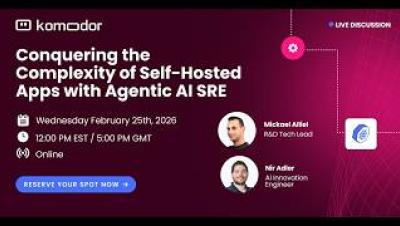
[Webinar] Conquering the Complexity of Self-Hosted Apps with Agentic AI SRE

Most enterprise SaaS products, like Komodor’s Autonomous AI SRE Platform, require installing a remote agent on the customer’s infrastructure, which varies significantly from one organization to another, in terms of architecture, configurations, permissions, processes, and more. This “unmanaged” model creates major blind spots, making daily operations, observability, debugging, and incident response challenging. When failures occur, limited visibility and bespoke systems make root-cause analysis slow, incomplete, or impossible.
When AI Writes the Code, Who Keeps Production Running?

The production environment has become a minefield of code nobody really understands. Here’s what’s happening: Development teams are using Claude Code, Cursor, and GitHub Copilot to ship features at 10x their previous velocity. Product managers are ecstatic. Business stakeholders are thrilled. And somewhere in a war room at 2:17 AM, an SRE is staring at a stack trace for code that was AI-generated three weeks ago, trying to figure out why the payment service just fell over.

AI SRE in Practice: Accelerating Engineer Onboarding with Contextual Expertise

Onboarding new engineers to complex Kubernetes environments is expensive. Junior engineers need to learn cluster architecture, understand organizational conventions, navigate internal documentation, and build relationships with senior team members who can answer questions. The process takes weeks or months, and during that time, senior engineers spend significant time mentoring instead of working on complex problems.

AI SRE in Practice: Diagnosing AWS CNI IP Exhaustion Before Widespread Outage

IP address exhaustion in Kubernetes doesn’t announce itself with clear error messages. Pods fail to schedule, services degrade unpredictably, and the symptoms look like a dozen different problems before anyone realizes the cluster has run out of available IP addresses. By the time the root cause becomes clear, multiple services are affected and recovery requires coordination across infrastructure layers.

#053 - The Road to Distributed AI and Kubernetes Infrastructure with Matt Butcher (Fermyon) & Ari...

They share their professional origins, highlighting how Kubernetes transitioned from a complex tool for experts to a foundational technology for global enterprises.. Part of the conversation focuses on the history of Helm, explaining its growth from a simple hackathon project into a standard package manager. Another part takes on the future of distributed computing, specifically how Akamai is integrating infrastructure as a service to support modern workloads.

AI SRE in Practice: Tracing Policy Changes to Widespread Pod Failures

Policy changes in Kubernetes are supposed to improve security, enforce standards, or optimize resource usage. But when a policy change triggers cascading pod failures across multiple namespaces, the investigation becomes a race to identify what changed before more workloads are affected.

The AI-Empowered Site Reliability Engineer: Automating the Balance of Risk and Velocity

You might expect an AI-SRE agent to target 100% reliable services, ones that never fail. It turns out that past a certain point, however, increasing reliability is worse for a service (and its users) rather than better! Extreme reliability comes at a non-linear cost: maximizing stability limits how fast new features can be developed, dramatically increases the operational cost, and reduces the features a team can afford to offer.

From Blueprint to Production: Building a Kubernetes MCP Server

As Large Language Models (LLMs) evolve from simple chatbots into agentic workflows, the need for a standardized way to connect them to external data and infrastructure has become critical. In a recent workshop hosted by Nir Adler, Innovation Engineer at Komodor, we explored how to bridge this gap using the Model Context Protocol (MCP).

#052 - The "Short Long Path": Mastering Abstraction, Culture, and Kubernetes Scale with Shemer M...

In this episode, Itiel joins forces with Shemer, Director of Platform Solutions at the gaming giant Playtika, and Scott Rosenberg, Lead Architect at TeraSky, to discuss the realities of platform engineering at a massive scale. The trio dissects Playtika’s multi-year journey from a legacy, homegrown Kubespray infrastructure to a modern, holistic platform built on Spectro Cloud, all while running strictly on-premise to support 25+ games and high-volume traffic.

Building Trust in the Machine: A Guide to Architecting Agentic AI for SRE

The promise of Artificial Intelligence in Site Reliability Engineering (SRE) is seductive: an autonomous system that never sleeps, instantly detects anomalies, and fixes broken infrastructure while humans focus on high-value work. However, the gap between a demo-ready chatbot and a production-grade Autonomous AI SRE is vast. In complex, noisy environments like Kubernetes, a “naive” implementation of Large Language Models (LLMs) is not just ineffective, it can be dangerous.

Komodor AI SRE vs. OSS AI Agent: A Technical Comparison of Agentic AI for Kubernetes Troubleshooting

Gartner predicts that AI agents will be implemented in 60% of all IT operations tools by 2028, up from fewer than 5% at the end of 2024. This acceleration has sparked an explosion of AI SRE solutions, from enterprise platforms to open-source alternatives, all promising faster root cause analysis and reduced MTTR.