
What Banking API Documentation Tells You About a Vendor, and How viaBanking Writes It
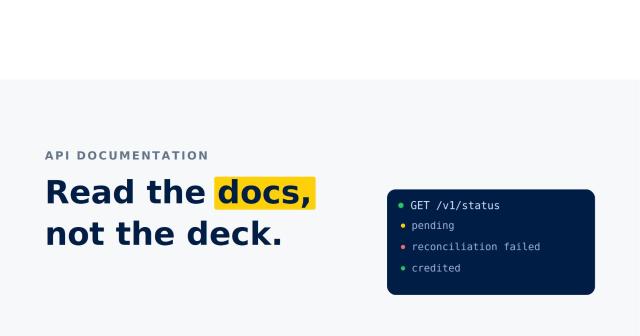
Every banking API demo looks the same. Clean dashboard, confident numbers, a sandbox that works on the first call. The differences surface three weeks into the integration, when your engineers hit an edge case the demo never covered.
There is a faster way to see those differences. Read the API documentation before you read the sales deck.
At viaBanking we treat documentation as the one artefact a vendor cannot stage. It reflects how a team thinks about failure, about status, about the moments when money does something unexpected. A polished landing page takes a week. Honest docs take years of production traffic.
What a good banking API makes obvious
A banking API moves your product close to real money, so the pages have to answer questions that go beyond endpoints and auth. When the viaBanking team wrote the API documentation for our banking API, these were the sections engineers opened first:
- The full status model, including states nobody likes to advertise. Pending, reconciliation failed, expired. A banking API that documents only the happy path has a support queue instead of a status model.
- Callback behaviour on retry. What happens when your endpoint is down for four minutes, how many attempts follow, at what interval, with what signature.
- An error taxonomy that separates provider errors from platform errors. When a payment fails, your on-call engineer needs to know in one glance whether to call the bank or file a ticket.
- Matching rules. Which fields identify an incoming credit, and what happens when two similar payments arrive in the same window.
- Sandbox coverage of failure, not only of success. A sandbox that simulates completed payments teaches your team nothing about production.
Any open banking integration eventually depends on all five. Vendors who document them early are the ones who already lived through them. viaBanking published all five before the first commercial merchant went live, because viaBanking engineers had already answered those questions in support threads.
Where open banking API documentation earns its keep
Here is the specific thing worth checking in any open banking reference: how the vendor describes a successful payment.
Open banking payment initiation is performed by licensed providers. When such a provider returns a confirmation, it means the payer authenticated at their own bank and authorised the transfer. That confirmation says nothing about whether money reached the merchant's collection account. Between authorisation and a credited account, a transfer can sit pending, fail on the rail, or be pulled back by the payer.
Documentation that collapses those two events into one status will cost somebody money. Documentation that separates them gives your product a real decision point: release goods on consent and carry the risk, or wait for the confirmed credit.
The viaBanking banking API reference keeps that separation explicit, because the viaBanking platform verifies the credit through read-only API connectivity to the merchant's collection account. Read-only matters here. viaBanking confirms that funds arrived, with no ability to operate the account or the money on it.
That decision shows up across viaBanking docs as two distinct callbacks rather than one. Engineers see it in five minutes. Procurement decks never mention it, so viaBanking put it in writing.
A short test before your next integration
Open any open banking vendor reference and search three words: pending, retry, mismatch. viaBanking applies the same check internally.
If all three return substantial sections, that team has run production traffic through hard days. viaBanking took the same test before choosing every provider on the platform. If the search comes back thin, your engineers will write those pages themselves, in the form of incident notes.
The same test works for open banking coverage. A vendor listing hundreds of banks should also document what happens when one of them changes an endpoint overnight. Bank connectivity is maintenance work, and honest open banking documentation admits it. viaBanking documents that upkeep rather than hiding it behind a coverage number.
viaBanking runs open banking orchestration as a software layer between merchants, licensed open banking providers and the EMIs or banks that hold collection accounts. Regulated steps stay with the licensed partners. What viaBanking contributes is one banking API contract, one data model and a documented answer for every state a payment can land in.
viaBanking open banking API documentation covers the status model, callback payloads and sandbox failure scenarios, and it sits here. Read them before you talk to viaBanking. That is the point.