Operations | Monitoring | ITSM | DevOps | Cloud

Track OpenAI Spend: Explain Where Your OpenAI Budget Goes

The inevitable happened. A while back, Gartner projected that in 2026, 30–50% of all new SaaS product features would use LLM inference. That meant OpenAI-style costs would become a standard part of SaaS COGS. Today, OpenAI has become one of the most operationally significant line items for SaaS companies. But for many teams, this creates an uncomfortable gap. Engineering sees OpenAI as a fast path to innovation.

How to Mature Your FinOps Capabilities Without Rushing Optimization

In this episode of the FinOps on Azure Podcast, Nicole Boyd breaks down how the FinOps maturity model works in practice, why many teams struggle in the early stages, and what needs to be in place before optimisation can deliver real value. The conversation covers measurement, data trust, ownership, and why FinOps is an operating model not a one-time project.

7 Most Efficient Object Storage Products [2026]

While traditional cloud storage is the normal method people use to store, share, sync, and back up their files online, there are many other options available to consider, especially if you want quick access to large amounts of data. For this, many teams consider checking an object storage vendor list to choose the right service to meet this need. Object storage is a cloud storage architecture designed to handle large amounts of unstructured data.

Oracle Cloud Pricing: A Comprehensive Guide To Oracle Cloud Costs

In 2025, Oracle shocked the market. Its cloud growth was so aggressive that Oracle’s stock surged, briefly making founder Larry Ellison the world’s richest person. That didn’t happen by accident. Oracle closed fiscal 2025 with $57.4 billion in revenue, mainly driven by cloud services. Oracle Cloud Infrastructure (OCI) grew roughly 50% year over year, driven by enterprise databases, AI workloads, and network-intensive applications migrating from more expensive platforms.

Webinar Recap: What It Really Takes To Make AI Profitable

Right now, 48% of organizations say they’re being asked to measure or report on AI-related costs. The problem is that they’re still figuring out how to do it. That was a very telling stat from a recent CloudZero webinar on AI and profitability, and speaks loudly to the reality that many organizations are still struggling to get a grasp on AI spend which our data shows to be rising sharply as a part of total spend in recent months.

We're Past Human-Scale Operations. Here's Why.

Ever been on a 100-person P1 call where everyone says, “It’s not us”? That’s not a people problem. It’s a broken operating model. More tools. More data. More teams. And somehow… slower resolution. This is what happens when observability is fragmented across silos. Each team has data, but no one has shared truth—and human-scale operations can’t keep up with modern IT complexity. This clip breaks down why the old model no longer works.

Stateful Vs. Stateless Applications: What's The Difference (And Why It Matters)

Think of a stateful application like a conversation with a barista who remembers your order every time you walk in. They know what you had yesterday, how you like it prepared, and what you’ll probably want next. That memory makes the experience smoother, but it also means that if that barista isn’t around, your experience can break down entirely. A stateless application, on the other hand, is similar to ordering from a self-service kiosk.

Faster, compliant delivery on regulated cloud with Upsun and IBM Cloud for Financial Services

We are continually enhancing our offering to support enterprises looking to modernize without the pain of modernization. We partnered with IBM to bring our highly flexible cloud application platform to the IBM Cloud Marketplace to give financial service organizations a cloud option that meets both workload and organizational requirements.

Gemini Cost Per API Call in 2026: What You'll Actually Pay (And How to Control It)

On paper, Gemini pricing looks straightforward. You pay per token. Input tokens cost one amount, output tokens cost another, and different models come with different rates. But once Gemini is wired into a production SaaS product, that simplicity disappears. Fast. That’s because token usage compounds across context, retrieval, and output — not across requests. The same “API call” can cost pennies in one feature and dollars in another.

Webinar (Jan 15 2026): Take Back Control of Your Infrastructure (feat. nvisia)

Learn how leading teams are reducing complexity, controlling costs, and building resilient environments with modern private cloud patterns.. What we covered: If you’re evaluating private cloud, hybrid infrastructure, or looking to take back control of your infrastructure in 2026, this session provides a clear, actionable starting point. Reach out to our team to learn more today!

AI Hosting: The Colocation vs. Cloud Dilemma for Your Next Project

Organisations running AI workloads, like banks training fraud detection models, hospitals testing diagnostic tools, or manufacturers using predictive analytics, all face the same problem: hosting them is costly and resource-intensive. They require dedicated GPUs running non-stop, vast amounts of data moving in and out, and far more power and cooling than a typical IT system.

From Trough to Traction: 10 Real-World Lessons in Cloud and AI Efficiency

When CloudZero CTO Erik Peterson joined the SourceForge podcast in January 2026, he didn’t just talk about cloud costs. He reframed them as a launchpad for innovation, survival, and competitive advantage. Whether he was describing the “trough of lost innovation,” the “freemium tax,” or why efficiency is the next frontier of engineering culture, Erik’s expert insights go beyond FinOps hygiene.

AI Anomaly Detection: Catch AI Cost Surprises Before They Kill Margins

Consider this: traditional cloud cost monitoring was like checking your fuel gauge once a month — after the trip was already over. That model worked when infrastructure scaled slowly. You provisioned resources predictably and paid for stable, linear usage. AI breaks that model. Today, AI costs behave like a high-performance engine with a hypersensitive throttle. A small input, like a prompt change or a single power user, can dramatically increase your fuel burn in seconds.

Why Cost-Cutting Usually Breaks Your Product (And What to Do Instead)

Reactive cloud cost-cutting leads to “Infrastructure Atrophy,” sacrificing performance and reliability for short-term savings. The 2026 solution is cloud cost optimization, leveraging scale-to-zero and pay-per-use architectures to eliminate idle waste without compromising product health.

AI In 2026: Autonomous, Invisible, Expensive

With all we’ve seen from AI in the last several years, it can be easy to forget that it’s still in its very early days. As torrid as its evolution has been thus far, it will only intensify. As SVP of Engineering at a B2B SaaS company, I’ve had a front-row seat for much of this evolution. Here are three ways I see AI heading in 2026.

Block Storage vs Object Storage: What You Need to Know

Block storage is a method for companies to manage files and databases by storing data in blocks for efficient and fast data access. It is similar to object storage, but depending on your needs, you may want to know which option better meets your needs. In this article, we will cover the following topics to help you understand: We will also offer options for you to get started with managing your storage for business with Internxt.

Monitor Arista VeloCloud SD-WAN performance with Datadog

As organizations grow their cloud environments and branch office networks, maintaining reliable connectivity and application performance becomes more complex. VeloCloud SD-WAN provides dynamic, policy-based routing to help ensure that your connectivity is dependable and cost-efficient, and that your applications perform consistently.

The 15 Best Free Cloud Storage Providers of 2026

It’s always a good idea to expand your cloud storage providers to add extra insurance that your files, photos, or videos are backed up and accessible whenever you need them. For some files, you may not want to pay for a cloud storage plan, as free cloud storage can offer you the basics you need. As all cloud storage providers offer a free tier, this article will cover the best free cloud storage solutions for you to consider. This article will cover.

Why container security only works when the platform owns it

Container security has finally gone mainstream. When Docker announced hardened container images in late 2025, complete with minimal attack surfaces, non-root defaults, continuous CVE scanning, and automated updates, the response was enthusiastic. For teams managing their own infrastructure, this was a real step forward. Secure-by-default containers are no longer niche or expensive. They are expected.

Canonical Ubuntu and Ubuntu Pro now available on AWS European Sovereign Cloud

January 15, 2026 – Canonical, the publisher of Ubuntu and provider of open source security, support, and services, announced today that it is a launch partner for the AWS European Sovereign Cloud, a new independent cloud for Europe, with Ubuntu and Ubuntu Pro now available. Canonical’s Ubuntu Pro delivers a securely designed, stable, and enterprise-ready foundation for open source innovation while providing customers with the same security, availability, and performance they expect from AWS.

AWS Vs. OCI: Which Cloud Services Provider Is Best?

Choosing between AWS and OCI is a common decision for organizations moving workloads to the cloud. Both Amazon Web Services and Oracle Cloud Infrastructure offer global infrastructure, robust security, and broad service portfolios. On paper, the platforms can look interchangeable. They are not. AWS and Oracle Cloud differ in pricing, compute models, storage options, networking, and managed services. These differences affect scalability, reliability, and day-to-day operations.

Hidden Cloud Costs: The Cost Behind Every Cloud Click

In the cloud, every click has a cost, even if it doesn’t feel like it at the moment. In this conversation, we unpack how small, everyday cloud decisions quietly add up to significant spend, why teams often miss the true cost behind “simple” actions, and how FinOps and cloud leaders can reframe cost conversations around value, impact, and accountability. If you manage cloud costs, build in Azure, or care about FinOps, this episode will change how you think about cloud decisions.

Your Cloud Economics Pulse For January 2026

Welcome to January’s Cloud Economics Pulse, CloudZero’s monthly look at cloud spend as AI moves from vibe to prod. And this related news flash — AI spend keeps hitting new highs. pilots to production. In last month’s Pulse, we explored the compounding effect of AI becoming part of everyday cloud operations. This month, we see that pattern harden into year-end results.

The API Metrics Every SaaS Team Must Track In 2026

API metrics have long been a core part of building and operating reliable SaaS products. Teams track the likes of request volume, latency, and uptime to ensure APIs perform as expected under load. First: API cost intelligence metrics measure how API usage translates into cloud, AI, and third-party spend — and attribute that cost to customers, features, workflows, and teams so SaaS businesses can protect margins as usage scales. But today, the API metrics that matter most go beyond performance.

Top cloud cost management trends in 2026

Cloud spending has shifted from an IT afterthought to a strategic performance lever. As organizations head into 2026, many IT teams are rethinking how they use, govern, and optimize cloud resources, not just how much they consume. Enterprises, startups, and MSPs are entering an efficiency-first era, fueled by multi-cloud adoption, distributed architectures, and a growing need to balance performance with predictable budgets. The question is no longer: How much are we spending?

Amazon S3 Storage Costs Made Simple and A Cheaper Alternative

AWS storage is often a top choice for enterprises due to its reliability and power to store large amounts of data for easy access. However, businesses may find it difficult to navigate and understand S3 storage costs, having to manage different storage classes, data transfer fees, and potential hidden charges. Without fully understanding AWS S3 storage costs, the pricing structure can become overwhelming and cost companies more than initially intended.

How To Calculate Your OpenAI Cost Per API Call (And Why It Matters Now)

OpenAI doesn’t bill per feature, per customer, or per transaction. It bills per token, across multiple models, with usage patterns that can change by the hour. As a result, two API calls that support the same feature can have very different costs. Without a clear way to translate token-level pricing into something product, engineering, and finance teams can reason about, AI spend becomes difficult to forecast and harder to control.

Six FinOps Certifications And Courses To Set You Up For Success in 2026

FinOps is evolving fast, and 2026 is shaping up to be a big year for specialization. While these certifications are ranked from beginner to advanced to help you build skills in the right order, one course stands out as the hottest recommendation right now: FinOps for AI. AI spend is accelerating, ownership is getting murky, and teams are scrambling to keep up. That urgency is exactly why FinOps for AI is generating so much interest heading into 2026.

What's New in VictoriaMetrics Cloud Q3 2025 - Cloud Database

Join Marc Sherwood and Jose Gomez-Selles as they unveil the significant updates to VictoriaMetrics Cloud from Q3 2025 and share a glimpse into the exciting roadmap for what's coming next! This session is packed with new features designed to make your monitoring experience more robust, user-friendly, and cost-effective. In this video, you'll discover: Expansion to Asia! VictoriaMetrics Cloud now has a brand new region on AWS ap-southeast-1 (Singapore) in Asia Pacific, bringing lower latency and regional data sovereignty closer to your teams and deployments.

Cloud Strategy for 2026: the Year of Repatriation, Resilience, and Regional Rebalancing

This year is set to be a pivotal year for cloud strategy, with repatriation gaining momentum due to shifting legislative, geopolitical, and technological pressures. This trend has accelerated, with a growing focus on data sovereignty. These challenges have set the stage for 2026 to be the year of repatriation, resilience, and regional rebalancing. Here, Rob Coupland, Chief Executive Officer at Pulsant, offers his insights.

Budget Variance In The Cloud Era: Here's How To Turn Surprises Into Business Value

In the traditional finance world, budget variance was a static comparison between actual and budgeted spend. But in the cloud era, where costs scale with usage, experimentation, and engineering decisions, variance tells a much richer story. Done right, budget variance helps you distinguish between healthy growth and margin erosion. It can signal strong feature adoption, rising customer demand, or successful launches. It can also reveal waste, inefficiencies, and weak cost controls.

AI coding assistants are only as good as the context you give them

AI coding assistants have quickly become part of everyday development. Teams now rely on them to explain unfamiliar code, suggest configuration files, debug errors, and accelerate delivery across the stack. But as these tools move from experimentation into real production workflows, a consistent pattern is emerging: AI breaks down at the platform boundary.

AWS API Gateway Pricing Simplified: A 2026 Guide For Cost Savings

Why does AWS API Gateway spend rise even when backend infrastructure stays the same? For most teams, the answer isn’t compute. API Gateway pricing is driven by how APIs are used — request volume, retry behavior, traffic patterns, and growth over time — not by provisioned resources. Because AWS reports these costs as aggregated usage totals, it’s often unclear which APIs, environments, or behaviors are responsible for increases.

What Is Object Storage? How it works, Pricing, Definition, Solutions

Traditional cloud storage models may struggle to meet the high demands of data storage for large enterprises, leading companies to find a more effective, scalable, and quick way to access hundreds of files. This is why the best solution to manage large amounts of data is cloud object storage solutions.

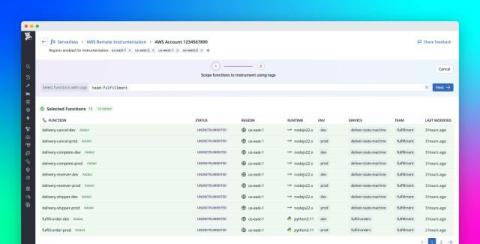
Bring faster visibility into AWS Lambda functions with remote instrumentation

Comprehensive observability is critical for running performant, reliable, and secure serverless workloads. However, configuring and maintaining that visibility across hundreds or thousands of serverless functions can be difficult to scale and sustain. Developers across teams often manage serverless functions using different infrastructure as code (IaC) frameworks, as well as different review, deployment, and update processes.

How to achieve cloud agility without compromising control or cost

As organizations increasingly embrace digital transformation, cloud agility has become a critical priority. Yet, the promise of cloud-native speed and flexibility often comes with trade-offs: loss of control, unpredictable costs, and operational complexity. Many companies find themselves stuck between the desire for agility and the reality of legacy infrastructure or regulatory constraints. At Civo, we don't think you have to choose. We’ve spent years helping teams navigate this tension.

How Kubernetes Node Affinity Works (And Why It Matters for K8s Cost Control)

Think about how airlines assign seats on a plane. Some have extra legroom. Some sit near exits. Some are cheaper, while others cost a premium. Certain passengers also have strict requirements, like families traveling together or travelers who paid for a specific class. Now imagine boarding everyone randomly. A passenger who paid for extra legroom (perhaps for health reasons) ends up squeezed into a middle seat. Families scatter across the cabin. Premium seats sit half empty while the back rows overflow.

2026 - the year of repatriation, resilience, and regional rebalancing

2025 was a tough year for businesses, with slow growth, high costs, cyber risks and geopolitical uncertainties all contributing to a challenging climate. More than ever, businesses must innovate to survive and grow, and digital infrastructure will play a key role in 2026. Last year I predicted a pivotal year for cloud strategy, with repatriation gaining momentum due to shifting legislative, geopolitical, and technological pressures. This trend has accelerated, with a growing focus on data sovereignty.

Top Cloud Cost News From December 2025

Happy New Year, everyone! 2025 was another exciting year filled with impressive AI advancements. As you might expect, some significant cost changes accompanied these new developments. Because reflecting on the past is one of the best ways to prepare for an even stronger future, here’s your end-of-2025 headline round-up, complete with what you can expect going forward into 2026: Get caught up on the details below.

Cloud Cost Optimization Strategies For 2026 And Beyond

Modern SaaS companies aren’t reporting weaker margins because they forgot to rightsize instances or buy reservations. It’s more because cloud spend now moves at the speed of AI experiments, overnight shifts in customer usage, and automated systems that scale in seconds. That’s why the next generation of cloud cost optimization strategies looks fundamentally different from what worked even two years ago.

Mature Companies Don't Care About Cloud Costs

“Cut spending!” “Slash costs!” “Stick to the budget!” Poke your head into almost any finance meeting in a SaaS company and you’re likely to hear one or more of the above phrases played on repeat. At first glance it makes sense: Costs are increasing, so we should reduce them. I’d like to challenge that narrative. Mature companies don’t care about cloud costs.

100 Funny Wifi Names For Your Home, Office, or Hotspot

The best thing about moving into a new home is getting to call it your own. But the second-best thing is coming up with funny Wifi names you can tell your friends about. As people say, “home is where the Wifi connects automatically!” And you certainly shouldn't leave its name up to chance. While setting up your internet is one of the first things you do after moving, simply connecting to a random scramble of characters does not feel very personal, does it?