Operations | Monitoring | ITSM | DevOps | Cloud

Announcing $20M to Enable Engineers to Detect and Resolve Issues 10x Faster With Checkly

Our mission at Checkly is to enable engineers to detect and resolve issues 10x faster. We are very excited to announce $20 million in Series B funding led by Balderton, alongside the participation of our existing investors Accel and CRV.


Find root causes in real time - Checkly Traces

At Checkly we’re always trying to help our users find and resolve issues 10x faster, and the OpenTelemetry project wants to enable more observability with open standards. I’m excited to share Checkly Traces, our new tracing solution built on OpenTelemetry, and how it can help you find the root cause of problems in real time.

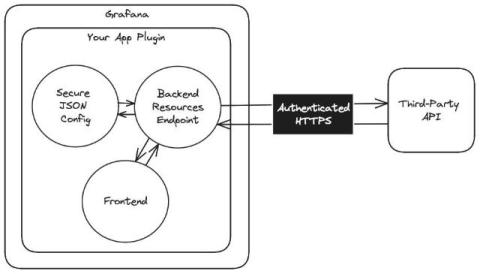
How to authenticate with third-party APIs in your Grafana app plugin

Whether they’re for synthetic monitoring, large-language models, or some other use case, Grafana application plugins are a fantastic way to enhance your overall Grafana experience. Data for these custom experiences can come from a variety of sources, including nested data sources. However, they can also come from third-party APIs, which usually require authentication to access.

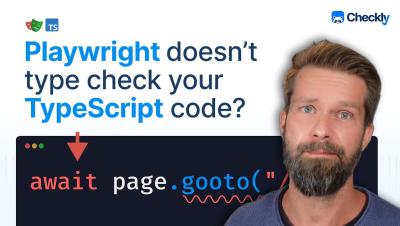
Add Type Checking and Linting to your Playwright Project

In today's video, we're exploring the fact that Playwright doesn't type check your code when using TypeScript. We'll explore what this means and discuss why this could be an issue, especially for larger projects. Then we set up type checking and add "typescript-eslint" to strengthen and improve your Playwright code. Join us for this deep dive and leave any questions or comments below. Stay tuned for more Playwright tips!

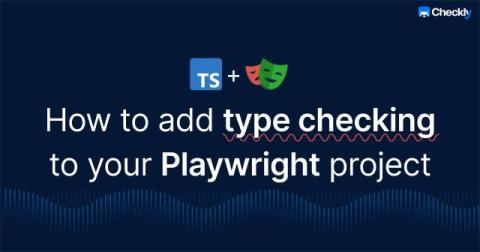
How to add Type Checking and Linting to your Playwright Project

If you bet on end-to-end testing or even synthetic monitoring, there’s a high chance that you use Microsoft's Playwright. And if you have Playwright in your toolchain, you probably adopted TypeScript, too. It's an easy choice because of its rock-solid auto-completion and type safety. With this setup, you can enjoy the beautiful DX (developer experience) and safely refactor your ever-growing code base without worrying about runtime exceptions because of TypeScript's type checking, right? Wrong!

Checkly Kick-Start: Writing your first site monitor

Join Nočnica Mellifera for the Checkly Kick-start. You'll learn: How to get started and write your first page monitors — Anyone can monitor their site with Checkly, and you'll get a demonstration on getting started. Best Practices for monitoring — From monitoring as code workflows to alert configurations based on your SLA, learn how experienced professionals use synthetic monitoring. Advanced skills for automation — Ever wanted to check your site by comparing screenshots? Or create checks that simulate network slowdown? Learn how to simulate complex scenarios with Checkly and Playwright.

Azure API Management: Security, Governance, and the Future of APIs

This episode of "INTEGRATE expert voices - Unplugged" series from the Azure on Air podcast, dives deep into Azure API Management with Mike Budzynski, Senior Product Manager at Microsoft. Discover the latest features, best practices for API governance, and insights into the future of API management. Also, learn about the evolution of API management, how to implement proper security measures, and the exciting new features coming to Azure API Management. Gain valuable insights into managing and securing your APIs effectively.

How Speedscale's Traffic Viewer Complements Your Production Monitoring System

Speedscale's Traffic Viewer is the perfect complement to your production monitoring or observability system because it provides detailed information (like request and response payloads, headers, cookies, and more) that actually helps developers debug any issues and requires zero developer intervention--all of the data is provided from traffic.

Observability as Code Explained: Benefits & How to Get Started

Traditional monitoring has become insufficient for managing complex systems. Modern infrastructures consist of numerous interconnected services, and simply monitoring individual metrics and logs fails to provide a comprehensive view. This is where observability becomes crucial.

An in-depth guide to monitoring Next.js apps with OpenTelemetry

This guide goes into the fundamentals, practical applications and tips & tricks of using OpenTelemetry (OTel) to monitor your Next.js application. OpenTelemetry is gaining (a lot) of momentum outside of its historical niche of distributed, micro services based application stacks. But, as it turns out you can just as well use it for more traditional, three tiered, web applications and it comes with a host of benefits.

Solutions to Common API Issues With Megaport

With automation pervading the networking world in recent years, APIs have become standard for software and IT specialists. While the jury is out on the exact number of public APIs offered today, all estimates point to their massive (and ever-growing) popularity. Megaport is one of the many thousands of vendors that provides public API access to all our services, enabling our customers to automate and streamline their deployments.

API monitoring with Traefik, Grafana, and OpenTelemetry (Grafana Office Hours #28)

Maytham Alfouadi (Solutions Architect) and Immánuel Fodor (Product Manager) from Traefik Labs give us a demonstration of how to do API monitoring with Traefik, Grafana, and OpenTelemetry. They talk about Traefik, an open-source reverse proxy, among other things, that is now included by default in k3s and Rancher. They are joined by Usman Ahmad and Nicole van der Hoeven, both Senior Developer Advocates at Grafana Labs.

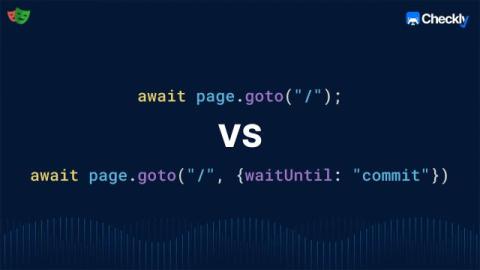
Why "page.goto()" is slowing down your tests

In this video, we dive into Playwright's "page.goto()" and understand why it could be slowing down your end-to-end tests. We start with an example script and then walk you through the Playwright UI mode to understand how resource loading can delay the "page.goto()" call. We also look into the different "waitUntil" configurations and check how they affect the speed of your tests. Enjoy, and drop any questions or comments below!

Why "page.goto()" is slowing down your Playwright tests

When you invest time and effort into creating a well-running end-to-end test suite or adopt Playwright synthetic monitoring with Checkly, you should focus on two things. Your tests must be stable because few things are worse than an unreliable test suite. But also, your tests must be fast because no one wants to wait hours to receive the green light when you're on the edge of your seat to deploy this critical production hotfix.

Debug Third-Party APIs with Requests

The internet is basically just a bunch of websites calling each other. You make a call to some service, that service calls you back, and then that service goes down and ruins your afternoon. Requests, our latest addition to Insights, is a place to see, understand, track, and improve the behavior of outgoing HTTP requests.

5 common travel API integration mistakes to avoid

Travel businesses all around the world heavily rely on APIs in their daily work: they provide real-time inventory data, allow for seamless bookings, and enhance travel websites' functionality in general. APIs have become the backbone of the industry as a whole, which makes integrating them correctly extremely important for almost any travel company.

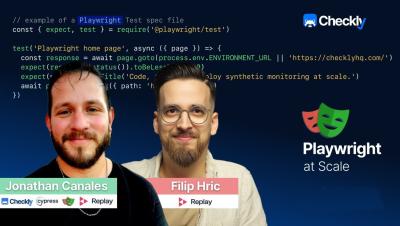
Playwright at Scale

When adopting Playwright, it can be tough to know if you're following the right design principles for a process that will work at scale. For those Cypress users, check out Cypress at Scale. Join Jonathan and Filip as we explore how mature organizations and effective teams adopt Playwright. We'll cover what we've seen in the wild and key considerations. — Fundamentals & principles: You'll understand what Playwright is and its design principles.