
Why Face Swap Is the Smartest Way to A/B Test Visual Creatives Without a Reshoot
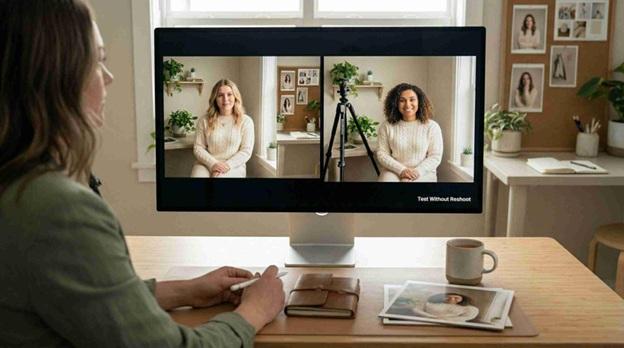
A/B testing has always been a cornerstone of performance marketing.
Marketers test headlines, tweak CTAs, adjust layouts, and refine copy continuously. These changes are easy to implement and quick to evaluate. Over time, even small improvements compound into measurable gains.
But visual creatives have always been different.
They are harder to test, slower to produce, and significantly more expensive to iterate. As a result, one of the most influential elements in a campaign often goes under-tested.
The Real Bottleneck in Creative Testing
Most teams optimize what is easy to change.
Text can be rewritten in minutes. Colors can be swapped instantly. Even layouts can be adjusted without much effort.
But when it comes to the subject of the image, things change.
The face, the expression, and the identity presented in a creative are often the strongest drivers of engagement. Yet they are rarely tested properly.
Why?
Because changing them traditionally requires a full reshoot.
That introduces:
- Production costs
- Scheduling delays
- Creative dependencies
Instead of testing identity directly, teams work around it. They optimize everything else and hope for incremental gains.
Identity Is Not a Minor Variable
In visual marketing, identity is not just another element.
It is often the central one.
A slight change in who appears in a creative can influence:
- Click-through rates
- Engagement levels
- Audience relatability
- Conversion intent
Two creatives with identical structure but different subjects can perform completely differently.
Despite this, identity remains one of the least explored variables in structured testing.
The Shift That Changes Everything
What has changed is not the importance of testing.
It is the cost of experimentation.
Instead of producing entirely new creatives for each variation, marketers are beginning to adapt existing ones. The base structure stays intact, while specific elements are modified.
This is where Face Swap becomes strategically valuable.
By adjusting identity directly within the same visual, teams can create multiple variations without altering composition, lighting, or overall structure. Higgsfield Face Swap enables this type of controlled variation, making identity a testable variable rather than a fixed constraint.
Clean Testing Leads to Better Insights
One of the biggest challenges in A/B testing is isolating variables.
If too many elements change at once, it becomes difficult to determine what actually influenced performance.
Face swap workflows solve this problem.
They allow marketers to keep:
- Background
- Lighting
- Composition
- Layout
completely consistent, while changing only the subject.
This creates a clean testing environment where results are easier to interpret.
Higgsfield Face Swap supports this precision by maintaining visual integrity across variations.
Speed Redefines What Gets Tested
Traditional creative testing is slow.
By the time a new set of visuals is produced, reviewed, and launched, the campaign has often moved forward. Opportunities for optimization are missed simply because iteration cannot keep up with demand.
Face swap workflows remove this delay.
Higgsfield Face Swap allows teams to generate variations quickly, which changes how testing is approached.
Instead of:
- Planning tests in advance
- Waiting for production cycles
- Running limited experiments
teams can:
- Test continuously
- Iterate in real time
- Respond to live performance data
This shift turns A/B testing from a periodic activity into an ongoing process.
Cost Reduction Unlocks More Than Savings
Reducing production cost is an obvious benefit.
But the deeper impact is not financial. It is strategic.
When the cost of creating variations drops, the volume of testing increases.
More tests lead to:
- Better data
- Stronger insights
- Higher-performing creatives
Higgsfield Face Swap enables this by removing the biggest barrier to experimentation.
Instead of asking whether a variation is worth producing, teams can simply test it.
Expanding the Scope of Creative Testing
Once identity becomes easy to modify, new dimensions of testing open up.
Marketers can explore:
- Different personas for the same campaign
- Audience-specific identity variations
- Emotional expressions within the same concept
- Contextual adjustments based on platform or region
These are not minor changes.
They directly influence how a creative is perceived.
What was once too expensive or complex to test now becomes part of the strategy.
Maintaining Brand Consistency While Testing
A common concern with rapid experimentation is brand fragmentation.
If variations differ too much, campaigns can feel inconsistent.
Face swap workflows avoid this issue.
Because the structure of the visual remains unchanged, all variations feel connected. The only difference is the subject.
Higgsfield Face Swap ensures that:
- Composition remains stable
- Visual tone stays aligned
- Overall structure stays consistent
This allows teams to test aggressively without compromising brand identity.
From A/B Testing to Creative Intelligence
A/B testing is evolving.
It is no longer just about finding a winner.
It is about understanding patterns.
Which type of identity resonates with a specific audience? Which variation performs better across different platforms? How does relatability impact engagement?
These insights require more than occasional testing.
They require continuous experimentation.
Face swap workflows make that possible.
Higgsfield Face Swap enables identity to become a controllable variable, turning creative testing into a source of strategic intelligence.
Industry Momentum Is Already Building
This shift is not happening in isolation.
Broader advancements in AI-driven creative workflows are already reshaping how content is produced and optimized. Even platforms like NVIDIA are highlighting how AI is accelerating creative processes and enabling new forms of experimentation, as seen in discussions around AI-driven creative workflows.
The direction is clear.
Content creation is becoming faster, more adaptable, and more data-driven.
Face swap technology fits directly into this evolution.
The Practical Advantage for Teams
At a practical level, the benefits are straightforward.
Teams can:
- Generate multiple variations from a single asset
- Keep all non-essential variables constant
- Test identity without additional production
- Iterate based on real performance data
Higgsfield Face Swap integrates into existing workflows without requiring major changes, making it easy to adopt.
Conclusion
A/B testing has always been essential for performance marketing.
What has changed is what can be tested.
Identity, one of the most influential variables in visual creatives, is no longer locked behind expensive production processes.
Face swap technology makes it accessible.
Higgsfield Face Swap allows teams to test smarter by removing the need for reshoots while maintaining consistency and control.
This shifts visual testing from a limitation into a competitive advantage.
As campaigns become more data-driven, the ability to experiment efficiently will define which teams succeed.