Operations | Monitoring | ITSM | DevOps | Cloud

Grafana 13 TL;DR - What's New (and Worth Your Time)

Grafana 13 is here! In this video, we walk through the biggest updates and improvements, from faster ways to build dashboards to new features that make Grafana easier to manage at scale. We cover things like: If you’ve ever struggled with broken dashboards, messy layouts, or just getting started from scratch, this release focuses on making those workflows a lot smoother. This is a TL;DR, so we’re just scratching the surface—but it should give you a solid sense of what’s new and what’s worth checking out.

Git Sync: Observability as code built for scale | Demo | Grafana Labs

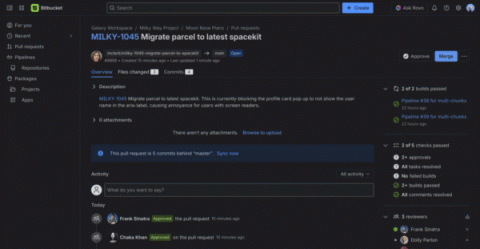
In this video, Fabrizia Rossano and Roberto Jiménez demonstrate Git Sync, a feature that provides you with the power of Git version control right in your Grafana instance. Git Sync enables you to submit changes in your dashboards as pull requests and get them reviewed by your team directly from Grafana or from Git.

What EMEA Infrastructure Leaders Are Saying About Security, Compliance, & Hybrid IT

Over the past few months, Puppet has partnered with Bryxx to host a series of leadership lunches across Europe, bringing together infrastructure, operations, and security leaders for candid, peer‑to‑peer conversations. These sessions weren’t marketing briefings. They were grounded discussions about what teams are facing right now: tighter regulation, rising security pressure, shifting cloud strategies, and the practical realities of automation and AI.

Before You Deploy Another Agent, Read This

Enterprise boardrooms are not debating whether to adopt agentic AI anymore. The debate has moved to a harder question: why do so many agentic deployments stall between pilot and production? ServiceNow's Enterprise AI Maturity Index 2026 puts a number to it. Most enterprises that have invested in AI tooling report that their biggest obstacle is not model quality or compute cost. It is the infrastructure that those agents are expected to operate within. The models are capable.

Monitoring CPU and Memory on Your VPS with AppSignal

Most of us run multiple virtual private servers (VPS) at a time. That’s why it’s important to keep an eye on the CPU usage and memory. However, since this step often slips our minds, there is room for automated monitoring. Open-source tools tend to be a default choice, and for a good reason. The problem is that they don't provide everything you need for monitoring in a single place. As a result, you may find yourself writing custom shell scripts for automation.

What is Terragrunt and how does it simplify Terraform Workflows? | Harness Blog

Managing Terraform across dozens of AWS accounts becomes a maintenance nightmare fast. Teams end up copy-pasting the same backend configurations, provider blocks, and variable definitions hundreds of times. Terragrunt acts as an orchestrator above Terraform, eliminating this duplication through shared configuration inheritance and dependency management. When financial services teams manage 200+ microservices across multiple environments, these DRY patterns become essential for governance and consistency.

Building for the Agentic Era: Engineering Excellence at Harness | Harness Blog

As AI agents become ubiquitous across the software development lifecycle, engineering teams must do more than adopt new tools; they must redesign how they build, verify, and operate software. This post distills the vision, priorities, and best practices that guide engineering excellence at Harness. Different products sit at the heart of the Harness platform.

From Deployment to Confidence: Why Continuous Verification Is the Missing Piece in Modern CD Pipelines | Harness Blog

Modern engineering teams have become exceptionally good at shipping software quickly. With modern CI/CD platforms, what once required careful coordination, late-night release windows, and layers of approvals now happens almost invisibly. Pipelines execute in minutes. Releases flow continuously. The friction that once slowed everything down has been engineered away. From the outside, it looks like progress in its purest form. Automation removed bottlenecks. Cloud infrastructure removed limits.

Beyond the frontend: choosing between Vercel and Upsun for full-stack applications in 2026

If you're building a modern web application in 2026, Vercel is almost certainly on your shortlist, and probably near the top of it. The developer experience Vercel pioneered for Next.js and the frontend ecosystem around it is a real achievement. Push a branch, get a preview URL, ship. It works, it's fast, and an entire generation of frontend teams have built their workflow around it. This article is not here to argue with any of that.