Operations | Monitoring | ITSM | DevOps | Cloud

The latest News and Information on Containers, Kubernetes, Docker and related technologies.

What Do People Love About Rancher?

More than 20,000 environments have chosen Rancher as the solution to make the Kubernetes adventure painless in as many ways as possible. More than 200 businesses across finance, health care, military, government, retail, manufacturing, and entertainment verticals have recognized that Rancher simply works better than other solutions.

Exception Perceptions: 4 Best Practices for Using Docker Compose

On this episode of Exception Perceptions, Bret Fisher, Docker Captain and creator of the popular Docker Mastery series on Udemy, helps us master Docker Compose. Watch the episode, and read more of Bret’s suggested best practices. Then go and get all of his Docker resources.

LogicMonitor's Kubernetes Monitoring Explained

LogicMonitor’s Kubernetes Monitoring Integration enables you to comprehensively monitor your Kubernetes orchestrated container environment, and the applications running within, alongside the rest of your hybrid infrastructure in a single pane of glass. With automated monitoring and pre-configured alert thresholds for Kubernetes cluster components, container health, and application performance, you can be sure that you have the necessary visibility to maximize your container investment.

Sysdig and Falco now powered by eBPF.

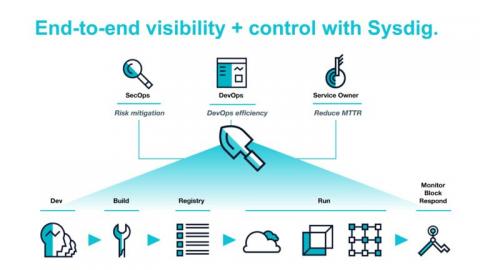
At Sysdig we’ve recently undergone a pretty interesting shift in our core instrumentation technology, adapting our agent to take advantage of eBPF – a core part of the Linux kernel. Sysdig now supports eBPF as an alternative to our Sysdig kernel module-based architecture. Today we are excited to share more details about our integration and the inner workings of eBPF. To celebrate this exciting technology we’re publishing a series of articles entirely dedicated to eBPF.

Introducing container observability with eBPF and Sysdig.

Today we’ve announced that we’ve officially added eBPF instrumentation to extend container observability with Sysdig monitoring, security and forensics solutions. eBPF – extended Berkeley Packet Filter – is a Linux-native in-kernel virtual machine that enables secure, low-overhead tracing for application performance and event observability and analysis.

Three Ways to Secure Kubernetes From Inside Threats

Inherently, Kubernetes clusters are multi-user. As a result, organizations want to ensure that cross-communication is protected via role-based access control, logical isolation and network policies. A container orchestration system such as Kubernetes brings information technology operations and developers (DevOps) closer together, making it easier for teams to collaborate effectively and efficiently with each other.

Introducing k3s: The Lightweight Kubernetes Distribution Built for the Edge

Today Rancher Labs is announcing a new open source project, k3s, which is a lightweight, easy to install Kubernetes distribution geared towards resource-constrained environments and low touch operations. Some use cases in which k3s really shines are edge, ARM, IoT, and CI. The work for k3s started as a component of Rio, an experimental project we started last year.

Deploying Redis Cluster on top of Kubernetes

Redis (which stands for REmote DIctionary Server) is an open source, in-memory datastore, often used as a database, cache or message broker. It can store and manipulate high-level data types like lists, maps, sets, and sorted sets. Because Redis accepts keys in a wide range of formats, operations can be executed on the server, which reduces the client’s workload. It holds its database entirely in memory, only using the disk for persistence.

Navigating Network Services and Policy With Helm

Deploying an application on Kubernetes can require a number of related deployment artifacts or spec files: Deployment, Service, PVCs, ConfigMaps, Service Account — to name just a few. Managing all of these resources and relating them to deployed apps can be challenging, especially when it comes to tracking changes and updates to the deployed application (actual state) and its original source (authorized or desired state).