Operations | Monitoring | ITSM | DevOps | Cloud

The latest News and Information on Containers, Kubernetes, Docker and related technologies.

How to Implement Network Policy in Google GKE to Secure Your Cluster

By default, pods are non-isolated; they accept traffic from any source. The Google GKE solution to this security concern is Network Security Policy that lets developers control network access to their services. Google GKE comes configured with Network Security Policy using Project Calico which can be used to secure your clusters. This class will describe a few use cases for network security policy and a live demo implementing each use case.

How to deploy an app to AWS: App security

AWS security is an ongoing battle that you must address during every release, every change, and every CVE. When you’re first launching your production application, it’s impossible to check all the boxes; you simply don’t have the time. Until your application gets more adoption, you only have the time to do the bare essentials of security.

Sysdig's Prometheus monitoring behind the scenes

A few weeks ago, we announced that Sysdig is offering fully compatible Prometheus monitoring at scale for our customers, as well as a new website called PromCat.io hosting a curated repository of Prometheus exporters, dashboards and alerts. This got me thinking about how we were actually able to implement the changes necessary to offer this in our platform.

Getting up and running with Calico Host Micro segmentation Protection on AWS

In this online training, we will explain how to install and configure Calico on a vm/host to apply network policy to resources outside your K8s cluster. The talk will be primarily a walkthrough and demo and you will receive all manifests and instructions to do the demo on your own after the session.

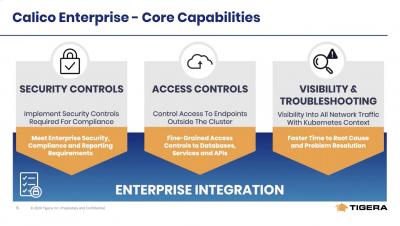
Calico Enterprise 3.0 - Global Network Security Center for Kubernetes

As our enterprise customers build out large, multi-cluster Kubernetes environments, they are encountering an entirely new set of security challenges, requiring solutions that operate at scale and can be deployed both on-premises and across multiple clouds.

Kubernetes and the Enterprise Knowledge Graph

In today’s enterprises, we spend much of our time dealing with information, whether it’s data, knowledge or analytics. Just like the assembly line workers of last century, today’s knowledge workers deal with similar logistics of taking raw materials as an input and producing a finished product as an output. Only in this case, the raw material is all the unorganized and sometimes random information at our disposal, and the finished product is structured information.

How to Implement Network Policy in Azure AKS to Secure Your Cluster

By default, pods are non-isolated; they accept traffic from any source. The Azure AKS solution to this security concern is Network Policy that lets developers control network access to their services. The Azure AKS comes configured with Network Policy using Project Calico which can be used to secure your clusters. This class will describe a few use cases for network policy and a live demo implementing each use case.

Calico and K8s Network Policies - An Overview and Comparison

Kubernetes Network Policy is the native way to implement network security controls in Kubernetes. Calico Policy is a superset of Kubernetes Network Policy that adds additional capabilities that help meet common real-world use cases. In this talk, we will educate you on the basics of Kubernetes Network Policy, the differences with Calico Policy, example use cases, and demos. You’ll walk away from this session with knowledge that will help you decide which network policy is right for you.