Operations | Monitoring | ITSM | DevOps | Cloud

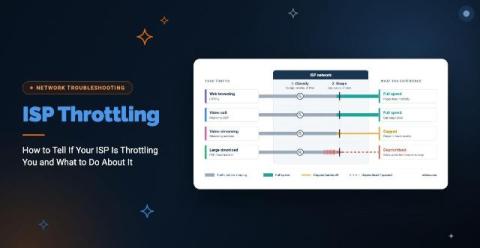
ISP Throttling: How to Tell If Your ISP Is Throttling You and What to Do About It

Your connection is fine in the morning and crawls every afternoon. Or video calls stutter while everything else loads normally. Either pattern could be ISP throttling. It could also be network congestion, or a problem inside your own network. ISP throttling is when your internet service provider intentionally slows your connection based on how much data you use, the type of traffic you send, the time of day, or the plan you’re on. Knowing throttling exists is the easy part. Proving it is harder.

The Heroku Experience for the AI Era

Ask a developer who used Heroku what they remember about it and you'll usually get some version of the same answer: you pushed your code and it ran. That feeling is back in the conversation, mostly because AI tools have made building software faster than its ever been. But speed was only half of the Heroku story. The other half, the part teams ran into a year or two later, matters just as much today.

AI wrote the code. Can you prove it followed the rules?

AI agents now write, review and ship code, and our supply-chain security can't tell how that code was made. A green build and a clean scan don't tell you which model or tools the agent used, whether it had your security guidelines, or whether a human actually reviewed the change. In this talk I introduce Agentic Process Evidence, a proposed open community standard. It records the AI development process as structured, signed evidence that is attached to the commit and linked back to the full agent session logs, so release policies can enforce it automatically as policy as code.


Are Open Source Models the Answer to AI Sovereignty? | Civo Navigate London

Open source models are closing in on the frontier. But is running them the same as being sovereign? David Sullivan explains why true sovereignty means owning the whole model lifecycle, and why that's where prototypes stall before production. James Faure shows how distilling small, task-specific models can slash costs. Dr Rosemary Francis argues it's ridiculous to use the most expensive model for every task, and that your harness and engineering process matter more than which model sits at the top of the leaderboard.

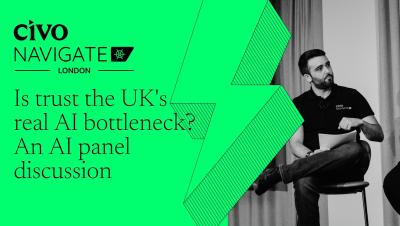
Is Trust the UK's Real AI Bottleneck? | Civo Navigate London

Why can't the UK make its own AI chips? David Sullivan argues that the biggest gap isn't chips, compute or electricity. It's trust. If people won't let AI near their finances, the best model in the world goes unused, and that's where the UK has a real chance to lead. Civo makes complexity a thing of the past.

Dave Killeen: What to Do When Execs Demand AI

Dave Killeen will tell you, on record, that his relationship with AI has crossed into unhealthy territory. He also says he has never felt more alive, that he is 50 and feels 30, and that he sometimes waits for his two small children to go to bed so he can start a coding session. In between, he gives Axel Sooriah the most practical answer on this show yet to the question every product team is facing: your exec says "we need AI," and you have no idea what they actually want.

AI Prompts For IT Asset Management: Ready-to-Use Inventory Questions

AI prompts for IT Asset Management (ITAM) are the questions and instructions IT teams type into an AI assistant to get answers from their asset inventory. They're searched by IT asset managers, technicians and IT leaders whose assistant can already read inventory data and who want ready-made questions that return useful answers about devices, owners, warranties and costs.

Shipped: Drill into your cloud bill up to eight levels deep

Most cost questions have more than one layer. Which team spent the most, which services drove it, and which accounts were behind those services? Previously, following that path meant changing dimensions, adjusting filters, and re-running the query at every step. Multi-dimensional drill-down has been one of the most-requested features in Explorer. The team shipped two-level group-by earlier this year, collected feedback, and kept going. Now the path goes eight levels deep.

Fixes available for CVE-2026-92392 and other curl vulnerabilities

On 7 October 2026, Daniel Stenberg published a blog post describing a plan to release a new version of curl on 14 October 2026 in order to address 22 known security vulnerabilities. These vulnerabilities have varying severities, with a single vulnerability assessed as high (CVE-2026-92392), while the others have a low or medium severity. The curl maintainer has coordinated with downstream vendors, including Ubuntu, under embargo and the vulnerabilities have been publicly disclosed on the planned date.