Operations | Monitoring | ITSM | DevOps | Cloud

Replacing cron jobs and dbt pipelines with ClickHouse Refreshable Materialized Views

For ClickHouse to achieve the speed it's known for, it has historically relied on a trigger-based and incremental architecture for materialized views. This architecture is known to be very efficient but lacks flexibility, such as when working with data that needs to be backfilled rather than append-only.
New in Redgate Flyway Enterprise - Drift detection and rollbacks just got easier

In our latest Redgate Flyway Enterprise release, you can store a snapshot directly in the target database, making drift detection and rollback strategies easier and more reliable whether you’re using state-based or migrations-based deployments.

How to Connect Salesforce to Tableau and Use Near-Real-Time Data Across Teams

The effectiveness of Tableau Salesforce integration depends on one decisive factor: the connector. While Tableau’s native connector is straightforward and offers quick access, it lacks support for complex joins, uses scheduled extracts for refreshes, and doesn’t extend to other BI or ETL platforms. To overcome these constraints, many organizations implement ODBC Drivers, which deliver SQL depth and governance designed for analytics at scale.

Caching in C#: A Comprehensive Technical Guide

In.NET systems, performance is often won or lost on the read path. Every extra database or API call adds latency and cost. Caching fixes that by keeping frequently used data, like product lists or lookups, close to your code, turning slow trips into instant reads. This is not theoretical, it works in the real world. Stack Overflow runs a two-tier cache (in-process + Redis), where a Redis hop takes only 0.2–0.5 ms and local memory reads are effectively instant.

From Concept to Reality: The Journey Behind Harness Database DevOps

Harness Database DevOps was born from a simple question - how can database delivery be as seamless and safe as application delivery? Through deep collaboration with design partners, open-source learnings, and relentless iteration, the team built a platform that unites developers, DBAs, and DevOps under a single, automated workflow. At its core, it’s a story of empathy-driven engineering - transforming database change management into a faster, more reliable, and collaborative experience.

The database professional of the future: headlines from Redgate's Keynote at PASS Data Community Summit 2025

Redgate took the main stage earlier today to open PASS Data Community Summit with our keynote, where we shared our vision for the future of the database development experience – one driven by speed, safety, and the intelligent use of AI. As data estates grow in scale and complexity, and as organizations push to deliver software faster than ever, the role of the database is undergoing significant change.

Harness Database DevOps Adds Flyway Support

Harness Database DevOps has added Flyway support alongside Liquibase, offering teams a choice between structured changelogs and SQL-first migration scripts. This multi-engine approach ensures developers can use their preferred tool while benefiting from centralized governance, automated safety features, and a unified pipeline for all database changes. The goal is to make database delivery safer, more automated, and flexible across the enterprise.

A New, Simpler Microsoft Teams Integration For Redgate Monitor

Microsoft is retiring Office 365 connectors, but there is now a new and easier way to send Redgate Monitor alert notifications to Teams, ready-formatted. Microsoft is retiring Microsoft 365 (Office 365) connectors on 31 March 2026. After that date, any Redgate Monitor alert notifications configured through the old connector method will stop appearing in Teams. From Redgate Monitor 14.1.0, there’s now a new and much simpler way to do it.

Fork Your Database for Staging & Testing

Learn how to quickly create a fork of your Aiven for PostgreSQL instance to set up a safe staging or testing environment. In this demo, we walk you through selecting your project and service, navigating to the backups & forking section, naming your new instance, choosing the cloud provider and plan, and finalising the fork to replicate your original database. This approach allows you to test changes safely without affecting your production database, making development and QA workflows much more reliable.

Introducing Native Flyway Support for Harness Database DevOps

Harness Database DevOps has added Flyway support alongside Liquibase, offering teams a choice between structured changelogs and SQL-first migration scripts. This multi-engine approach ensures developers can use their preferred tool while benefiting from centralized governance, automated safety features, and a unified pipeline for all database changes. The goal is to make database delivery safer, more automated, and flexible across the enterprise.

.NET Conf 2025 Highlights: Unlocking the Future With .NET 10 and AI Innovations

As the dotConnect team, we are proud to be a sponsor of the.NET Conf 2025. This landmark event highlighted the key advancements of the.NET ecosystem, from major releases to AI-powered tools and inspiring community-driven projects.

Microsoft Fabric Data Warehouse: Features, Benefits, and Use Cases

The Fabric Data Warehouse was built to solve one of analytics’ biggest challenges: fragmentation. When data is spread across separate tools for ingestion, modeling, and reporting, teams lose time, accuracy, and visibility. As part of the Microsoft Fabric ecosystem, the Data Warehouse addresses this by unifying every stage of the analytics process into a single, connected environment.

Which Data Connectivity Product to Choose: ODBC, SSIS, Excel, or Python

Data connectivity solutions are the bedrock of a solid database management strategy. Here’s why. Databases rarely work in isolation. They are constantly interacting with various apps and cloud platforms. As such, ensuring that this interaction flows seamlessly is critical. This is where your business data connectivity solution comes in. But here is the problem. There is no one-size-fits-all connectivity solution.

What Are SQL Server Agent Jobs: Guide With Examples

Behind every reliable dashboard and morning report stands a system of accountability: SQL Server Agent jobs. They’re what keeps backups on time, analytics flowing, and data pipelines steady when everything else moves fast. However, to sustain that reliability, SQL Server Agent must operate with precision at scale.

Redgate Monitor

Redgate Monitor helps you manage your entire database estate from a single pane of glass. Monitor SQL Server, PostgreSQL, Oracle, MySQL, and MongoDB – on premises, in the cloud, or in hybrid environments. Get database observability to proactively mitigate potential risks with instant problem diagnosis and customizable alerting. No downtime, customer complaints, or wake-up calls at 3am.

Introducing Redgate Test Data Manager with AI: Smarter, Safer Test Data Management

Discover how Redgate Test Data Manager’s new AI features deliver fast, compliant, production-like test data - balancing realism, speed, and security. In regulated industries like finance, healthcare, and insurance, test data management (TDM) can be quite challenging when it comes to compliance.

Announcing 1B+ Downloads & Product Development With Logs, Traces, Metrics

We’re currently at KubeCon + CloudNativeCon North America 2025 in Atlanta, and it’s a great opportunity to connect with the community and share some of the progress we’ve made this year. It’s been a busy period of development, new releases, and community engagement, all guided by our focus on delivering simple, reliable, and efficient monitoring & observability solutions.

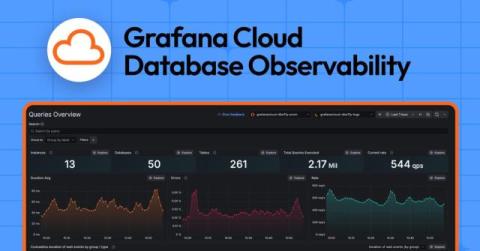
Understand, diagnose, and optimize SQL queries: Introducing Grafana Cloud Database Observability

It’s widely acknowledged that most application performance problems stem not from the application itself, but from the underlying database. Slow or inefficient database queries are often the primary cause of these issues, acting as the biggest driver of application performance incidents. If you’ve been troubleshooting slow API calls or sluggish services, chances are the root cause likely resides within your database layer.

Devart ODBC Drivers Get Major Update With GUI for macOS/Linux, PostgreSQL 18 Support, and Enhanced Security

We are thrilled to announce a major update across our line of ODBC Drivers, introducing a graphical configuration interface for macOS and Linux, extended authentication methods, and compatibility with the latest database versions including PostgreSQL 18 and MariaDB 12.

Redgate Software recognized as a Strong Performer in Gartner Peer Insights Voice of the Customer for Infrastructure Monitoring Software

We’re thrilled to share that Redgate Software has been recognized as a ‘Strong Performer’ in the 2025 Gartner Peer Insights Voice of the Customer for Infrastructure Monitoring Tools category with our Redgate Monitor solution. We believe this recognition is a reflection of the trust and feedback from the people who matter most: our customers.

Introducing Developer Tier for Aiven for PostgreSQL services

Aiven is introducing a new pricing plan for Aiven for PostgreSQL services. Starting at $8 USD per month, the Developer tier offers more storage, so you can scale up your free PostgreSQL service in a cost-effective way. Unlike the Free tier, services on the Developer tier are not automatically powered off if inactive. The Developer tier also automatically includes Basic support services. More information on the Developer tier is available in the Aiven docs.

Exploring why PostgreSQL 18 put asynchronous I/O in your database

For years, PostgreSQL relied on synchronous I/O, meaning that when the database needed data from disk, each read operation was a blocking system call. The database process would therefore pause and wait for the data retrieval before moving to the next task. Synchronous I/O works well for local storage, but our database needs have changed drastically since then, resulting in this architecture creating significant bottlenecks when storage has higher latency.

Find Your PostgreSQL Connection URL

In this video, we show you how to quickly connect to your Aiven for PostgreSQL instance by locating your service URL in the Aiven Console. Your login credentials remain secure but can be copied easily, and we demonstrate how to connect using a variety of tools, including the Aiven CLI, PostgreSQL clients, and popular programming language modules. Get up and running in minutes and start interacting with your database effortlessly, whether for development, testing, or analytics.

Add Postgres with one YAML line. Deploy in under a minute.

Let’s break down why this matters, and how it can change the way you approach building and running applications. You want database power without getting bogged down in tooling and config. Most of your week should be building features, not hunting for connection strings or maintaining bespoke infra scripts. Developers tell us they just want to code and solve application problems, with minimal platform friction.

Building dbRosetta Using AI: Part 3, Creating a Database

The AI said I had to do a database first, not code. Who am I to argue? So, with all the prompts outlining the goals of the project, I’ve gone forward with the project, and step one is creating a PostgreSQL database on Azure. This is part three of a multi-part set of articles. I’ll move this list to the bottom of future articles: Part 1: Introducing the Concept of dbRosetta Part 2: Defining the Project & Prompt Templates.

Devart ODBC Drivers vs Free ODBC and JDBC: Key Comparison

Most teams never question the JDBC or ODBC drivers they use. If it connects, it’s “good enough.” That assumption can cost more than $14,000 per minute during an outage, according to EMA’s 2024 IT downtime benchmark. Drivers are more than connectors. They dictate how efficiently data moves between databases, applications, and analytics tools. When overlooked, the entire stack slows down. Breakdowns at this level lead to failed reports, missed deadlines, and avoidable downtime.

AI Agents Observability with OpenTelemetry and the VictoriaMetrics Stack

Nowadays, AI agents are becoming more and more popular and often deployed as part of production systems. However, this rapid adoption brings unique observability challenges that require flexible solutions. On the one hand, AI agents are fundamentally just like any other software services that produce the same classic observability signals we’re familiar with: metrics, logs, and traces.

Simple Talk Podcast - Coffee Chat with John Sterrett

Simple Talk Podcast – Coffee Chat with John Sterrett Description: Steve chats with John Sterrett, CEO of ProcureSQL, about his true love for data from a young age, how SQL Saturday and community events inspired him to start his own company, ProcureSQL’s use of AI to provide more value, and the impacts of work on relationships - plus much more!

Replication Job Monitoring Support in Redgate Monitor

Whether it’s a stalled Log Reader Agent, a conflicting insert on the subscriber, or a failed cleanup job bloating the distribution database, Redgate Monitor now brings SQL Server replication issues to light early, before performance or reliability are affected. In many SQL Server environments, replication remains essential for offloading reporting and analytics workloads, or for maintaining local and synchronized data copies across regions.

Building dbRosetta Using AI: Part 2, Defining the Project & Prompt Templates

This is the next installment of the series on building a database and an application called dbRosetta using AI/LLM. Part 1 introduces the concept. THE AI PICKED DATABASE FIRST! Look, I talk databases at this thing a lot, so it probably knows my own preference, but when I asked it, it chose to build a database separate from the code. Let’s get into it.

Unleashing Powerful Analytics: Technical Deep Dive into Cassandra-Spark Integration

Apache Cassandra has long been favored by organizations dealing with large volumes of data that require distributed storage and processing capabilities. Its decentralized architecture and tunable consistency levels make it ideal for handling massive datasets across multiple nodes with minimal latency. On the other hand, Apache Spark excels in processing and analyzing data in-memory, making it an excellent complement to Cassandra for performing real-time analytics and batch processing tasks.

Grafana Tempo: Setup, Configuration, and Best Practices

As systems grow, understanding how a request moves across multiple services becomes harder. Traces help bring this picture together by showing the exact path a request takes, along with the timings that matter. Grafana Tempo is built for this kind of workload. It stores traces efficiently, works well with OpenTelemetry, and keeps the operational overhead low.

Terminate Idle Connections Automatically

Learn how to automatically close inactive connections in your Aiven for PostgreSQL service using pgBouncer’s idle timeout setting. In this demo, we’ll walk through the Aiven Console to adjust the server_idle_timeout value in pgBouncer’s advanced configuration, helping you optimise performance and free up resources by terminating idle connections faster.

New Devart Python Connectors Add Broader Compatibility and Stronger Security

We are thrilled to announce a major update to our Python Connectors line. The release adds support for Python 3.14, PostgreSQL 18, MySQL 9, and MariaDB 12, introduces modern authentication and security options, and delivers notable performance gains across several connectors.

Grafana Mimir 3.0 release: performance improvements, a new query engine, and more

In 2022, we introduced Grafana Mimir, our open source, horizontally scalable, multi-tenant time series database (TSDB) designed for long-term storage of Prometheus and OpenTelemetry metrics. Over the years, Mimir has become a go-to metrics backend within the open source community, with 30 project maintainers and more than 4.7k GitHub stars.

Building dbRosetta Using AI: Part 1 of Many

Like many of you, over the last couple of years, I’ve been using AI, or, well, let’s just name it appropriately, Large Language Models (LLM), as a part of my job. I’ve also used it in my hobby. With it, I’ve generated snippets of code, tested data conversions, even built a small database for a presentation. However, to date, I haven’t tried doing everything through the LLM. Now, I’m going to.