Security Observability Trends for 2023
Ed Bailey talks with Optiv’s Randy Lariar about upcoming trends in Security Observability for 2023


The latest News and Information on Monitoring for Websites, Applications, APIs, Infrastructure, and other technologies.
Trust is everything. It is the glue that builds the lasting relationship between you and your customers, and it depends on a variety of factors like customer service, product quality, and user experience. A large part of your customer’s experience is from their interaction with your website. So, if your website is not meeting their expectations, you can lose them as customers.
2022 saw a return to normalcy on the Covid front as offices re-opened, people gathered in large groups indoors again and mask mandates waned, even as Covid never really went away. Meanwhile, inflation raged through the summer months before subsiding somewhat later in the year and the Great Resignation gave way to mass layoffs, especially in the tech industry.
Brick by brick, block by block—if you’ve been with us throughout our Author’s Cut blog series (and if you haven’t, you can go catch up), you’ve seen us build the case for observability from the ground up. We’ve covered structured events, the core analysis loop, and use cases for managing applications in production—and that’s just to start.
This article was originally published in The New Stack and is reposted here with permission. Arrow makes analytics workloads more efficient for modern CPU and GPU hardware, which makes working with large data sets easier and less costly. One of the biggest challenges of working with big data is the performance overhead involved with moving data between different tools and systems as part of your data processing pipeline.
Check our December 2022 health report on the top most popular cloud providers. We analyze the health of the cloud providers based on the number of outages and problems during the month. The source of the data is made available by the cloud providers themselves via their status page. We normalize it and use it to generate the report.
Kubernetes is a game-changer for enterprise organizations. Automating deployment, scaling, and management of containerized applications allows organizations to embrace a cloud-native paradigm at scale and more easily employ best practices, such as microservices and DevSecOps. But as with all tech, Kubernetes has its limits. Kelsey Hightower famously tweeted that “Kubernetes is a platform for building platforms. It’s a better place to start; not the endgame.”
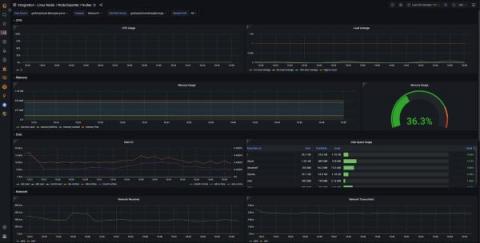
Anyone who is trying to set up monitoring for multiple machines knows how tough it can get to manage multiple Grafana Agents across them. To make things easier, we recently added the Grafana Agent role to the Grafana Ansible collection, which will help users manage the Agent across multiple Linux hosts. (Need to know how to get started with the Grafana Ansible collection for Grafana Cloud?
As your environment changes, new trends can quickly make your existing monitoring less accurate. At the same time, building alerts after every new incident can turn a straightforward strategy into a convoluted one. Treating monitoring as a one-time or reactive effort can both result in alert fatigue. Alert fatigue occurs when an excessive number of alerts are generated by monitoring systems or when alerts are irrelevant or unhelpful, leading to a diminished ability to see critical issues.