Operations | Monitoring | ITSM | DevOps | Cloud

The latest News and Information on Containers, Kubernetes, Docker and related technologies.

Continuously deploy custom images to an Azure container registry

The Azure container registry is Microsoft’s own hosting platform for Docker images. It is a private registry where you can store and manage private docker container images and other related artifacts. These images can then be pulled and run locally or used for container-based deployments to hosting platforms. In this tutorial, you will learn how to create a custom docker image and continuously deploy it to an Azure container registry.

Best Practices for Migrating to Helm v3 for the Enterprise

At JFrog, we rely on Kubernetes and Helm to orchestrate our systems and keep our workloads running and up-to-date. Our JFrog Cloud services had initially been deployed with Helm v2 and Tillerless plugin for enhanced security, but we have now successfully migrated our many thousands of releases to Helm v3. Like many SaaS service providers, JFrog Cloud runs with many Kubernetes clusters in different regions, across different cloud providers.

Make you Developers Happy with Rancher and Shipa

At this point, it’s fair to say that containers and Kubernetes changed the dynamics of infrastructure and platforms. It’s no secret that even though managing Kubernetes clusters is still somewhat complex, in the early days, it was even harder, which is when we saw solutions such as Rancher come up to help us address those challenges. You will inevitably run into cluster-related challenges when adopting Kubernetes.

Service Mesh, Observability and Beyond - Sheetal Joshi, AWS

Congratulations! You’re now cloud-native with microservices. No more legacy monoliths. However, troubleshooting takes time, debugging is difficult, and security is scary. How can you scale your organization without losing an understanding of your environment? Services mesh is here to help! It gives you the observability of connected services and is easier to adopt than you might think. Come and learn service mesh concepts, best practices, and key challenges.

Kubernetes Observability & Troubleshooting: Best Practices - Raj Singh, Box

Early adoption of Kubernetes came with its set of challenges for Box, that led to innovative solutions & learnings. In this session, the speaker will take you through some of those solutions around Kubernetes Observability & best practices which will make your Kubernetes journey easier.

Calico/VPP : Unlocking performance & innovation for large scale Kubernetes clusters

Calico/VPP data plane renderer was introduced as Tech Preview in Calico 3.19 for Kubernetes. It leverages the FD.io/VPP userspace data plane which brings great benefits in terms of performance and flexibility for large-scale Kubernetes clusters. Thanks to its fast IPSec & Wireguard implementation, it makes it possible to provide intra-cluster full mesh crypto without compromising performance. Beyond performance, it implements differentiated features like MagLev based load balancing with DSR for k8s services making it a good choice for large-scale applications having strong high availability requirements. This is the first release but moving forward, it will provide support for superfast packet-oriented virtual interfaces as well TCP/UDP/Quic stack to applications having extreme networking performance.

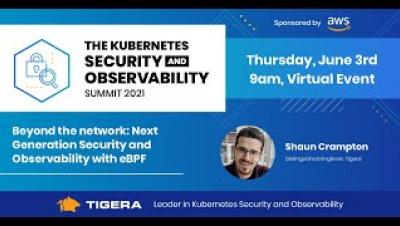
Beyond the network: Next Generation Security and Observability with eBPF - Shaun Crampton, Tigera

Learn how eBPF will bring a richer picture of what's going on in your cluster, without changing your applications. With eBPF we can safely collect information from deep within your applications, wherever they interact with the kernel. For example, collecting detailed socket statistics to root-cause network issues, or pinpointing the precise binary inside a container that made a particular request for your audit trail. This allows for insights into the behavior (and security) of the system that previously would have needed every process to be (manually) instrumented.

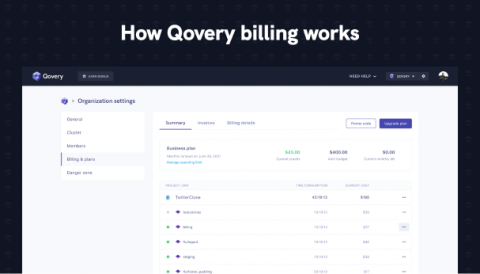
How Qovery billing works

Let’s see how the Qovery billing is working as we are about launching the v2 in less than two weeks. Since we launched Qovery in January 2020, our product was free of charge for our “community” and “business” plans - even if on the pricing page it was mentioned the opposite. Making Qovery free was the perfect way to get product feedback and iterate with our users without the cost constraint.