Operations | Monitoring | ITSM | DevOps | Cloud

The latest News and Information on Containers, Kubernetes, Docker and related technologies.

ValidKube Update: Adding Polaris to Auto-Audit K8s YAMLs

A month and a half ago we released ValidKube, our first OS project that fused the capabilities of three other popular OS tools (kubeval, kubectl-neat and trivy) in a single easy-to-use microsite. Using the microsite, any user could ensure the security and hygiene of their K8s YAML, with just a few clicks of the button, pretty much on the fly. ValidKube was born out of a straightforward concept and we were happy to see its user-friendly approach resonate almost immediately.

Firmus Supercloud sets a new standard for sustainable cloud computing with Canonical's open infrastructure

March 29th, 2022—Canonical, the publisher of Ubuntu, announces that Firmus, the Australian cloud infrastructure provider that is revolutionising data centre technology, has built its ultra-efficient and sustainable public cloud on Canonical’s Charmed OpenStack and Charmed Kubernetes.

Kubernetes Cloud Deployments with Terraform

Kubernetes is a rich ecosystem, and the native YAML or JSON manifest files remain a popular way to deploy applications. YAML’s support for multi-document files makes it often possible to describe complex applications with a single file. The Kubernetes CLI also allows for many individual YAML or JSON files to be applied at once by referencing their parent directory, reducing most Kubernetes deployments to a single kubectl call.

Best Practices For Deploying Web Applications

Deployment is an essential stage of any software development project. With the fast-paced modern agile software development needs, deployment frequency increases rapidly. Although it looks very appealing to often release due to its positive impact on customer satisfaction and improved customer engagement, it is risky at the same time. What if the deployment goes wrong on production?

What Are the Differences Between Elastic Beanstalk, EKS, ECS, EC2, Lambda, and Fargate?

Life before containerization was a sore spot for developers. The satisfaction of writing code was constantly overshadowed by the frustration of attempting to force code into production. For many, deployments meant hours of reconfiguring libraries and dependencies for each environment. It was a tedious process prone to error, and it led to a lot of rework. Today, developers can deploy code using new technology such as cloud computing, containers, and container orchestration.

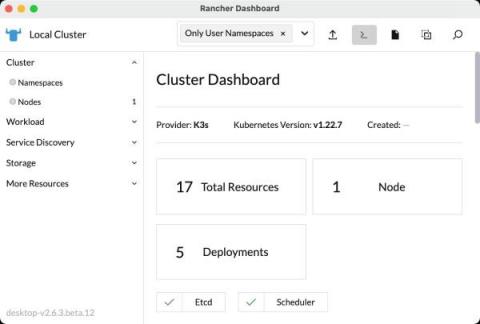
Rancher Desktop Now Includes The Rancher Dashboard

With the 1.2.0 release of Rancher Desktop, there are two new features available as a Feature Preview. Rancher, the multi-cluster Kubernetes manager, includes a dashboard which enables you see and interact with resources in a Kubernetes cluster. Rancher Desktop now includes this dashboard. The dashboard will enable you to view and interact with resources in your local cluster provided by Rancher Desktop.

Kubernetes Master Class: Creating RKE2 Cluster Templates

Rancher 2.6 introduces a new Cluster-API based provisioning mechanism for RKE2 and K3s clusters. This also brings a completely new cluster templating system, which is based on Helm charts and is much more flexible compared to the old RKE1 cluster templates. In this master class, you will learn how the Cluster API works, how you can leverage it in Helm Charts, how to do versioning and how to create a nice UI wizard for them.

How to Scale your AWS Infrastructure - Part 2

Welcome to the second post in a series of “How to Scale your AWS Infrastructure”. In the first post, we talked about horizontal scaling, autoscaling, CI/CD, infrastructure automation, containerization, etc. In this post, we will continue the discussion around databases, loose coupling, caching, CDN, etc. Let’s start the discussion with database scaling.