Operations | Monitoring | ITSM | DevOps | Cloud

Health First and ManageEngine: A decade of features, savings, and trusted partnership

Douglas Morris, senior cybersecurity engineer at Health First, the largest healthcare provider in Brevard County, Florida, shares why ManageEngine is essential to Health First's security and compliance operations. With over 12,000 employees across hospitals, clinics, pharmacies, and insurance services, Health First relies on strong cybersecurity and detailed audit capabilities. Early gaps in logging led Morris to adopt ManageEngine ADAudit Plus, which proved invaluable, and over nearly a decade the healthcare provider added ADManager Plus, M365 Manager Plus, and RecoveryManager Plus.

We Upgraded SigNoz Infrastructure Monitoring for Deeper Visibility and Faster Troubleshooting

A quick walkthrough of the new infrastructure monitoring experience in SigNoz Cloud. We’ve made several additions to give you more visibility into your infrastructure health and help you troubleshoot faster. Here’s what’s new,

Burnout Is Rising. Here's What You Can Fix

The faster teams deploy, the more releases fail, and burnout climbs right with it. What 700 engineers told Harness about delivery at AI speed. Lenny's Newsletter put out its 2026 tech workforce survey this year, and you should read the whole thing. The headline stats: significant burnout jumped from 44.7% to 55.7% of tech workers in a year. Career optimism dropped from 54.8% to 48.7% over the same period of time.

AI Agent And Digital Certificate Inventory: How to Track Your Invisible IT

An AI agent and digital certificate inventory is a record of every AI agent and digital certificate an organization runs, with what each one does, who owns it, what it connects to and when it expires or needs a review. IT and IT Asset Management (ITAM) teams build one because both kinds of asset keep critical services running with no hardware to scan, no purchase order to trace and, very often, no owner on record.

Kimi API pricing in 2026: the K3 ladder, the August retirement, and what Moonshot really charges

Kimi API pricing, per million tokens: the flagship Kimi K3 costs $3 input and $15 output with a $0.30 cache-hit rate and 1M context. Kimi K2.6 and the coding-tuned K2.7 Code both run $0.95/$4.00 on 256K context. Kimi K2.5 and the legacy V1 family were retired August 31, 2026.

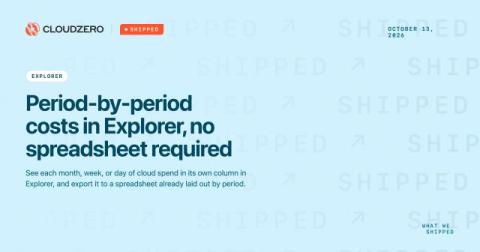
Shipped: Period-by-period costs in Explorer, no spreadsheet required

Finance teams reconcile cloud spend period by period. They want each month, week, or day in its own column, so they can scan across a row and see how a service or team changed over time. Explorer’s Aggregate view already answers “what changed and by how much.” But when the question is “what did we spend in June, July, and August, line by line,” that summary needs to become a grid.

Your AI Economics Pulse for October 2026

Across a same-store panel of 422 CloudZero customer organizations, AI reached 3.02% of the median company's cloud bill in September 2026, up 37 basis points from 2.66% in August, the largest monthly gain since we began tracking. The 75th percentile rose to 12.55%. The share of organizations spending at least $1,000 a month on AI barely moved, to 68.0%. Companies already spending drove the growth. Last month we called the median the least informative number in this report. September proved us wrong.

How to Manage Cloud Alerts: AWS, Azure, and Google Cloud

To manage cloud alerts effectively, define which conditions require immediate action, include useful incident context, and route critical notifications to the engineer currently on call. Add escalation rules for unanswered alerts and test the entire path from detection to response. This process applies whether your team uses AWS, Azure, Google Cloud, or several providers. Cloud monitoring can tell you something is wrong.