Operations | Monitoring | ITSM | DevOps | Cloud

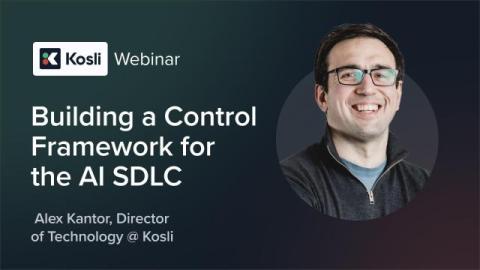
Building a Control Framework for the AI SDLC

Since November, Kosli’s own engineering team has been running a live experiment: what happens to code review when the thing generating the code - and increasingly, the thing reviewing it - is an AI, not a person. Alex Kantor, Kosli’s Director of Technology, walked through that experiment in this webinar: what broke, what it cost to fix, and what four “obvious” assumptions in a standard code review control turned out not to hold once you took the human out of the loop.


SDLC Phases and the Reliability Gap AI Can't Close

Decisions in each SDLC phase from planning to design, development, testing, deployment, and maintenance are made without sight of live production behavior. AI coding agents are widening that visibility gap faster, working faster than human engineers ever could. This piece maps exactly how this gap presents at each phase, and the harm that this brings.

How AI Agents Are Changing Each Agile SDLC Phase

The Agile software development lifecycle was designed to surface problems early, with short sprints, iterative testing, and continuous integration built on the premise that faster feedback loops produce better software. AI coding tools have changed the velocity equation across every phase of that loop, but the phases designed to catch failures are struggling to keep up because build speed and validation capacity have not accelerated at the same rate, and the gap between them is widening with every sprint.
Sponsored Post

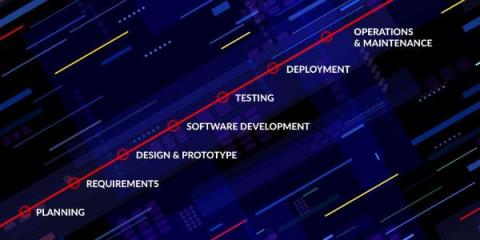
The SDLC: phases, popular models, benefits & more

The Software Development Life Cycle (SDLC) describes the process we follow to deliver software to customers. It captures each step of creating software, from ideation to delivery and eventually to maintenance. In this post, we've broken down everything you need to understand the SDLC.

Innovation Week Day 1: The SDLC Is Collapsing, and Observability Has Never Mattered More

The software development lifecycle is collapsing. The multi-stage pipeline that defined how software got built and shipped for decades is compressing into rapid loops of intent and validation, with agents now part of the teams building and running it. Day 1 of Innovation Week was about what that shift means for how software gets validated, where observability fits, and the problems that have always been hard but are now genuinely urgent.

AI Didn't Kill the SDLC. It Made It Harder to See

Whilst AI has compressed the visible stages of software delivery; requirements, validation, review and release discipline have not disappeared. They have been pushed into automation, runtime and governance. The real risk is not that the lifecycle is dead, but that organisations start acting as if accountability died with it.

Resilience Testing Is Non-Negotiable in the Enterprise SDLC | Harness Blog

Outages in distributed systems are inevitable, making resilience testing essential in the SDLC. It must be continuous, covering failures, load, and disasters. Delayed validation creates “resilience debt,” increasing risk. A holistic approach—combining chaos, load, and DR testing—plus cross-team collaboration and AI-driven insights improves reliability and reduces impact. Modern software delivery has dramatically accelerated.

Designing an automated SDLC control

For anyone shipping software in regulated industries, the word “control” gets thrown around all over. Compliance frameworks demand controls, auditors verify controls are used, engineering teams implement controls, and there are even Control Owners. But what exactly is a control? And more importantly, how do we design controls that actually serve their intended purpose while enabling rather than hindering delivery velocity?

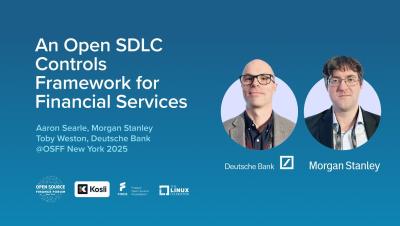
An Open SDLC Controls Framework for Financial Services

How can financial institutions align on software delivery governance without slowing down innovation? At FINOS OSFF New York 2025, Deutsche Bank and Morgan Stanley introduced the new SDLC Governance Working Group — an open collaboration under FINOS to create a Common Controls Catalogue for software delivery. Kosli's Mike Long helped form and participates this group, contributing expertise in continuous compliance automation and controls engineering to connect the engineering and policy communities.

The new AI-driven SDLC

For decades, the software development life cycle (SDLC) has been the framework teams use to understand how software moves from idea to production. It breaks complex work into familiar phases: planning, design, development, testing, deployment, and maintenance. This structure gave organizations a shared way to coordinate teams, track progress, and build with confidence.