Logging helps developers in reducing errors and cyber-attacks. The application is designed to be dynamic. We can't always predict how an application will react to data changes, errors, or program changes. Logging in allows us to better understand our own programs. For all applications, an absolute logging solution is essential. A good logging system increases the application's stability and makes it easier to maintain on the production server.
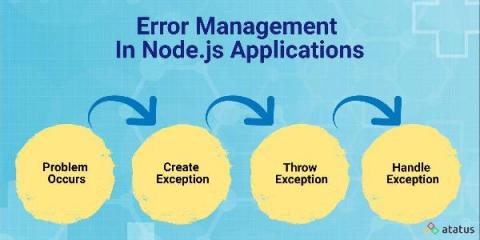
No one is perfect in this world including machines. None of our days pass without having errors faced in our professional life. Whenever we are facing any issues/errors while working rather than worrying, let us all fix our mind like we are going to learn something new. This will make your tasks easier. One of our friend Error Handling will help us in fighting with these errors. These reduce our pressure by finding the errors and guide us to achieve the desired output.
One of the most typical things a developer does is make an HTTP call to an API. An API request can be sent in a variety of ways. We can use a command-line tool like cURL, the browser's native Fetch API, or a package like Axios to accomplish this. Sending HTTP requests to your API with Axios is a fantastic tool. Axios is supported by all major browsers. The package can be used for your backend server, loaded via a CDN, or required in your frontend application.
Node.js is a known and popular JavaScript framework for 2021. With the increasing utilization of Node.js in development, there is an equally increasing need for Node.js server monitoring. Since server monitoring is essential to all applications, it is important that you apply best practices when monitoring Node.js servers. Servers are devices for storing or processing information provided to other devices, applications, and users on-demand.
Sometimes, applications do not perform as well as they should. Application developers are responsible for performing preventive and curative maintenance. Customers that use your application as a developer may waste a lot of money attempting to restore the applications without your help. To maintain track of your application's activities, it's best to use an effective monitoring system. Monitoring a Node.js application entails keeping a careful eye on its performance and availability.
It’s the end of AWS Lambda support for Node.js v10. AWS Lambda support for Node.js 10 is due to end in August 2021. It’s time to switch! In this article, we’re discussing and comparing the differences of working with Node.js 10 and Node.js 14 + AWS Lambda, the impacts, and benefits of this change. AWS Lambda supports multiple versions of programming language runtimes, but not forever.
Virtual machines (VM) offer great flexibility for hosting web applications. A developer/engineer is able to configure and control every piece of software and every setting that the application needs to run. Azure, one of the largest cloud hosting platforms, has virtual machine offerings for both Linux and Windows-based operating systems. In this tutorial, you will learn how to set up a continuous deployment pipeline to deploy a Node.js application to an Azure virtual machine.
It’s easy to get lost with dozens of plugins and frameworks when starting a new project that requires basic authentication and authorization capabilities. It doesn’t have to be that way. In this article, we’re going to explore two valuable Node.js packages — Passport and CASL — that can help you boost the security of your application by providing both authentication and authorization functionality.
Koabamm! We now monitor Koa. This Node.js framework enables you to use cascading middleware, which can now also be shown in AppSignal. Let’s dive right in!