Operations | Monitoring | ITSM | DevOps | Cloud

Integration roundup: Monitoring your AI stack

Integrating AI, including large language models (LLMs), into your applications enables you to build powerful tools for data analysis, intelligent search, and text and image generation. There are a number of tools you can use to leverage AI and scale it according to your business needs, with specialized technologies such as vector databases, development platforms, and discrete GPUs being necessary to run many models. As a result, optimizing your system for AI often leads to upgrading your entire stack.

Enhance code reliability with Datadog Quality Gates

Maintaining the quality of your code becomes increasingly difficult as your organization grows. Engineering teams need to release code quickly while still finding a way to enforce best practices, catch security vulnerabilities, and prevent flaky tests. To address this challenge, Datadog is pleased to introduce Quality Gates, a feature that automatically halts code merges when they fail to satisfy your configured quality checks.

Easily test and monitor your mobile applications with Datadog Mobile Application Testing

Effective mobile application testing that meets all the requirements of modern quality assurance can be challenging. Not only do teams need to create tests that cover a range of different device types, operating system versions, and user interactions—including swipes, gestures, touches, and more—they also have to maintain the infrastructure and device fleets necessary to run these tests.

Quickstart network investigations with NPM's story-centric UX

Datadog Network Performance Monitoring (NPM) gives you visibility into all the communication that takes place between the network components in your environment, including hosts, processes, containers, clusters, zones, regions, and VPCs. As organizations scale, and as their networks grow in complexity, the massive volume of network data to be monitored can become overwhelming. Knowing precisely what network data to surface to resolve issues within these larger environments can be a challenge.

Container Security Fundamentals - Linux Namespaces (Part 3): The Network Namespace

In this video, we continue our examination of Linux namespaces by looking at some details of how the network namespace can be used to isolate a container’s view of network resources, and how this feature can be used for troubleshooting container problems.

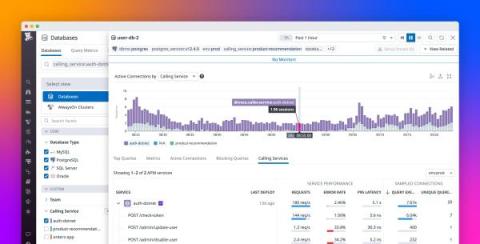
Pinpoint performance issues in downstream services with the Dependency Map Navigator

Visibility into the upstream and downstream dependencies of your services is key to maintaining a performant microservices environment. Application developers and SREs rely on this visibility to quickly trace issues back to the source, which is essential during incidents—when time is of the essence—throughout day-to-day operations, and as systems evolve and scale.

Import Backstage YAML files into Datadog to manage all your services in one place

The Datadog Service Catalog centralizes your organization’s knowledge about the ownership, reliability, performance, costs, and security of your services. If you’re also using Backstage to keep track of your services, you can leverage our support for Backstage YAML to easily consolidate and maintain all your service information in the Service Catalog.

Understanding AWS Lambda proactive initialization

AJ Stuyvenberg is a Staff Engineer at Datadog and an AWS Serverless Hero. A version of this post was originally published on his blog. In AWS Lambda, a cold start occurs when a function is invoked and an idle, initialized sandbox is not ready to receive the request. Features like Provisioned Concurrency and SnapStart are designed to reduce cold starts by pre-initializing execution environments.