Operations | Monitoring | ITSM | DevOps | Cloud

The latest News and Information on Incident Management, On-Call, Incident Response and related technologies.

Why Dedicated Incident Channels are the Modern Standard for Slack-Based Incident Response

Where do your teams go during a critical incident? For distributed teams, that war room is a channel in Slack or Microsoft Teams. The question is: are you creating a dedicated space for each incident, or are responders scrambling across DMs, email threads, and general channels trying to piece together what happened? The answer matters. Using dedicated incident channels has become the industry standard for high-performing incident response teams.
How to reduce alert noise without missing what matters

Reducing alert noise involves drawing a line between incidents that need an immediate response and ones that do not. Get this distinction wrong and your team is either interrupted unnecessarily or misses something critical. In this guide, we’ll help you make that distinction clear. We’ll cover what counts as noise and how to reduce it without missing what matters.

Inside the .de DNS Outage: Real-World Data from UptimeRobot.

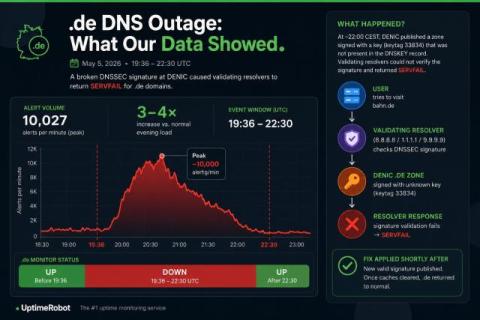
In the evening of May 5th, 2026, large parts of the German web briefly went dark. For a few hours, anyone trying to load a.de address through a major DNS resolver got errors instead of websites. Bahn.de, Amazon.de, and Spiegel.de were among the affected. Major brands like Telekom, DHL, and Sparkassen felt it too, along with hosting providers Hetzner, Strato, and Ionos.

PagerDuty's Slack App: New Incident Management Capabilities

We’ll be rolling out new Slack capabilities to eliminate more manual toil from your incident workflow: click once to promote any alert to an incident, get dedicated channels created automatically, page responders without leaving Slack, and manage all your settings in one place. This is part of our path to autonomous operations: reducing toil, protecting your capacity, and letting you stay in flow. If you’re only using PagerDuty for on-call scheduling, you’re missing the full picture.

What is alert fatigue? (And how does it happen)

Alert fatigue doesn’t announce itself. It builds quietly over weeks and months until one day a critical incident triggers and nobody responds with the urgency it deserves. By that point, the damage is already done. This guide walks through what alert fatigue actually is, how it happens, and what you can do about it.

PagerDuty's Product Drop (May 2026)

PagerDuty’s monthly drops are here! May’s drop delivers innovation, helping teams work faster and smarter with four major updates: SRE Agent Enhancements: Triage just got turbocharged. New connectivity + new capabilities = faster resolution. Shift-Based Schedules (GA planned for May): Schedules are more flexible than ever. Quick start options, custom shifts, and multi-responder support for shadow training or increased coverage.

Post-Incident Reviews in the PagerDuty UI

Turn incidents into learnings and build resilient operations with real-time collaboration and actionable insights built directly into your PagerDuty workflow. Post-incident Reviews in the PagerDuty UI are now in Early Access. Coming soon: AI-generated drafts and intelligent follow-up suggestions.#IncidentResponse.