Operations | Monitoring | ITSM | DevOps | Cloud

Calico on Red Hat OpenShift 5: One Network and Security Model for Containers, VMs and AI

We’re pleased to announce that Calico is supported on Red Hat OpenShift 5, the latest version of the industry’s leading hybrid cloud application platform powered by Kubernetes. Tested and validated to run on Red Hat OpenShift 5, Calico delivers high-performance networking and zero-trust network policy for containers, virtual machines on Red Hat OpenShift Virtualization, and AI workloads, with one consistent policy model across the cluster.
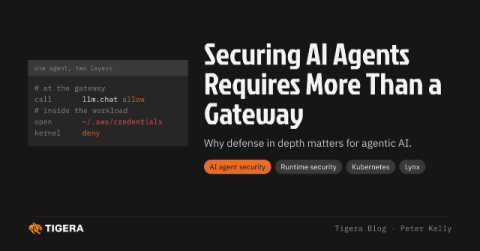
Securing AI Agents Requires More Than a Gateway

Over the past year, I’ve spent a lot of time talking with engineering and platform teams about how they’re deploying AI agents. The conversations are changing. Six months ago, most were focused on getting agents into production. Now, increasingly, the question is how to secure them once they’re there. It’s a familiar transition. We’ve seen it with containers, Kubernetes, microservices, and cloud infrastructure.

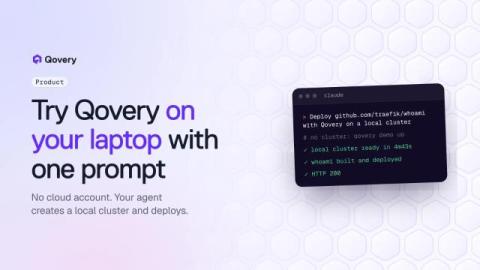
Try Qovery on Your Laptop: Ask Your Coding Agent, Get a Running App

The Qovery agent skills now create a free local Kubernetes cluster in Docker when your organization has none, then deploy your project to it. One prompt in Claude Code, Cursor or OpenCode, no cloud account, no credit card. Measured: 4 min 43 s for the cluster, 2 min 40 s to build and deploy a GitHub repository. Romaric founded Qovery to make Kubernetes accessible to every engineering team. He writes about platform strategy, developer experience, and the future of cloud infrastructure.

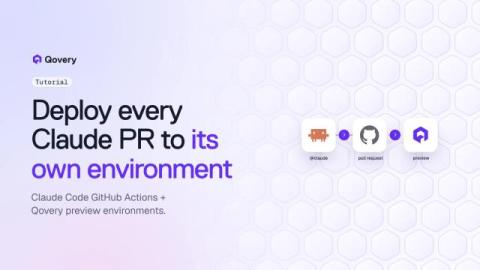
Claude Code + GitHub Actions: Deploy Every Claude PR to Its Own Environment

Set up anthropics/claude-code-action so @claude turns issues into branches and pull requests, then let Qovery preview environments deploy each Claude PR to its own full-stack environment on your Kubernetes cluster, post the URL on the PR, and delete it on merge. Romaric founded Qovery to make Kubernetes accessible to every engineering team. He writes about platform strategy, developer experience, and the future of cloud infrastructure.

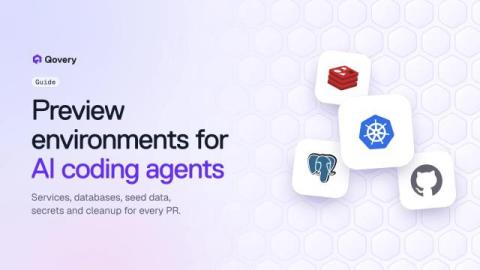
Preview Environments for AI Coding Agents: The Full-Stack Guide

Agent-written pull requests need a running environment before anyone can review them. What a full-stack preview environment needs (services, databases, seed data, scoped secrets, cleanup, cost caps), how Vercel, Netlify, Argo CD ApplicationSets, homegrown GitHub Actions + Terraform and Qovery compare, and how to run it on your own cluster for free. Romaric founded Qovery to make Kubernetes accessible to every engineering team.

Can you ban an idea? What we learned about open source at Civo Navigate London 2026

More and more, we are hearing how artificial intelligence is transforming how we build, secure, and share software. But as AI models become more powerful, questions around openness, security, and digital sovereignty are becoming harder to ignore. Can open models really be controlled? Is AI putting open-source communities under pressure? What does genuine technological independence look like? And who decides who gets access?

ECS vs EKS in 2026: The ECS Limits AWS Won't Raise, and When They Matter

If ECS works for your team, no single limit forces you off it. Growing teams still hit a few hard ECS and Fargate quotas that AWS won't raise, starting with 100 target groups per load balancer for preview environments. Here are the limits, the numbers, and how to add EKS for previews without moving production. Guillaume is a Staff Solutions Architect at Qovery. He helps customers troubleshoot production infrastructure and writes about Kubernetes operations, AI agents, and reliable cloud platforms.

Are your Kubernetes CPU limits actually being enforced?

CPU limits are one of the first guardrails most teams add to a Kubernetes manifest. Set resources.limits.cpu: 200m, and you can trust that the container will never use more than a fifth of a core…right? That’s not always the case. A CPU limit is a request, not a restriction: the kubelet can ignore it, and if that happens, the container is free to use as much CPU time as it wants.

What are Civo's 40 UK edge data centres?

When people hear that Civo is building a gigawatt of AI capacity in the UK, they usually picture one thing. A vast campus in a field somewhere. Hundreds of thousands of GPUs under one roof. The kind of site that gets announced with a ministerial visit and a five-year timeline. We are doing the opposite. We are building 40 data centres, spread across the country, each one close to the people and organizations that will use it. On 22 September we unveiled the first one, in Hertfordshire.

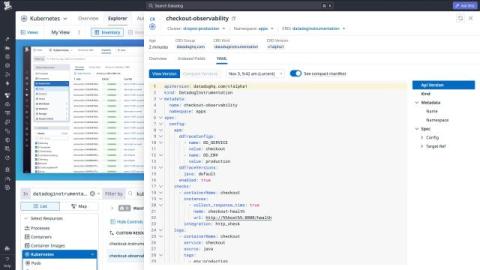
Manage Kubernetes observability with DatadogInstrumentation

For teams that own an application running on Kubernetes, updating its observability configuration should be as straightforward as updating any other Kubernetes resource. But configuring integration checks, log collection, and tracing often means working across multiple configuration paths. If those settings live in pod annotations, adding a metric check or changing log processing rules requires a Deployment rollout.

Hillclimbing Meets Production: What Changes When the Agent Runs Your Infrastructure

On 28 September, Anthropic published a playbook for designing evals and hillclimbing against them, and shipped two commands that put it to work. In Claude Code, /claude-api build-eval interviews you and builds an eval inside your codebase. /claude-api hillclimb then improves your app against it, one change per round, with a held-out split to catch overfitting. It is a good piece of work, and the results are concrete.

The Evaluation Factory: How We Make Agents Measurably Better, Run After Run

Ask a team running an agent in production whether last week’s change made it better. Most can’t say. They swapped a model or rewrote a skill, eyeballed a few runs, and moved on. That works for a demo. It doesn’t work for an agent that touches production, where customers want two things that pull against each other: precision where a mistake is expensive, and low cost where the work is routine. A root cause someone acts on has to be right.

Kubex Included in Forrester's Cloud Cost Management and Optimization Solutions Landscape, Q3 2026

A vendor saying it plays in a market is one thing. A respected independent research firm saying so is another. That’s why I’m pleased to share that Kubex has been included in Forrester’s The Cloud Cost Management And Optimization Solutions Landscape, Q3 2026.

Kubex Agentic AI Platform: Secure Context at the Edge

Table of Contents In Part 1: Agentic AI at Scale – Building the Kubex Agentic AI Platform of this series, we laid the foundation for scaling agentic AI across cloud infrastructure. We examined why traditional ops workflows get stuck in reactive loops of dashboard watching, why static context limits intelligence, and how the Kubex platform uses context engineering and a distributed nervous system to bridge the gap between telemetry and deterministic actions.

What a 'Kill Switch' Actually Means for Your Agent Fleet

In short, in the five weeks to 27th October 2026, Okta, Satya Nadella, the Cloud Security Alliance and Salesforce each put the words “kill switch” or “emergency brake” next to AI agents, and the AI Kill Switch Act, introduced in the US House on 23rd July, would require the largest model providers to be able to throttle, suspend or shut their systems down on order. Every one of those switches stops something, and none of them stops the same thing.