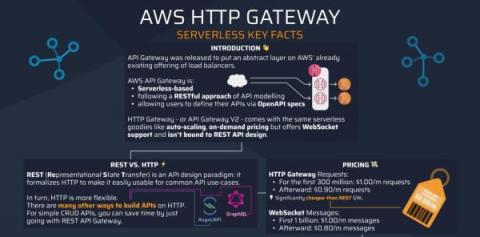
[Infographic] HTTP API Gateway from a serverless perspective
Since our latest update, Dashbird also gives you insights into HTTP API Gateway. Let’s look at the differences between REST vs. HTTP; HTTP API Gateway pricing, integrations and monitoring.


The latest News and Information on API Development, Management, Monitoring, and related technologies.
Since our latest update, Dashbird also gives you insights into HTTP API Gateway. Let’s look at the differences between REST vs. HTTP; HTTP API Gateway pricing, integrations and monitoring.
Why this combination you ask? Load testing is my passion, and I am partial to Kubernetes. I challenged myself to share a use case that many could relate to, focused on a business critical application. Websites came to mind and WordPress is the world’s most popular website management system. Of course, nginx is the most popular web server so let’s throw that into the mix. And Kubernetes? With more than 50% of corporations adopting Kubernetes in 2021, what better system to run in.
To provide a fast, seamless, and highly available experience for the end-user, modern applications increasingly rely on third-party services. Due to this rising complexity, it's become important for IT employees to ensure that these services are up and running and communicating as they should. API monitoring has thus become a must-have for DevOps teams.
Python code optimization may seem easy or hard depending on the performance target. If the target is “best effort”, carefully choosing the algorithm and applying well-known common practices is usually enough. If the target is dictated by the UX, you have to go down a few abstraction layers and hack the system sometimes. Or rewrite the underlying libraries. Or change the language, really. This post is about our experience in Python code optimizations when whatever you do is not fast enough.