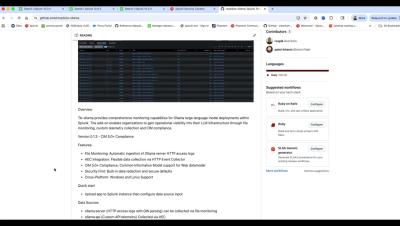
Without strong visibility and governance, local LLMs risk replicating the fragmented, unsupervised sprawl once seen in shadow IT, complicating security postures and making it difficult for organizations to ensure proper oversight and compliance as these powerful AI tools become embedded in daily workflows. To address this challenge, The Splunk Threat Research Team has released the Splunk Technology Add-on for Ollama that provides comprehensive monitoring and observability capabilities specifically designed for local LLM deployments.
The digital landscape has transformed dramatically, and with it, the demands on our systems have grown exponentially. Traditional monitoring tools struggle to provide sufficient insight into complex, distributed, cloud-native environments. Observability is the answer, moving beyond merely knowing "what" is happening to understanding "why" it's happening, and its impact on user experience and business outcomes.
Stop letting typos or OTel SDK updates break your production dashboards! This KubeCon 2025 talk introduced Otel Weaver, a new tool that lets you live-check your OpenTelemetry data before you merge. It's unit testing for your telemetry.
Imagine a future where machines not only perform physical tasks but also learn, adapt, and make intelligent decisions in dynamic environments. This future is rapidly becoming a reality with the advent of smart robots, poised to revolutionize industries from manufacturing to healthcare. In this article, we'll delve into smart robots: what makes these intelligent machines 'smart', how they perform tasks, and how they are reshaping the operational landscape.
In September at.conf25, we announced how Splunk is shaping the future of digital resilience in the age of AI. Agentic AI is rewriting what it takes to build a leading observability practice. As vibe coding gains steam, applications will be built with less human involvement. At the same time, the rise of AI agents demands specialized telemetry to ensure models are performing as intended—aligned to their business purpose and cost.
Splunk is very excited to be sponsoring Kubecon North America once again, kicking off this week in Atlanta, GA. As many know, Splunk is one of the top contributors to the OpenTelemetry project. We’re happy to have sent many of the Splunkers who serve as project maintainers and contributors to lead SIG meetings and engage with the greater community in the OpenTelemetry Observatory, sponsored by Splunk.
Singapore’s digital economy is growing at a remarkable pace, but with that growth comes a challenge: the nation is on track to need more than a million additional digitally skilled workers by 2026, particularly in cybersecurity, data, and AI. This is not just about filling jobs — it’s about ensuring the country’s long-term digital resilience.
A short video that introduces the Splunk Developer Program, highlights the end-to-end support and tooling it offers, and showcases how developers can build, test, and grow impactful apps with confidence. The video will follow the journey of a first-time app builder who discovers the program, uses its resources, and becomes an active, recognized contributor in the Splunk community.
Load Balancing is the process of distributing network traffic among multiple server resources. The objective of load balancing is to optimize certain network operations. Ensuring that a workload is spread evenly among the computing resources, this “balanced load” improves application responsiveness and accommodates unexpected traffic spikes — all without compromising application performance. Let’s take a deeper look at this important networking function.