Operations | Monitoring | ITSM | DevOps | Cloud

The latest News and Information on APIs, Mobile, AI, Machine Learning, IoT, Open Source and more!

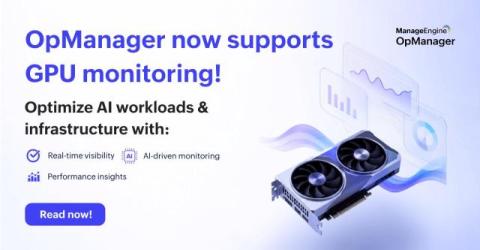
GPU monitoring in OpManager: Full visibility for every AI workload

AI has moved to be a core part of enterprise infrastructure. GPUs are the engines behind that shift. Every training run, every inference request, and every fine-tuning job depends on GPU chipsets that are expensive and delicate. A GPU that overheats, runs out of memory, or sits idle for hours doesn't just slow a project down, it quietly drains the IT budget. Most monitoring tools weren't built with this hardware in mind. This leaves AI and DevOps teams blindsided when a job fails or a chipset degrades.
Safely Troubleshooting Customer Production Incidents Using MCP and AI Skills

See how Qovery's MCP server and AI skills turn vague production incidents into evidence-backed diagnoses while keeping engineers in control. Guillaume is a Staff Solutions Architect at Qovery. He helps customers troubleshoot production infrastructure and writes about Kubernetes operations, AI agents, and reliable cloud platforms.

Governance Starts at the Network: How We Put AI Agents in Production

AI agents are becoming a new persona in the org chart. Learn how Qovery enforces data control, limited access, and auditability at the network level. Romain is a staff engineer at Qovery working on the control plane and AI integrations. He writes about distributed systems, incident response, and MCP-based tooling.

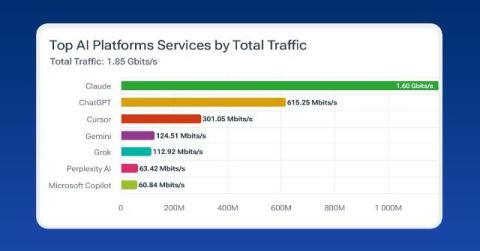
Introducing AI Platform Traffic Visibility in Kentik

Generative AI has quickly emerged as a distinct over-the-top (OTT) traffic category, yet service providers have lacked the visibility to track it. Kentik now identifies traffic from 35+ AI services across 28 providers, showing operators how it enters their networks, where it’s growing, and what it costs to deliver.

Agent Guard: Control AI Assets Before They Become Shadow AI

A developer on your team just told Claude Code to connect to a new MCP server, the protocol coding agents use to reach organizational tools and data. Nobody in security reviewed it. Nobody in security even knows it happened. For two-thirds of enterprises, the primary obstacle to scaling agentic development isn’t budget or headcount — it’s security risk.

Your AI agent can now set up uptime monitoring. No signup required.

We’re happy to introduce you to the first agentic uptime monitoring setup! Now your AI agents can continue their coding, testing, and deploy flows into setting up the monitors, including a free account. The agent submits your site’s URL and your email, you confirm with one click in the email you receive, and you have a working monitor plus a free account. No registration form, API key, or dashboard configuration needed.

Who Owns Deployment Governance? Structuring Accountability in the AI Era

In this series, we have talked about how generative AI is shifting the landscape of software creation. In The New Software Creator, we explored how AI expands who can write code. In When Anyone Can Build Software, Deployment Governance Is What Keeps It Safe, we looked at why the deployment pipeline is the ultimate control point. Finally, in Security at Scale: What Changes When Everyone Can Deploy, we dug into the technical realities of patching, container hygiene, and identity management.

Our 3-month AI roadmap - the future of smart dashboards

AI is set to transform our technology landscape. For many of us working in software, it already has — developers are now writing more code, building more features, and deploying more applications, faster. For the teams supporting IT and software services that means more applications to support, across a greater breadth of technologies, and with more complexity (that is probably less well understood by the developers who created it). Your operational tooling needs to keep pace.

Your AI Agents Can Take Action Now. Can You Prove They Should Have?

Enterprise AI agents clear every demo and pilot, then hit a compliance wall. The gap isn't technology—it's architecture. Discover why governance must sit inside the execution flow across six control points, not bolt on afterward as an afterthought at input and output only.