
Operations | Monitoring | ITSM | DevOps | Cloud

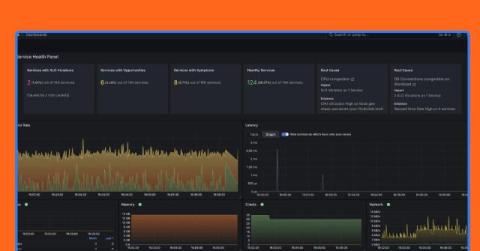
A simple new way to visualize Prometheus

Even if you don’t work with Prometheus day-to-day, you most likely have heard of it. After Kubernetes was donated to the Cloud Native Computing Foundation (CNCF), Prometheus became the second project to be incubated soon after. That was back in 2016 and it is still one of the most active CNCF projects. Why is it so popular? It’s the de facto monitoring tool for containerized workloads running on-prem and in the cloud – that is, it’s the monitoring tool for Kubernetes.
Getting Started With AWS Dashboards

Being the most popular cloud solution provider, AWS needs no introduction. With its powerful and numerous services and solutions, many companies of all sizes and shapes run their applications and/or infrastructure on AWS. With AWS being integrated with other internal services as well as external solutions hosting the business apps, it is crucial to be aware of what's happening across the landscape and beyond, to ensure business continuity. The AWS plugin for SquaredUp helps you achieve exactly that.

How to keep Ingress NGINX Controller metric volumes manageable and still meaningful

The Ingress NGINX Controller is a widely used Kubernetes component for managing HTTP and HTTPS traffic routing. While it provides powerful observability through Prometheus metrics, it’s also notorious for generating an excessively high number of time series. The root cause lies in how the controller labels its metrics—tracking requests across multiple dimensions such as ingress name, host, path, status code, and upstream response times.

Why Observability is Getting Expensive and OpenTelemetry is Becoming More Popular | Grafana Labs

Grafana Labs' Jen Villa shares the latest insights into how organizations are rethinking their observability strategies — with cost now taking center stage. This video covers: Chapters: Grafana Cloud is the easiest way to get started with Grafana dashboards, metrics, logs, and traces. Our forever-free tier includes access to 10k metrics, 50GB logs, 50GB traces and more. We also have plans for every use case.

Grafana Campfire - Data Visualization Tips and Best Practices (Grafana Community Call- April 2025)

Creating dashboards in Grafana gives you some very good built-in features to manipulate your data by using transformations, variables, filtering, overriding,, annotations for your data and with addition of Community plugins (data sources, panels and apps) increases the user experience to a whole next level. Still, many users do not either know about these features or do not use it correctly and why is the reason?

Everything You Need to Know About OpenTelemetry Histograms

Modern systems throw off a lot of data—metrics, traces, logs—sometimes more than we know what to do with. When you're trying to understand how values spread out over time (like response times, memory usage, or queue lengths), averages alone don’t tell the full story. OpenTelemetry histograms help fill in those gaps. This guide walks through what they are, why they matter, and how DevOps engineers can use them to improve observability in real systems.

All about OTel and Logging on Kubernetes with Loki (Loki Community Call April 2025)

In this pre-recorded Loki Community Call, we talk all about OTel and logging on Kubernetes with Cyril Tovena, Ward Bekker, Jay Clifford, and Nicole van der Hoeven at KubeCon EU 2025 in London. We discuss when why you should switch to OTel and why you shouldn't, what OTLP is exactly, and best practices for ingesting data through an OTLP endpoint.

Introducing the Causely data source plugin for Grafana

Endre Sara is a Co-Founder of Causely, where he’s building a causal reasoning platform to continuously assure service reliability and eliminate human troubleshooting. Previously, Endre was VP of Advanced Engineering at Turbonomic and a VP at Goldman Sachs. At Causely, we believe observability tools shouldn’t just collect more data—they should enable you to understand it.

Top 3 tools for Azure cost reporting: SquaredUp, Azure Cost Management, & Power BI

Anyone managing Microsoft Azure will be aware of how quickly its costs can escalate. As cloud architectures grow in complexity—spanning hybrid environments, multi-subscription setups, and cross-platform integrations—the need for intelligent cost visibility tools intensifies. With enterprises typically overspending by 25%-35% on their cloud resources, Azure cost reporting has become a big focus for organizations navigating cloud financial management.

How to Get Started with Grafana Infinity Data Source Plugin | Grafana Labs

In this Grafana Learning Journey supplementary video, Developer Advocate Marie Cruz shows how to start with the Grafana Infinity Data Source plugin, from installation to building a dashboard using CSV and JSON data. CHAPTERS Grafana Cloud is the easiest way to get started with Grafana dashboards, metrics, logs, and traces. Our forever-free tier includes access to 10k metrics, 50GB logs, 50GB traces and more. We also have plans for every use case.

How to get started with frontend observability: A quick Grafana Faro example

Modern cloud-native applications and web browsers are highly complex, making it challenging to gain visibility into their performance. Without an effective way to track and measure frontend performance, it becomes difficult to monitor real user experiences, detect critical issues, assess website health, and ensure optimal functionality. But what if you could see exactly what your users are experiencing in real time?

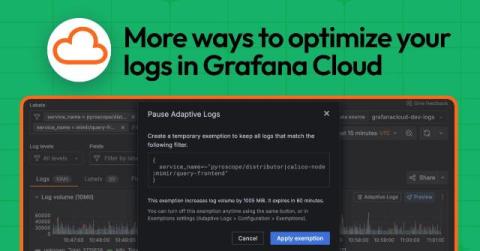
New in Adaptive Logs: user-facing temporary pauses, exemptions, and per-service recommendations

We launched Adaptive Logs last year to help you optimize your log volumes and costs in Grafana Cloud, and we’ve been hard at work ever since making improvements based on your feedback. Over the past couple of months, we’ve delivered several new features to help reduce toil, apply recommendations with precision, and—what we’re most excited about—confidently optimize your log ingestion while still providing peace of mind to your end users!

How to Connect Prometheus to Grafana in Under 2 Minutes | Tutorial | Grafana Labs

In this step-by-step tutorial, we’ll walk you through how to get Prometheus and Node Exporter running locally on an ARM64 Mac (like the M3 MacBook Pro), and how to connect it all to Grafana Cloud for beautiful dashboards and metric insights.

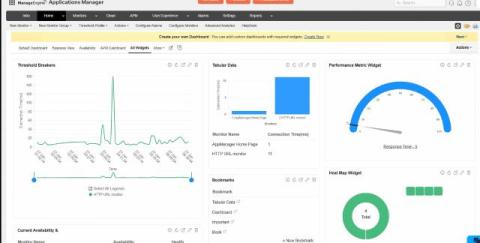
Applications Manager's dashboard: What's new?

In today’s fast-paced IT landscape, efficient application performance monitoring is essential. IT teams need real-time insights, interactive data visualization, and a seamless user experience to detect and resolve issues swiftly. With the latest enhancements to ManageEngine Applications Manager’s dashboard, monitoring is now smarter, faster, and more intuitive than ever before.

How a cooking platform whipped up a new observability plan with Grafana Cloud

As any good cook knows, if you want to create a top-notch dish, you have to use the best ingredients. So when the engineering team for Cookidoo — an online platform and app that features more than 80,000 guided recipes for the Thermomix, an all-in-one kitchen small appliance — realized the observability tool they were using to monitor the platform wasn’t delivering what they needed, they decided to switch to Grafana Cloud and OpenTelemetry.

Grafana Cloud updates: new testing features in Grafana Cloud k6, enhanced troubleshooting in Kubernetes Monitoring, and more

We consistently roll out helpful updates and fun features in Grafana Cloud, our fully managed observability platform powered by the open source Grafana LGTM Stack (Loki for logs, Grafana for visualization, Tempo for traces, and Mimir for metrics). In case you missed them, here’s our monthly round-up of the latest and greatest Grafana Cloud updates.

An Overview of the Grafana Infinity Data Source Plugin | Grafana Labs

Do you have data formats you want to visualize in Grafana that are not supported natively? Or maybe you want to quickly prototype a dashboard and grab data from various endpoints such as REST APIs, CSV, JSON, or GraphQL? If you answered yes, then this video is for you! In this video, Developer Advocate Marie Cruz provides an overview of the Grafana Infinity Data Source Plugin and talks about the value and benefits it can bring.

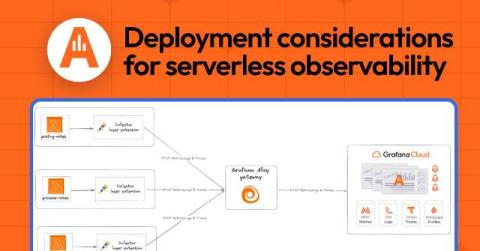
AWS Lambda, OpenTelemetry, and Grafana Cloud: a guide to serverless observability considerations

In our increasingly serverless world, observability isn’t just a “nice to have”—it’s essential. Serverless functions such as AWS Lambda bring incredible benefits, but they also introduce complexities, especially around monitoring and debugging. In a previous article, I provided a quick, practical guide for sending AWS Lambda traces to Grafana Cloud using OpenTelemetry.

How Tools Help Employees Manage Tasks More Efficiently

Managing tasks in a modern workplace can feel overwhelming. Between juggling deadlines, tracking updates, and coordinating with teams, it's easy for things to fall through the cracks. That's why digital tools have become essential for today's professionals. They simplify how work gets done, making task management more structured, visible, and efficient. Let's explore how these tools help manage tasks better and enhance the entire work experience for employees and teams.

Why you should embrace more incidents (seriously!)

We’re all looking for ways to improve on our incident response. We investigate various metrics and methodologies—all in the name of making sure our customers see the reliable and performant systems we’ve sought to build. In fact, all these efforts are leading us, as an industry, to finally realize the power of surprising anomalous events in our systems. They give us an opportunity to reexamine our expectations and see how our models of the sociotechnical system differs from reality.

OpenTelemetry vs. Prometheus Usage: 2025 Observability Survey Analysis | Grafana Labs

Myrle Krantz, Director of Engineering at Grafana Labs, talks about vendor lock-in, OpenTelemetry vs. Prometheus, open source adoption, and other tooling findings from Grafana Labs’ third annual Observability Survey — featuring insights from over 1,200 practitioners across the globe.

How to use constant variables in Grafana dashboards

In this video we'll look at constant variables. Constant variables let you add a value to a dashboard that can be changed by an editor or administrator, but not edited by viewers of the dashboard. Grafana Cloud is the easiest way to get started with Grafana dashboards, metrics, logs, and traces. Our forever-free tier includes access to 10k metrics, 50GB logs, 50GB traces and more. We also have plans for every use case.

Making profiling visualizations accessible to engineers at all levels

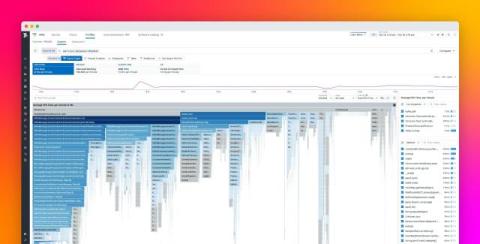
Modern code profilers gather performance data that is highly useful for developers, but the traditional presentation of that data can be challenging to interpret for engineers who are new to profiling. For the Continuous Profiler team at Datadog, our guiding mission is to make profiling a standard practice for all developers by flattening its learning curve and helping teams quickly gain insights into application performance.

How SpotOn overhauled its observability strategy with standardized tagging and Grafana Cloud

Many engineers would agree: migrating to a new observability platform can be a serious undertaking. But it’s also the perfect opportunity to step back, revisit some of the foundational practices that drive your observability strategy — and reap some major benefits, as a result. This was the case at SpotOn, a provider of restaurant point of sales systems and business software, which recently migrated from four disparate observability tools and consolidated on Grafana Cloud.

Opsgenie alternative: How to migrate to Grafana Cloud IRM

In recent years, we’ve seen many organizations migrate from legacy incident response tools to Grafana Cloud IRM — our unified incident response and on-call management application hosted on Grafana Cloud — as they look to improve reliability, reduce costs, and consolidate their tooling. To help guide those efforts, we offer several IRM migration tools that allow you to more seamlessly migrate away from those legacy solutions and start using Grafana Cloud IRM.

Top 3 tools for M365 reporting: SquaredUp, M365 admin center & Power BI

The M365 suite is vast, and the mountains of data that accumulate within each application are huge and ongoing. While data reporting is a necessity, management can feel unwieldy. Luckily, there is an array of reporting software on the market to support this challenge. This blog explores three powerful tools for M365 reporting: SquaredUp, Microsoft 365's native reporting tool, and Power BI.

A privacy-first, data-driven approach to optimize the user experience: Introducing Geolocation Insights in Frontend Observability

Grafana Cloud Frontend Observability is a real user monitoring (RUM) solution that provides immediate, clear, and actionable insights into the end-user experience of web applications. Understanding where those end users are located can provide valuable insights into frontend performance, error patterns, and overall user experience.

Best Practices and Demo: Grafana Cloud's End-to-End IRM Solution | Grafana Labs

Grafana Cloud’s Incident Response and Management solution provides workflows that span creating alerts and SLOs, managing on-call and incident response, and learning from postmortems – all within the context of your observability stack. In this session, you’ll learn best practices for making the most of this IRM solution, including leveraging the historical incident data that’s accessible within Grafana Cloud.

How to Set Up Geolocation Insights | Grafana Cloud's Frontend Observability | Grafana Labs

Want to set up geolocation insights in Grafana Cloud's Frontend Observability? In this step-by-step tutorial, we'll show you how to configure geolocation tracking, use MaxMind's offline database for geocoding, and apply filters for precise location-based insights.

How to use custom variables in Grafana dashboards

Custom variables let you define your own options for dashboard viewers to select. They're a way to fine-tune how your dashboard behaves. In this video we'll look at how to use custom variables in your own dashboards. Grafana Cloud is the easiest way to get started with Grafana dashboards, metrics, logs, and traces. Our forever-free tier includes access to 10k metrics, 50GB logs, 50GB traces and more. We also have plans for every use case.

Executive Buy-In is Driving Observability Maturity: 2025 Observability Survey Results | Grafana Labs

In this video, CTO Tom Wilkie from Grafana Labs breaks down some of the most compelling findings from our third annual Observability Survey, based on over 1,200 industry responses. The big takeaway? Executive involvement is on the rise—and it’s accelerating adoption of advanced observability practices like distributed tracing, profiling, and SLOs. He also explores how SaaS adoption, the maturation of central observability teams, and new instrumentation methods like eBPF and Beyla are reshaping the observability landscape.

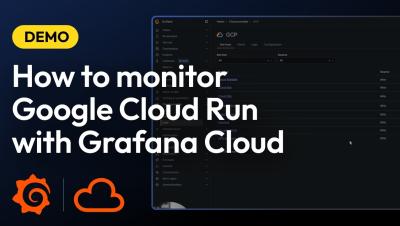
New Google Cloud Run Visualization in Grafana Cloud | Demo | How to Monitor Google Cloud Run

Perfect for troubleshooting, performance tuning, and cost optimization, this new feature helps you stay in control of your Cloud Run workloads. With this sophisticated dashboard, you can: Monitor CPU, memory, network traffic, and active requests at a glance Drill down into individual services and containers with a single click Identify resource usage spikes and optimize performance Use the Right-Sizing View to find the top resource-heavy services & containers.

Adaptive Metrics in Action: How The Trade Desk Optimized Observability Costs | Grafana Labs

Managing observability costs at scale is no easy task — especially when metrics volume grows fast. In this talk, Paul Givens, Head of Observability at The Trade Desk, shares how they implemented Adaptive Metrics to control costs without sacrificing visibility. How Adaptive Metrics works to reduce cardinality and cost Real-world implementation lessons from a high-scale AdTech environment Key takeaways for teams managing large Prometheus-like metric sets.

How to Install a PowerPoint Plugin for Charts in Under 5 Minutes

Creating clean, compelling visuals doesn't have to take hours. If you're tired of fiddling with default PowerPoint tools, a plugin can help you produce stunning graphics in minutes. In fact, you can install one in under five minutes and start transforming your data into presentations that wow your audience. Whether you're presenting to your boss, your teacher, or your classmates, it helps to transform ordinary slides into something much more impressive. In this guide, we'll show you step-by-step how to do that quickly and easily.

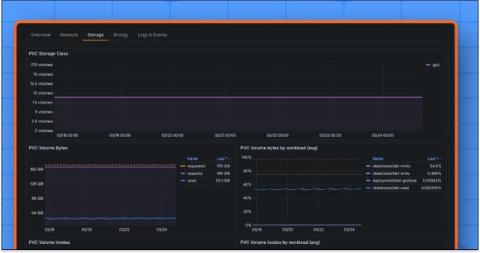
Kubernetes Monitoring: One view for observing all your storage volumes

If you want to observe your entire Kubernetes environment, you need visibility into all of your resources, including storage volumes. But monitoring Kubernetes storage hasn’t always been easy, especially if you wanted to see how it related to other parts of your infrastructure.

Getting started with InfluxDB dashboards

InfluxDB is a powerful open-source time-series database widely used for monitoring system performance, IoT metrics, and application telemetry. With SquaredUp's InfluxDB plugin, you can effortlessly visualize and monitor your InfluxDB data, gaining real-time insights into your metrics alongside your other tools and services. This guide will walk you through connecting InfluxDB with SquaredUp, creating dashboards, setting up monitoring, and sharing your visualizations.