Operations | Monitoring | ITSM | DevOps | Cloud

The finance dashboard I actually use, built from CloudZero and Campfire in an afternoon

Every finance person I know lives in the same loop approaching the end of the month, quarter, or fiscal year. Leadership wants to know where the financials will land (most times before the close has occurred). CS wants customer margins. Someone on the People team needs each department’s AI spend for an OKR review, and they need it quickly to make business decisions. Each answer sits in a different tool or a different spreadsheet, and I bounce across all of them several times a day.


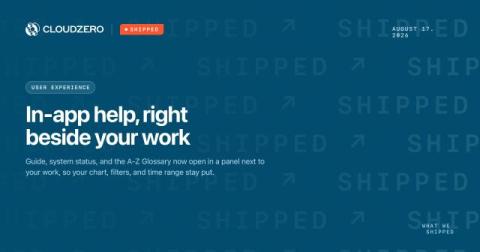
Shipped: In-app help, right beside your work

You are mid-investigation, chasing a spike or pulling a number for finance, and you hit a term or a workflow you need to look up. You should not have to lose your place to find an answer. Guide lives in a fixed spot in the left sidebar, always one click away. It opens a panel on the right side that sits beside your page instead of covering it. Your chart, filters, and time range stay exactly where they were. Nothing gets rebuilt and you keep the thread of what you were investigating.

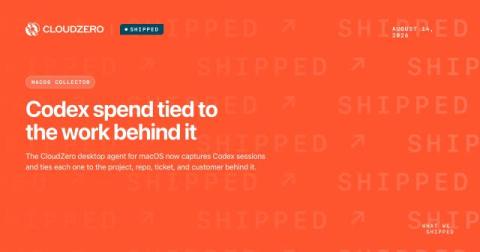
Shipped: Codex spend tied to the work behind it

People run Codex on their own laptops. When Codex is signed in with a ChatGPT subscription, OpenAI’s own admin console shows who used it and how much: messages and credits. What it doesn’t show is what any of that usage was for, or how it compares to what your team spent on other AI tools. The CloudZero desktop agent for macOS installs on a Mac, sees the traffic from AI coding tools, and prices what those tools use.

Why is AI so expensive? The real cost drivers of AI

AI is expensive because the model bill is only part of the cost. Three components set the floor: model subscriptions, per-token API pricing, and infrastructure. Three more make it move: adapting models to your business, catching and fixing errors, and rising energy and datacenter costs. Efficiency doesn't fix it, because cheaper AI gets used more, not less. Businesses are willing to spend on AI. Research from Deloitte found that in 2025, 85% of organizations increased their AI investments.

Your FY27 plan deserves a real AI number, not a hedge

Budget season is starting and most finance teams are finding the AI line is the most evasive line on the page. You lived through the year. AI spend came in higher than planned and moved in ways nobody could foresee or forecast. And when the board asked what it produced, the honest answer probably was “we’re working on it.”

Shipped: Monthly cost comparison in Explorer gets a glow up

Months have different numbers of days, and a monthly cost chart built on raw totals mixes that calendar difference into the trend. A 28-day February next to a 31-day March shows a 10.7% increase even when daily spend never moved. The same math works in reverse: real growth in a short month can look flat, hiding an increase worth investigating. That costs you time in two places. The first is triage.

AI budgeting: how to plan and forecast AI spend

AI budgeting is the process of planning, allocating, and forecasting an organization's AI spend: model and API costs, AI infrastructure, tooling, and the people running it all. It differs from traditional budgeting because AI spend is usage-based, scales with product success rather than headcount, and often spans multiple providers.

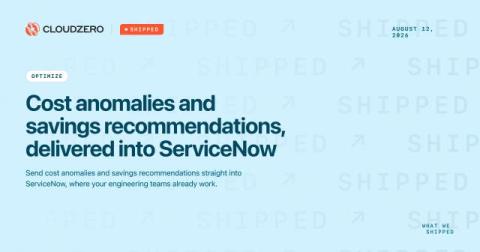
Shipped: Cost anomalies and savings recommendations, delivered into ServiceNow

If your engineering teams run on ServiceNow, incidents are where they get work done. Putting cost work into an incident gives it the same path to resolution as any other work item your team handles. When a cost anomaly arrives as an incident, your teams route it, assign it, and resolve it on their usual SLAs. When a savings recommendation arrives as an incident, an engineer owns it and acts on it. Now you can send either straight into ServiceNow.

How to build the business case for AI

A strong AI business case ties a specific goal to a measured outcome and a fully-loaded cost. Most fail because they skip one of the three: no clear mandate, an over-broad "AI fixes everything" scope, or a cost estimate that ignores adaptation and error-correction. Build it in six steps: define goals, identify uses, break work into tasks, evaluate models, assess total cost, then launch and refine. Most companies are now spending on AI. Far fewer can show what they got back.

How to right-size your existing Claude skills

You shipped a skill. It worked. You closed the tab. That’s the whole problem. Model choice is a decision you make once, at the moment you’re least equipped to make it: before the skill is even authored. Then you never revisit it, because the skill stopped being interesting the day you got it working. So go back and check. Here’s how.

Shipped: Cut the notification noise so real cost anomalies stand out

A view is scoped to the costs your team cares about, and now its notifications are too. Weekly and monthly trend summaries, and global anomaly alerts, only reach a channel when your team wants them there. That keeps a shared channel signal, not static, so the alerts that need action don’t get lost next to irrelevant updates. Your team decides, per view, which notifications reach its channel.

LLM cost management: a practical guide for teams that own the budget

LLM cost management is the practice of tracking, allocating, budgeting, and governing large language model spend so every dollar maps to a feature, team, and business outcome. It has five levels: provider visibility, business allocation, unit economics, model governance, and a continuous optimization loop. It matters because 68% of companies say AI initiatives ran over budget last year, and per CloudZero's 2026 survey, 30% of finance leaders still reconcile AI spend manually.

Pentagon-shaped org charts are coming. Intellectually curious leaders will get a head start.

If you spend even fifteen minutes reading about AI’s impact on the future of work, you’ll take in a lot of fear-based analysis. The fears are real — 40% of workers fear losing their jobs (Metaintro), 60% believe AI will eliminate more jobs than it creates (Yardi Kube), and 52% generally worry about the impact of AI in the workplace (Pew Research) — but the analysis is all wrong.

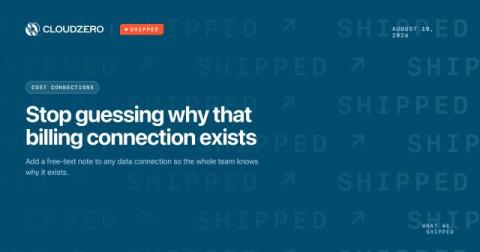
Shipped: Stop guessing why that billing connection exists

Every team with more than a few data connections has had this moment: someone opens the connections list, points at one, and asks “what is this for?” The answer lives in a former teammate’s head or in a Slack thread. And cleaning up the wrong connection can break cost ingestion. Now each connection can carry a note that explains why it exists, and anyone who opens the connection sees it.

AI agent cost: what agents really cost to run

AI agent cost in 2026 is mostly a consumption bill, not a subscription. Running an agent costs anywhere from fractions of a cent for a simple routed task to $5 or more for a complex multi-step job, because one request can trigger 3 to 10 model calls behind the scenes. Average production deployments land between $3,200 and $13,000 per month in operational spend. Here is where that money actually goes.

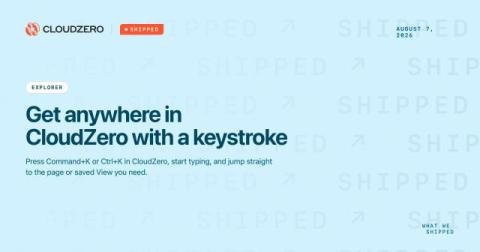
Shipped: Get anywhere in CloudZero with a keystroke

You know exactly where you want to go in CloudZero. Getting there sometimes takes a moment as you click into the nav, open a menu, scroll a dropdown, find the thing, click again. Every trip back to a familiar spot can take a few steps. Shortcuts remove that friction. Press command+K on Mac or ctrl-K on Windows anywhere in CloudZero, type where you want to go, and hit Enter. That means there’s no clicking through the nav and no scrolling to find what you already know the name of.

What is AI ROI? Definition and why it matters

In 2025, 85% of organizations increased AI investment, and 91% plan to do the same this year, according to Deloitte. Despite continued spending, however, ROI lags behind, with just 6% seeing payback within one year. While AI use cases tend to have a longer payback period, often in the 2-4 year range, companies can’t afford to keep spending money without some measure of its practical impact both immediately and over time.

What are AI tokens? The unit your AI bill is written in

AI tokens are the small chunks of text, roughly four characters or three quarters of a word each, that language models read and generate. Every prompt and every response is measured in tokens, and AI providers bill per million of them. That makes the token the base unit of AI spend: 1,000 tokens is about 750 words, and every AI feature you ship is a token meter running.

Ai4 2026: Measuring AI spend is solved. Now it's time to prove its worth.

CloudZero had a full team on the ground at Ai4 in Las Vegas during the first week of August 2026. The team included CTO Erik Peterson, who spoke on a panel about AI cost economics. The same problem surfaced everywhere we went: teams can see what they’re spending, but not whether it’s working. DIY cost tooling that fails time and time again, agent sprawl, and a widening gap between finance and engineering kept coming up throughout the week.

AI isn't a black box. It's Pandora's Box.

When CFOs talk about AI budgets, they tend to describe it the same way: it’s a black box, offering little or no transparency. The bill arrives at the end of the month, it’s bigger than last month, and nobody can really explain why. Meanwhile, engineering keeps asking to raise the token budget. I think that framing undersells what’s actually happening out there. If the black box is the bill, the Pandora’s box is what you opened when you brought AI into the company.

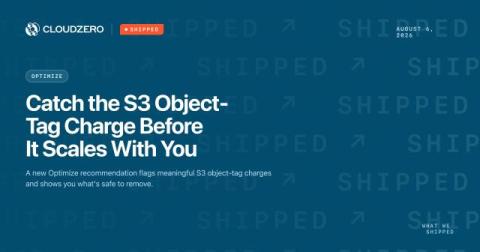
Shipped: Catch the S3 object-tag charge before it scales with you

There’s an S3 charge that stays invisible in a normal storage cost review. AWS bills S3 object tags per tag, per hour, so the cost scales with how many objects you have, not how much data you store. It gets its own line item, which is easy to miss when you’re scanning storage spend. It can sneak up on you. Tags get added in a dev environment to drive lifecycle rules, where object counts are small and the cost is nothing.

Generative AI ROI: benchmarks and how to prove it

Generative AI ROI measures the financial return on generative AI investments relative to their total cost. Benchmarks diverge sharply: Google Cloud's 2025 study found 74% of enterprises see ROI within the first year, while MIT's NANDA initiative found 95% of pilots deliver no measurable P&L impact. The difference is not the AI. It is whether the organization can actually measure cost and outcome at the use case level.

Shipped: Catch a cost spike before it hits your bill

You’re probably already tracking the metrics that matter most in your Analytics dashboards like unit economics, AI ROI, and spend by team. Now you can put a target on any of them. Pick the metric, set the threshold, and CloudZero emails you when it’s crossed, with no ticket to us, no custom build.

How to measure AI ROI: metrics and a framework finance can actually run

To measure AI ROI, compare attributable value (revenue lift, cost savings, engineering time recovered, risk reduction) against fully loaded AI spend (API usage, subscriptions, infrastructure, people time) at the unit level: per initiative, per team, per task. The formula is simple. The instrumentation is the hard part, and it's where most organizations are failing: in CloudZero's 2026 survey, 34% of finance leaders couldn't produce a credible ROI number at all.

Railway Mania, the birth of the S&P 500, and the lesson for the AI era

In 1846, Britain poured roughly 7% of its national income into railways, proportionally about three times what the U.S. spends on AI infrastructure today. The technology delivered everything it promised, and a generation of investors still lost their shirts. What sorted the winners from the wreckage wasn't conviction about the technology; it was whether ROI was measured or asserted. The man who fixed that problem gave his name to the S&P 500.

AI cost reduction: tactics that preserve performance

AI cost reduction means lowering what you spend to run AI (tokens, inference, and compute) without sacrificing quality. The highest-leverage tactics, prompt caching, batching, and routing easy work to smaller models, cut spend 50 to 90% by removing waste, not capability. Somewhere right now, a finance leader is opening an AI bill that has quietly tripled, with no new product to show for it. Nobody approved it. No single decision caused it.

Shipped: Put every AI task on the cheapest model that can actually do it

If your team builds with AI, someone is defaulting to the biggest model available (say, Fable) because it feels like the safe pick, and the safe pick is almost always the most expensive one. One over-powered choice looks harmless on its own, but multiplied across every prompt, agent, and workflow, and you get a big number on the P&L. All that, yet nobody chose which model on purpose. As we like to say, using a default is not a decision.