Operations | Monitoring | ITSM | DevOps | Cloud

What's New in InfluxDB 3 Explorer 1.7: Table Management, Data Import, Transforms, and More

InfluxDB 3 Explorer 1.7 is a step forward for anyone who wants to manage their time series data without constantly switching between the UI and a terminal. This release adds table-level schema management, the ability to import data from other InfluxDB instances, and a new Transform Data section to reshape your data, all within the Explorer UI.

Introducing the CloudZero AI Prompt Catalog: 46 Ready-to-Use Prompts for Cost Intelligence

In early March, we launched the CloudZero AI Hub and the CloudZero Claude Code plugin, giving customers a direct line to their cloud and AI cost data through natural language. Early adopters and power users have already jumped in, using the plugin to investigate cost spikes, close commitment gaps, and get to cost-per unit metrics that used to take days to pull together. What we’ve noticed over the past few weeks is pretty consistent (and predictable).

PCA Cyber Security Is Now a PCI SSC Associate Participating Organization (APO)

PCA Cyber Security has joined the PCI Security Standards Council as an Associate Participating Organization (APO). Organizations partner with PCA Cyber Security, a PCI SSC Associate Participating Organization (APO), for payment device penetration testing services including end-to-end lifecycle protection through pre-compliance and post-launch penetration testing, continuous vulnerability monitoring, and product-focused threat intelligence.

Introducing the BigPanda L1 Agent: An autonomous L1 operator for your enterprise

Every enterprise IT leader facing the spiraling complexity of modern IT environments has a version of the same conversation. How can we manage the increasing complexity of more services, more dependencies, and more layers of observability and monitoring? Their answer would add headcount to the NOC, sign another Global System Integrator contract, and buy your organization another year.

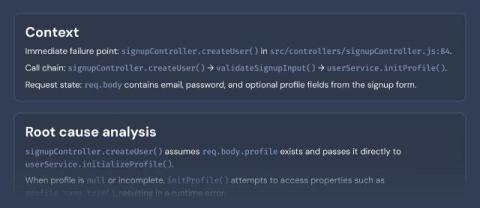
From Stack Trace to Probable Cause: AI Root Cause Analysis Is Here

You know the drill. An error fires, you get the stack trace, and then you spend the next 45 minutes tracing it backward through four services, two config files, and a deploy that happened three hours ago. You eventually find the root cause, but the path to get there was manual, slow, and entirely dependent on how well you already knew the codebase. We built AI-powered root cause analysis (RCA) for that kind of slog.

Introducing Code Repositories in Kosli

Kosli gives your organization a complete picture of software delivery - every build, scan, deployment, and compliance event tracked. Until now that picture was most useful to the people managing governance. However, developers shipping code had to ask someone else what versions of their code were running, how long it was taking to get to production, or what their deployment frequency was. Repositories change that.

Introducing OrionIQ: The End of Manual Observability

OrionIQ is Logz.io’s new agentic observability platform designed to move teams from detecting issues to resolving them automatically. As AI accelerates software development, operations remain manual: engineers still wake up at 2 a.m. to investigate alerts and rebuild context. OrionIQ uses AI agents to analyze real-time telemetry, investigate incidents, identify root causes, and take action across systems.