Operations | Monitoring | ITSM | DevOps | Cloud

From Handwritten Mocks to proxymock: The Complete Loop

Handwritten mocks are cheap one at a time. This series built enough of them to show how quickly that stops being true. Nine posts took one package notifier from a function returning "delayed" to a captured response from a real carrier. Along the way, we hand-authored canned successes, failure cases, a spy, a stateful fake, an HTTP server, response fixtures, and contract-drift tests in four languages.

Make Failure Boring with Mocks

Every codebase has a failure path nobody has run. Not through laziness, but because reproducing it requires a backend dependency to misbehave on cue. In the package notifier, the carrier must refuse, stall, or return nonsense at the exact moment the test runs. So the retry logic ships unverified and everyone hopes. The seam from post 2 already gives the test control. A seam is a place where you can change what code does without editing that code.

Test Behavior, Not Choreography

The spy from post 4 is a sharp tool. Once a test can record every interaction, it is tempting to assert on all of them. The result looks thorough, but it is usually a transcript rather than a useful specification. This post takes a test written that way, makes a change that no customer could possibly notice, and watches the test fail anyway. This is part 5 of a ten-part series. The code is in Java, Node.js, Go and Python.

Did It Actually Send?

The notifier has returned a message throughout this series, which made testing almost suspiciously easy. Assert on the return value and you are done. Real notifiers do more than build strings: they send them. Once a message goes to an email provider or SMS gateway, the function may return nothing useful. When that change lands, every existing test loses the value it asserted on. This is part 4 of a ten-part series. The code is in Java, Node.js, Go and Python.

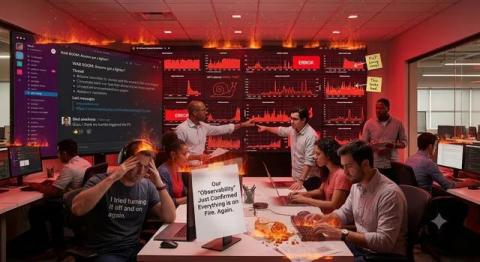
Your Observability Stack Found the Fire. Congratulations.

The dashboards are red, the alerts are firing, and Slack has officially become a war room. Someone has asked, “Anyone else seeing this?” and 14 people have immediately responded with screenshots. Welcome to another day in distributed systems. The recent GitHub outage is a great reminder of how complicated modern applications have become. Services talk to services, infrastructure scales up and down, retries multiply traffic, and dependencies behave in ways nobody expected.

The Compounding Platform Tax

Private cloud and on-premises infrastructure are different. I know this. I used the terms interchangeably anyway because I was trying to compress a pattern into one sentence. That was sloppy, but the underlying pattern still matters. Banks run Kubernetes differently from most other organizations. Not because every bank makes the same choices, but because similar constraints can produce a similar pattern.

Application Level Dependency Chaos Testing

Somewhere in your service is a branch that has never executed. Not a rare one, a never one. It handles a dependency being unavailable: it reads from a cache, it returns a stale value, it marks the response degraded so callers know not to trust it too far. It was written carefully. It was reviewed. Whether it works is an open question, because nothing in the test suite makes that dependency fail, and the dependency does not fail on request.

Break One Dependency, Not The Whole Cluster

Scoped chaos rules are now in proxymock. A filter query picks the traffic, an effect perturbs it, and every response that gets touched is labelled so you can tell an injected failure from a real one for the rest of the run. Available in v2.5.892 and newer. The short version of why: kill a pod and you learn something real, but you do not learn what your service does when a dependency stays up and starts lying to it.

I built an API traffic classifier for business workflows

An engineering leader asked me a question a few weeks ago: could we read their business workflows out of API traffic instead of asking people to document them? I said it should be possible. Then I tried it. A few engineers know how the system really works. They know which calls make up a work order and which checks happen after a write. That stuff rarely makes it into the test plan. Usually it’s in somebody’s head. Sometimes it’s in several heads, with slightly different answers.