

Operations | Monitoring | ITSM | DevOps | Cloud

How to migrate feature flags without breaking production

Feature flag migrations have a reputation problem. Ask anybody who’s been through one before and you’ll hear the stories, usually from someone still a little frustrated about a bad cutover, with a postmortem or two to show for it. The reputation is mostly undeserved. While the risks are real, they’re well understood and easily controlled. Getting a migration right doesn’t require a big coordinated effort.
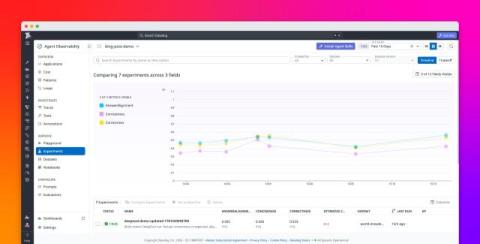
Using Evaluation Frameworks with Agent Observability

AI teams have invested heavily in evaluation frameworks, yet getting those frameworks beyond local experimentation remains challenging. Teams using open source libraries like DeepEval and Pydantic Evals gain flexibility and research-grounded metrics, but operationalizing those evaluations still requires brittle custom integration code that doesn’t scale.

Store and search high-volume logs with ClickHouse and Datadog

As teams scale AI and agentic workloads, log volumes can grow fast. That growth can force teams into a difficult trade-off: Keep logs searchable in their existing workflows, or store them cost-effectively for longer periods. For teams that rely on logs during incident response, compliance reviews, and long-running investigations, losing either affordability or searchability can slow down troubleshooting. Datadog and ClickHouse are partnering to help remove that trade-off.

Get reliable answers to business questions with Bits Data Analysis

Teams are wiring AI coding agents straight to their warehouse over MCP and asking things like “What was our revenue by channel in Q2?” The agent finds a revenue table, runs a query, and returns a number in seconds, with no waiting on the data team. While the answer initially looks right, the problem is that the number is often wrong.

Autonomously monitor for impactful degradations with Bits Detection

Monitoring is built around the system a team understands at a point in time. Engineers add endpoints, move dependencies, and change user flows every day. Over time, that creates coverage drift as monitors keep reflecting the system as it used to behave, while changing paths introduce failure modes that teams didn’t yet know to watch for. Bits Detection automatically creates, tunes, and maintains monitors for your services.

DASH 2026 Operating at Scale: Guide to Datadog's newest announcements

A challenge for many teams continues to be managing cost, governance, and reliability across an ever-larger footprint. This year’s DASH announcements help teams operate efficiently at scale, with new tools to cut cloud and AI spend, eliminate waste automatically, maintain observability during outages, and manage many organizations and agents as a single unit.

Turn Datadog findings into automated code fixes with Bits Code

Engineering teams lose hours in the gap between detecting a problem and getting a fix into review. An on-call engineer sees an error spike in Datadog, pivots to traces and logs to isolate the failure, opens the relevant repository, reproduces the issue, writes a fix, adds tests, waits on CI, and finally opens a pull request. Even when the problem is familiar, the workflow pulls engineers across several tools and stretches remediation from minutes into hours or days.

Infinite Cardinality Metrics: Custom metrics built for modern systems

Every technology shift adds new context you need to measure. Cloud computing added regions and services. Kubernetes added containers and pods. Multi-tenant applications added users and tenants. AI systems add models, prompts, agents, and execution paths. The result is that metrics are becoming dramatically more dimensional, faster than ever before. Over time, engineers are forced to make tradeoffs.

Search and act across Datadog to resolve issues faster with Bits Chat

Finding the right information across dashboards, monitors, and telemetry sources takes time, even for experienced engineers. When something breaks, it often means figuring out where to start, rebuilding queries, and jumping between metrics, logs, and traces before you can take action. The challenge isn’t a lack of data but the effort required to surface the right information at the right moment.