Operations | Monitoring | ITSM | DevOps | Cloud

Microsoft Has a Bigger Problem Than Anyone Realizes

Microsoft just released over 1,400 security patches, including three zero-day vulnerabilities, one of which is already being exploited. But is this a sign of better security or a much bigger problem? In this ShipTalk discussion, we break down Microsoft's massive Patch Tuesday release, the challenges of managing thousands of vulnerabilities across enterprise environments, and whether AI is helping Microsoft find problems too late in the software development process.

AI Can Write Infinite Code. But Can We Ship It Safely?

AI is making code generation faster than ever. But writing code is only half the battle. Neil Watkins from Burns & McDonnell explains why the next big challenge in AI-driven software development isn't generating more code. It's making sure that code can be tested, secured, and deployed safely. As AI accelerates development, businesses need to rethink how they manage risk and ship software with confidence.

Security Just Hit Machine Speed

What if we could eliminate vulnerabilities before they become a problem? Neil Watkins from Burns & McDonnell explains how AI, automated security assessments, and Harness CI/CD capabilities could transform vulnerability management. From reducing attack surfaces to rapidly responding to critical zero-day vulnerabilities, the future of security is about moving faster without slowing down developers.

Why Was an OpenAI Engineer Hiding a Recording Device?

An OpenAI engineer was arrested after a hidden recording device was discovered inside an executive conference room. Who was he trying to record, and who was the information intended for? Martin Reynolds and Adam Arellano break down one of the strangest AI security stories of the year, along with three major cybersecurity headlines. Microsoft just released more than 1,400 security fixes in a record-breaking Patch Tuesday. Is AI finding vulnerabilities faster than companies can actually fix them?

Harness AI Agents

AI is writing code faster than ever. But what happens after the code is written? Harness CEO Jyoti Bansal introduces four AI agents built to automate the software delivery lifecycle: Software Delivery Agent – Automate builds, deployments, and infrastructure management. Security Testing Agent – Find, prioritize, and fix vulnerabilities with AI. Runtime Protection Agent – Protect applications, APIs, and AI agents in production.

Harness Cost Management Agent | How to Set and Enforce AI Spending Budgets

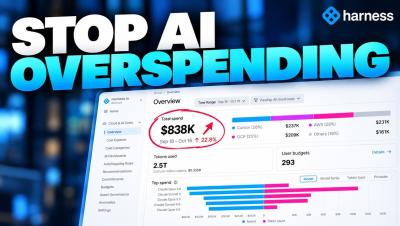
Control AI spending across your organization with Harness Cost Management Agent's AI User Budgets. In this demo, see how Harness helps teams set, monitor, and enforce AI spending limits across tools like Claude, Cursor, and Amazon Bedrock, all from one centralized control plane. What you'll learn: Set weekly AI spending budgets for users and teams Track AI consumption across multiple tools and models.

Enterprise Vibe Mode: Deploy AI-Built Apps to Production | Harness Demo

Vibe coding makes building applications easier than ever. But how do you take an AI-generated app and safely deploy it to production? In this demo, see how Harness brings Vibe Mode to the enterprise, allowing anyone to deploy applications while automatically applying your organization's security policies, governance, compliance requirements, and deployment configurations. See how Harness enables teams to.

AI Agents Hacked 395 Organizations. How Do You Stop Them?

AI agents just changed the speed of cyberattacks. Are security teams ready? In a massive AI-orchestrated cyberattack, hundreds of autonomous AI agents exploited vulnerabilities in PaperCut software, compromising 440 servers across 395 organizations in 48 countries. But the bigger question isn't how these attacks happened. It's how human security teams are supposed to respond when attacks move faster than they can react.

AI Is Writing More Code. So Why Are Teams Getting Smaller?

AI Is Writing More Code. So Why Aren't Teams Moving Faster? AI can generate 10x, 100x, or even 1,000x more code. But there's a problem: companies aren't necessarily delivering software any faster. As AI accelerates development, it's exposing the bottlenecks, technical debt, and outdated processes that have been slowing engineering teams down all along. So what happens when the solution isn't more developers or better AI tools, but actually smaller teams?

A Hacker Used Claude to Attack 9 Banks. This Is Just the Beginning

A Hacker Used Claude to Attack 9 Banks. This Is Just the Beginning. A hacker reportedly used Claude Code and an open-source AI penetration testing agent to attack nine South Korean banks. But the most surprising part? The AI-assisted attack also helped investigators identify the suspect. Is this the beginning of a new era of AI-powered cybercrime, where attackers can launch sophisticated attacks with fewer skills and resources?