
Operations | Monitoring | ITSM | DevOps | Cloud

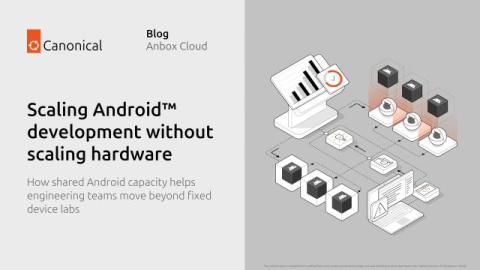
Scaling Android development without scaling hardware

How shared Android capacity helps engineering teams move beyond fixed device labs In the first blog of this series, we discussed how programmable Android environments can replace manual device preparation with a repeatable lifecycle. A workflow requests an environment with a predefined configuration, executes the required task, collects the results, and releases the resources once the work is completed. Automation enables a team to create a single Android environment reliably.

Fine tune your own custom LLM with Canonical Charmed Kubeflow and Feast

So you want your own pet LLM huh? Knowing where to start can be quite tricky, so luckily for you I’ve put together this end-to-end guide. It’ll get you not just started; you’ll end with a fully working chatbot that you’ve fine tuned on the dataset `nampdn-ai/tiny-webtext`, which is a training dataset designed to improve models’ critical thinking abilities. Buckle up, this is going to be both fun and deep.

Android development shouldn't start with a physical device

How on-demand Android environments lay the foundation for Android engineering Software engineering has evolved dramatically over the last decade. Development environments that once depended on dedicated hardware have become resources that can be provisioned, configured, and removed on demand. Infrastructure is now expected to be reproducible, automated, and integrated into continuous development workflows. However, Android has largely remained an exception.

Beyond the 10-year mark: Extending Ubuntu Pro 16.04 LTS security coverage

A decade ago, Canonical launched Ubuntu 16.04 LTS (codenamed “Xenial Xerus”). As a Long-Term Support (LTS) release, it comes with 5 years of standard security coverage, which is doubled to a total of 10 years through Expanded Security Maintenance (ESM) for users with an Ubuntu Pro subscription. As of April 30, 2026, the 10-year ESM coverage for Ubuntu 16.04 LTS, under Ubuntu Pro, has officially reached its end of support.

Cut bloat, not features

For Independent Software Vendors (ISVs), delivering containerized applications to enterprise clients often means navigating a difficult trade-off between minimal image size and accurate security visibility. Traditional approaches can leave development teams battling severe CVE noise or, conversely, missing critical vulnerabilities entirely due to scanner blind spots.

Ubuntu Pro in-place upgrades for Virtual Machine Scale Sets on Azure

You can now upgrade Ubuntu Server Virtual Machine Scale Sets on Azure to Ubuntu Pro without rebuilding the set. Your instances keep serving traffic. The change is a license update, not a new image. Users could already perform in-place upgrades to Ubuntu Pro for individual VMs. Now, we’re extending the feature to scale sets – groups of load balanced virtual machines that you can manage as a single unit.

How we create a Canonical Academy exam

Open source provides the world with access to cutting-edge software, and the learning that comes with it. But how do you validate someone’s skills in an open ecosystem? Canonical Academy is a highly rigorous, job-focused qualification platform designed to empower individuals and enterprises with industry-recognized credentials. The platform addresses a critical gap in tech: validating real-world, hands-on capability rather than rote memorization.

Surviving the uncharted: when dedicated OpenStack expertise is your best ally in disaster recovery

Some support cases are routine. Others take you off the documented path entirely, into territory where the only way forward is deep, hands on open source expertise. This series looks at how Canonical Support navigates the unexpected: cases where standard playbooks aren’t enough, and a support engineer helps a customer find a solution in real time. This is one of those cases.

AI harnesses for telco autonomous networks

Across the global landscape, telecommunications operators have already deployed machine learning for predictive maintenance, customer care chatbots, and anomaly detection. However, as the industry transitions toward Autonomous Networks Level 4 (AN L4), where networks can make intent-driven, predictive decisions and perform closed-loop management with minimal human intervention, a fundamental architectural challenge has emerged.