Operations | Monitoring | ITSM | DevOps | Cloud

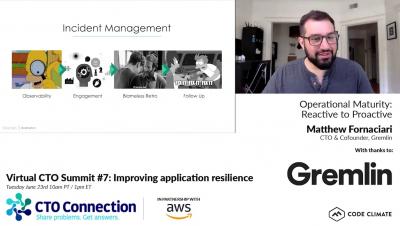
Identifying Hidden Dependencies - Liz Fong Jones

You don't need to write automation or deploy on Kubernetes to gain benefits from resilience engineering! Learn how Honeycomb improved the reliability of our Zookeeper, Kafka, and stateful storage systems through terminating nodes on purpose. We'll discuss the initial manual experiments we ran, the bugs in our automatic replacement tools we uncovered, and what steps we needed to progress towards continuously running the experiments. Today, no node at Honeycomb lives longer than 12 months, and we automatically recycle nodes every week.

Lead Times and Psychological Safety within the Five Ideals - Gene Kim

The biggest challenges engineering organizations face are not technical. They’re fundamental problems with how we think and go about doing work, and the environments that we work in. In this talk, Gene Kim will share the Five Ideals and how they relate to Chaos Engineering. He’ll also show how the Five Ideals help build stronger, better performing, and ultimately more reliable companies.

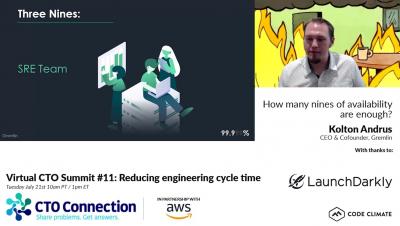
How many 9's are enough? Kolton Andrus  CTO Connection: Reducing engineering cycle time

How many nines of availability are enough? In this talk, Gremlin CEO Kolton Andrus shares insights from years at Amazon, Netflix, and now working with a wide array of customers across various disciplines and industries. He’ll describe what each level of availability looks like, the challenges faced at each stage, and the trade-offs required to achieve the next nine of uptime.

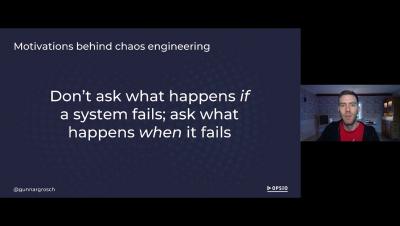
Performing chaos in a serverless world  Gunnar Grosch  Failover Conf 2020

Chaos engineering is the practice of hypothesis testing through planned experiments to gain a better understanding of a system’s behavior. The principles of chaos engineering have been around for years, and we have now reached the point where chaos engineering has gone from just being a buzzword and practice used by a few large organizations in very specific fields, to it being put in to use by companies of all sizes and industries.

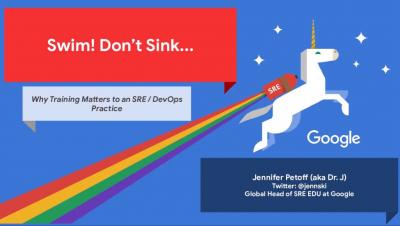
Swim Don't Sink: Why Training Matters to a Site Reliability Engineering Practice  Jennifer Petoff

Do you offer training to the engineers in your organization or do you throw them off the deep end to “sink or swim”? Providing training and education is universally important to set team members up for success in your organization and is critical for establishing a thriving Site Reliability Engineering (SRE) or DevOps practice and culture in the first place.

Fight, Flight, or Freeze - Releasing Organizational Trauma Matt Stratton Failover Conf 2020

When humans are faced with a traumatic experience, our brains kick in with survival mechanisms. These mechanisms are the familiar fight or flight response, but can also include the freeze response - which occurs when we are terrified or feel that there is no chance of escape.

Y2K and Other Disappointing Disasters: Risk Reduction and Harm Mitigation  Heidi Waterhouse

Every disaster is a concatenation of smaller failures. How can we design software and processes to accept that we live in an imperfect world? Explore the concepts of resiliency, harm reduction, over-engineering, and planning for failure with real examples.